KEY FACTS
Terminology
- •
Secondary (metastatic) neoplasms to ovary
- •
Krukenberg tumor: Subtype of metastatic tumors containing > 10% mucin-filled signet cells in cellular stroma
- •
High-stage mucinous tumors involving ovary frequently represent metastases from extraovarian primary sites and are often misdiagnosed as primary ovarian mucinous tumors
Imaging
- •
Bilateral ovarian masses in patients with known primary carcinoma
- •
Metastases to ovary are usually solid masses
- •
Often large
- •
Lobulated masses with smooth external contour
- •
US
- ○
Solid or cystic and solid
- ○
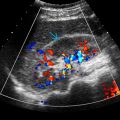
Solid components demonstrate vascularity on Doppler evaluation
- ○
Typically heterogeneous
- ○
May be complicated by hemorrhage
- ○
- •
CECT
- ○
Solid components often demonstrate heterogeneous enhancement
- ○
Cystic and necrotic areas do not enhance
- ○
- •
MR
- ○
T2WI: Solid components demonstrate heterogeneous signal intensity
- ○
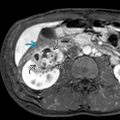
T1WI C+: Solid components show marked heterogeneous enhancement
- ○
- •
PET/CT is modality of choice for tumor staging and shows increased metabolic uptake in ovarian metastases
Top Differential Diagnoses
- •
Primary ovarian cancer
- •
Ovarian lymphoma
Scanning Tips
- •
Look for ascites, which is often seen in the setting of Krukenberg tumor
 are depicted.
 , which can rarely be seen in mucinous gastric adenocarcinomas.

 . The patient had a recent history of colon cancer, and these were confirmed metastases at oophorectomy.
 from colon cancer. The uterus
  is also seen.
 with cystic and solid components. The uterus
  is also seen.
 are seen.
 . The uterus
  is also seen. There is a small amount of pelvic ascites
  .
.