By Dr. Mara Ellison, Research Compounds Analyst | Fact-checked by J. Render, Editor.
Buying peptides online sounds simple until you realize you have almost no way to know what’s actually in the vial. There’s no pharmacy shelf to compare against, no pharmacist to ask, and no label the FDA has signed off on.
That’s the real problem this guide aims to solve. The strongest research-peptide vendors publish third-party COAs, verify purity with HPLC and mass spectrometry, and synthesize in the United States. That separates the best peptide companies from the risky ones, and our top pick is Koi Peptides for its testing transparency.
Four other vendors earn a spot as well, and every product here is sold for research use only and is not approved for human use by the U.S. Food and Drug Administration. We’ll break down exactly what sets each one apart so you can match the vendor to your research needs.
Best Peptide Companies at a Glance
The five vendors below were judged on the following things: tested purity, certificate-of-analysis access, catalog transparency, US synthesis, and shipping speed. It is the fastest way to shortlist and compare the best peptide vendors side by side.
| Company | Tested Purity | Testing & COA | Catalog | US Shipping | Best For |
| Koi Peptides | 99%+ | HPLC + LC-MS, independent ISO/IEC 17025 re-test, per-lot COA on the product page | ~20 curated | Same-day before 2 PM CT, free over $200 | Testing transparency |
| rPeptide | >97% β-amyloid; ≥90% tau | Analytical HPLC + SDS-PAGE, recombinant E. coli QC, lot COA on request | 76 peptides + proteins, antibodies, fibrils | US-based (GA); international via distributors | Recombinant neuro-research peptides |
| Biotech Peptides | 99%+ | HPLC + LC-MS, COA on request | Wide range + custom synthesis | Same-day, US-made | US synthesis + refund |
| Limitless Life | 99% | HPLC + LC-MS every batch, sterility + endotoxin, COA per order | 90+ (widest) | 3-5 business days | Largest selection |
| Peptide Pro | 99%+ | Independent HPLC + MS, COA included | GLP-1 + recovery | Same-day before 3 PM ET | Fast shipping |
Key Takeaways on Choosing the Best Peptide Companies
- Koi Peptides is our top pick among the best peptide companies for testing transparency, with 99%+ purity, ISO/IEC 17025 re-testing, and a per-lot COA you can read first.
- A trustworthy vendor proves three things: purity by HPLC, identity by mass spec, and a batch-specific COA you can actually see.
- Laboratory research vendors (the five here) sell research-use-only quantities online.
- US synthesis, cold-chain shipping, and clear pricing separate reputable peptide companies from risky sellers.
- These peptides are sold for lab use only and are not approved by the FDA for human use.
How We Tested and Ranked The Best Peptide Companies
We did not rank these vendors on price. Instead, we compared them on the signals that protect a research buyer, then cross-checked every claim against published lab reports and each vendor’s own COA.
If you are deciding where to buy peptides online, here is exactly what we weighed when ranking the best peptide companies and why each factor matters.
- Third-party testing: We looked for independent HPLC and LC-MS results, not just in-house numbers. We leaned on resources like Examine and published lab data to sanity-check each vendor’s purity claims.
- COA access: We favored COA-verified peptides with a certificate dated to your exact batch, ideally posted before you buy rather than emailed weeks later.
- Stated purity: A clear, written purity figure, with 99% as the baseline we expect from any serious vendor.
- US synthesis and shipping: Compounds are made and lyophilized in the United States, then shipped cold and fast so they arrive stable.
- Catalog transparency: Real product pages with visible pricing and specs, not a black box that hides the basics until checkout.
- Compliance: Honest research-use-only framing on every page, because a vendor that bends the rules on labeling tends to bend them elsewhere.
Best Peptide Companies of 2026 Reviewed
Below are the five research peptide vendors we rated, listed in the order our buyers asked about them. Each review opens with the one thing that the vendor does best, then covers tested purity, COA access, catalog, and shipping.
This is our pick of the best research peptide companies, with Koi Peptides as the top one.
1. Koi Peptides: Per-Lot COAs, Independently Verified
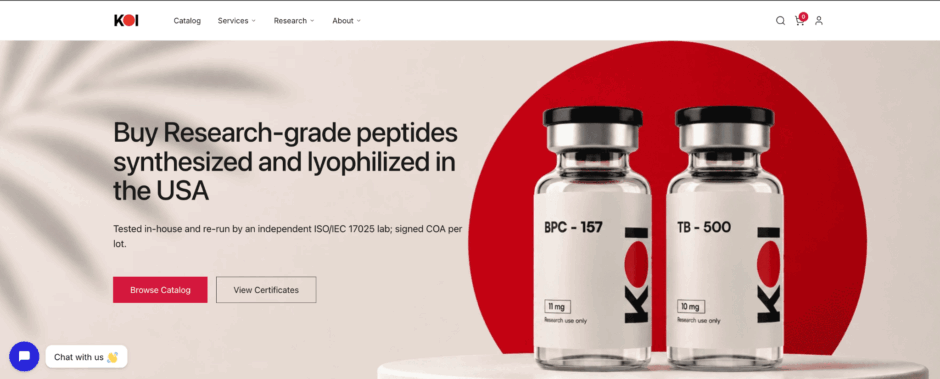
Koi Peptides earns our top spot because it’s the only vendor on this list that re-tests every lot through an independent ISO/IEC 17025-accredited lab before it ships and posts that certificate on the product page so you can read the numbers before you order. Testing goes further than the standard, too, with every lot clearing HPLC, LC-MS identity confirmation, and an endotoxin check before that certificate gets posted, so the COA you’re reading isn’t just a purity number; it’s a full pass/fail record for your exact batch.
- Purity: Koi states 99% or higher across every batch, with the figure printed on the certificate.
- Testing & COA: Each lot is run through HPLC and LC-MS, retested by an outside ISO/IEC 17025 lab, and endotoxin-checked with a pass/pass result on duplicate samples before release.
- Catalog: A focused range of about 20 peptides and blends, including Sermorelin, AOD-9604, PT-141, and the GLOW stack, so the menu stays curated rather than overwhelming.
- Shipping: Same-day fulfillment before 2 PM CT from US warehouses, with free shipping on orders over $200.
- Pricing: Listed clearly on every product page, so there is no guessing at checkout.
- Address: Koi Research Labs LLC, 30 N Gould St Ste R, Sheridan, WY 82801, United States
- Contact: +18338549601 (Toll-free · Mon–Fri 8am–6pm Central Time )
When we opened a recent product page, the posted COA matched the lot number and showed the endotoxin pass result we wanted to see. The catalog is smaller than a few rivals here, but that reads as deliberate curation rather than a gap.
For a buyer who cares most about verification, Koi is one of the best peptide companies on this list, and that mix of independent re-testing and visible documentation is hard to beat.
2. rPeptide: Recombinant Peptides for Neurodegeneration Research
rPeptide takes a different route to quality than the synthesis-only vendors here. It expresses its peptides and proteins recombinantly in E. coli using a proprietary vector platform, specializes in Alzheimer’s and Parkinson’s research targets such as beta-amyloid, tau, and alpha-synuclein, and has a published citation record in peer-reviewed neurodegeneration studies to back it up. For a lab working on neurodegeneration, that focus is exactly what you want to see first.
- Purity: Recombinant beta-amyloid peptides run consistently above 97% by analytical HPLC, measured as the beta-amyloid peak area against the total peak area; tau proteins carry a guaranteed 90% minimum that batches often exceed.
- Testing & COA: In-house purification with QC by analytical HPLC for beta-amyloid purity and SDS-PAGE for tau, with peptide quantities set against a calibration curve from amino acid analysis; lot-specific COA and QC documentation is available on request rather than as a public pre-purchase library.
- Catalog: 76 peptides plus proteins, antibodies, preformed fibrils, kits, and COVID-19 research tools, all centered on neurodegenerative targets rather than recovery or GLP-1 lines.
- Shipping: US-based in Watkinsville, GA, with ordering by phone, email, fax, or online and purchase orders accepted.
- Pricing: Listed on each product page, ranging from roughly $90 at the low end to about $810 for higher-grade compounds, depending on the target and quantity.
- Address: rPeptide, 1050 Barber Creek, Bldg. 300, Suite 103, Watkinsville, GA 30677, United States
- Contact: 866.753.0747
When we looked through the catalog, the specs were detailed and the focus was obvious; this is built for academic and pharma neuroscience labs, not for someone chasing recovery or weight-loss blends. Ordering also leans on the traditional PO-and-email route rather than a one-click cart, which adds a step casual buyers will not expect.
That narrow scope is really the only caveat, and it doubles as the selling point: the deep citation record and recombinant expertise are why rPeptide ranks among the best peptide companies for neurodegeneration research.
3. Biotech Peptides: USA-Made With 30-Day Refund
Biotech Peptides leans on its US supply chain and a safety net that is rare in this niche: a 30-day money-back guarantee. Everything is synthesized and lyophilized in the United States, verified above 99% purity by liquid chromatography and mass spectrometry, and shipped the same day. A full refund is available within 30 days if something is not right.
- Purity: Above 99%, confirmed by HPLC and mass spec across multiple purification rounds that strip out synthesis byproducts.
- Testing & COA: HPLC and LC-MS verification on each compound, though batch COAs are not posted publicly and are available only by support request.
- Catalog: A wide single-peptide range plus blends, with custom synthesis available on request for less common sequences.
- Shipping: Same-day shipping from the US, with credit cards accepted at checkout.
- Pricing: AOD-9604 from $44, BPC-157 from $52 to $92, and blends from $80 to $115.
- Address: Biotech Peptides, 8275 S Eastern Ave Suite 200, Las Vegas, NV 89123
- Contact: 619-453-0156
When we asked for a certificate, support pointed us to email rather than a public library, so plan for that extra back-and-forth before a big order.
The made-in-USA synthesis, strong purity, and refund policy still make this a low-risk choice for a first purchase. The custom-synthesis option is a nice bonus if you need something off the standard menu.
4. Limitless Life: Offers 90+ Research-Grade Peptides
Limitless Life wins on sheer selection, with more than 90 research-grade peptides, the widest catalog of the five. Every batch undergoes third-party HPLC and LC-MS testing, sterility and endotoxin screening, and a certificate of analysis ships with each order. It is also a name that research buyers actively recommend in community threads.
- Purity: A 99% purity specification applied across every product line, with contaminant screening on each batch.
- Testing & COA: These are properly HPLC-tested peptides, with independent HPLC and LC-MS for every batch, backed by sterility and endotoxin screening, and a COA included with each order.
- Catalog: 90+ peptides, the widest here, including powders and both Semax and Selank in nasal-spray form.
- Shipping: Orders are processed and shipped within 3-5 business days, which is slower than the same-day vendors.
- Pricing: Listed on individual product pages rather than summarized anywhere up front.
- Address: Pensacola, FL, USA
- Contact: 866-533-5017
When we browsed the site, the catalog depth was clear, but the slower 3-5-day handling and the lack of a homepage price or COA list meant more clicking than with same-day rivals.
The testing itself is thorough once you find it, and the community trust is well-earned. If you range and pre-order certificates over speed, those trade-offs are easy to accept.
5. Peptide Pro: Same-Day US Peptide Shipping
Peptide Pro is built for speed, shipping orders placed before 3 PM ET the same day from a US facility. Purity is strong, too, with a minimum of 99% and an average of 99.7% across the catalog, verified by independent HPLC and mass spec. A downloadable COA is included with every order.
- Purity: A 99% minimum, with a 99.7% average across the catalog, which is among the highest stated here.
- Testing & COA: Independent HPLC and MS testing, with a COA you can download and that ships with each order.
- Catalog: GLP-1 and recovery research lines, including staples like BPC-157 and TB-500.
- Shipping: Same-day dispatch from a US facility on orders placed before 3 PM Eastern.
- Pricing: Visible only after you create an account and clear the age-gate.
- Address: Peptide Pros, 1602 Alton Rd, Ste 371, Miami Beach, FL 33139, US
- Contact: 615-274-9877
When we tried to browse, the entire catalog was behind a mandatory login and age gate, so we could not compare prices or read a single COA until we registered. That makes pre-purchase vetting harder than it should be, even though the testing numbers look good once you are inside.
The speed and purity are genuinely strong, so the login wall is really a convenience cost rather than a quality one. It still ranks among the best peptide companies for shipping speed if you can clear the sign-up.
How to Select a Reliable Peptide Supplier?
Picking a peptide supplier you can trust starts with deciding which kind you actually need. Some buyers want small research-use-only quantities from an online vendor, while others need bulk, clinical-grade material made under strict manufacturing rules. The two are not the same, and the checks you run on each are different.
Laboratory-Grade Research Peptide Suppliers
These are the online vendors in this guide, like the five reviewed above. They sell research-use-only peptides in small quantities for in vitro and lab work, usually as single vials or small blends. Many of the best peptide companies in the USA fall into this laboratory-grade tier.
Judge these research peptide vendors on published COAs, HPLC, and mass-spec purity, US synthesis, and clear pricing. A lab supplier that hides its testing data or its prices is one to skip, no matter how polished the site looks.
The best ones make verification easy. They post a batch-specific certificate on the product page, name the lab that ran the test, and answer support questions quickly when you ask for documentation.
Commercial and Clinical-Grade Peptide Manufacturers
Commercial manufacturers, often called CDMOs, sit in a different tier. Companies like Bachem, AmbioPharm, and GenScript synthesize peptides at scale under strict manufacturing rules for drug makers and clinics, and their material can end up in registered clinical trials.
They rarely sell single vials to individuals and usually require contracts, minimum order sizes, and documentation that a small lab will not have. If you need a certified bulk supply or material tied to the FDA’s drug-compounding pathway, this is the tier you talk to, not a research vendor.
For most buyers reading a roundup like this, a laboratory-grade research vendor is the right fit. A single researcher rarely needs a CDMO contract to get clean, well-documented material. Save the commercial manufacturers for institutional or clinical work that genuinely needs that level of paperwork and scale.
Key Criteria for Choosing a Peptide Vendor
If you only have time to check a few things, make sure you check these. Each criterion below maps to a real risk: a missing COA means unverified purity, no US synthesis means an unclear supply chain, and hidden pricing usually means surprises at checkout.
This is how to choose a peptide supplier you can trust, so run down the list before you buy from anyone.
1. A Batch-Specific COA
Stick to third-party-tested peptides whose certificate matches the exact lot you are buying, not a generic sample from last year or an entirely different batch.
2. HPLC Purity Above 99%
Favor HPLC-tested peptides with a clear, printed purity number as the floor for a serious research vendor, and anything vaguer than a printed percentage should make you pause.
3. Mass-Spec Identity Confirmation
LC-MS confirms the molecule truly matches what’s on the label, ensuring it’s not a cheaper or mislabeled look-alike that just happens to have a similar weight.
4. Endotoxin And Sterility Testing
These extra checks catch bacterial contamination that a basic purity test will miss entirely.
5. US Synthesis And Cold-Chain Shipping
Domestic production and fast, insulated shipping protect the compound from heat and long transit times.
6. Transparent Pricing And Support
Clear pricing and genuine support, as Peptides.org shows, suggest a trustworthy vendor.
7. Research-Use-Only Compliance
Honest labeling protects you legally and shows the vendor takes the rules seriously.
Hit all seven, and you are dealing with a serious vendor. Miss two or more, and you are taking an avoidable risk with both your research budget and your results.
How to Read a Peptide COA and Purity Report
A certificate of analysis, or COA, is the lab report that proves what is actually in the vial. It is the single most useful document a research peptide vendor can hand you, and the good ones make it easy to find.
The two numbers that matter most are purity and identity. Purity indicates how much of the sample is the actual peptide, while identity confirms it is the correct molecule and not a cheaper look-alike. Here is how to read the rest of the report without a chemistry degree.
HPLC Purity (%)
High-performance liquid chromatography separates the sample and measures the percentage of your target peptide, following published HPLC methods. Look for 99% or higher, and treat a vague or missing percentage as a red flag.
Lc-Ms Identity
Mass spectrometry confirms the molecular weight matches the peptide you ordered, so you know the label is honest and not a swap.
Net Peptide Content
This shows how much actual peptide you get versus salts and water, and it can sit a little below the raw purity figure.
Endotoxin And Sterility
These results flag bacterial byproducts and contamination that a purity number alone will never reveal.
Lab Accreditation
A report from an ISO/IEC 17025-accredited lab carries far more weight than an unnamed in-house test.
If a vendor cannot show you these results for your exact batch, treat the purity claim as marketing rather than proof, and shop somewhere that can.
Are Research Peptides Legal to Buy in the US?
Yes. As of 2026, research peptides can be legally bought and sold in the United States when they are clearly labeled for laboratory research use only. They are not approved by the FDA for human or veterinary use, and reputable vendors state that on every page.
The legality turns on labeling and intended use, not the molecule itself. A vendor that markets a research peptide for human use, or makes health claims about it, steps outside research-use-only rules and can draw action from regulators like the FTC. These compounds are also not prescription peptide medicines, which are FDA-approved drugs you get through a doctor and a pharmacy.
To stay compliant, keep your peptides labeled, stored, and logged as laboratory materials, and never repackage or resell them for human use. That single line protects both you and the vendor.
Red Flags of an Unreliable Peptide Company
A sketchy vendor usually gives itself away fast. The warning signs are almost always about missing proof: no COA, no purity numbers, no clear address or support channel. If you spot two or more of these on a site, close the tab and take your research order elsewhere.
- No published COA: If you cannot obtain a batch certificate, you cannot verify anything the vendor claims.
- Inflated catalog claims: A site bragging about 100+ peptides with no lab data is selling hype, not proof, so cross-check its reputation.
- Vague purity language: “High purity” with no HPLC number behind it tells you nothing useful.
- No US synthesis disclosed: An unclear or hidden supply chain is a real risk for any research compound.
- No batch or lot testing: Using a single old sample report for the whole catalog is a shortcut, not real testing.
- Pressure pricing and a dead inbox: Countdown timers paired with support that never replies point to a flip-and-vanish seller.
The best peptide companies pass every one of these checks, so when in doubt, choose the vendor that shows its work. None of these takes more than a minute, but together they filter out most of the fly-by-night sellers in this space.
Best Peptide Companies FAQ
Who manufactures peptides in the US?
Both large CDMOs and smaller online vendors. Bachem, AmbioPharm, and GenScript supply pharma at scale; Koi Peptides and rPeptide sell research-use-only quantities online.
What are the most common research peptides?
BPC-157, TB-500, GHK-Cu, Ipamorelin, and CJC-1295. Most appear in preclinical PubMed studies, which doesn’t make them approved for human use.
How should you store research peptides?
Freeze the lyophilized powder until use. After reconstituting with bacteriostatic water, refrigerate and use within your protocol’s window.
Are research peptides the same as prescription peptides?
No. Prescription peptides are FDA-approved drugs from a pharmacy; research peptides are for lab use only and are not approved for humans, even when they share the same names.
How much do research peptides cost?
Depends on compound and vial size. We saw singles from $44 to $185, blends near $305. Price doesn’t equal purity, so check the COA.
Final Verdict: Which Peptide Company Should You Choose?
For most research buyers, the best peptide companies are simply those that demonstrate their quality. Koi Peptides does that best, with independent third-party re-testing and a per-lot COA you can read before buying. rPeptide stands out for recombinant, citation-backed peptides aimed at neurodegeneration research, while Biotech Peptides pairs US synthesis with a money-back guarantee.
Limitless Life has the widest catalog, and Peptide Pro is the fastest shipper of the group. Match the vendor to your priority, check the COA for your exact lot, and browse Koi’s research catalog first if testing transparency is at the top of your list.
Disclaimer
Research use only. Every peptide here is sold strictly for laboratory research, is not a supplement, food, or medicine, and is not FDA-approved for human or veterinary use. Nothing in this guide is medical advice or a dosing recommendation; always follow applicable laws and your institution’s guidelines.
Related posts:
 Other Imaging Techniques in Dilated Cardiomyopathy
 Basic Echocardiography in Arrhythmogenic Right Ventricular Cardiomyopathy
 Lu-177 PSMA Therapy Cost in Germany: What Affects the Price and How to Plan Treatment
How Do Medical Reports Strengthen Personal Injury Claims?
Raising the Standard: How Nurses Can Deliver Better Hospital Care
The Health Impact of Doomscrolling: What You Should Know
Lu-177 PSMA Therapy Cost in Germany: What Affects the Price and How to Plan Treatment
How Do Medical Reports Strengthen Personal Injury Claims?
Raising the Standard: How Nurses Can Deliver Better Hospital Care
The Health Impact of Doomscrolling: What You Should Know

Stay updated, free articles. Join our Telegram channel

Full access? Get Clinical Tree


