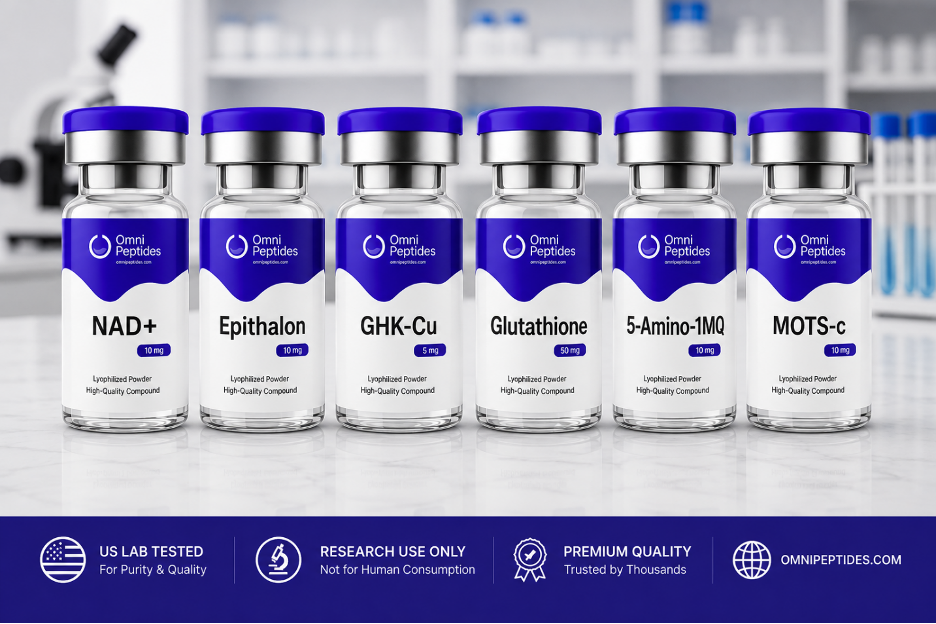
Anti-aging is the category where the science is most exciting and the marketing is most overheated. The compounds below are genuinely interesting because each targets a recognized hallmark of aging, from NAD+ decline to telomere shortening to the buildup of worn-out cells. What varies enormously is how much of that promise has actually been shown in people, as opposed to mice and petri dishes.
Here are seven longevity compounds worth knowing, with an honest read on where each one sits between compelling mechanism and proven benefit.
| Compound | Aging Target | Human Evidence | Stage |
| NAD+ (NMN / NR) | NAD+ decline, energy, DNA repair | Raises NAD+; function unproven | Studied |
| Epithalon | Telomere shortening | Cell/animal; limited human | Preclinical |
| GHK-Cu | Skin aging, collagen loss | Solid clinical (skin) | Studied |
| Glutathione | Oxidative stress | Some (skin, antioxidant) | Studied |
| 5-Amino-1MQ | Metabolic aging (NNMT) | None (mouse only) | Preclinical |
| MOTS-c | Mitochondrial decline | Emerging | Preclinical |
| FOXO4-DRI | Senescent cell buildup | None (mouse only) | Frontier |
1. NAD+ (and Its Precursors, NMN and NR)
NAD+ is a coenzyme every cell uses for energy and DNA repair, and its levels fall sharply with age, by up to 80% in some tissues. That decline is one of the most-cited mechanisms of aging, which is why boosting NAD+ has become the centerpiece of the longevity conversation. You do not take NAD+ directly; you take precursors like NMN or NR that the body converts. Human trials consistently show these precursors safely raise blood NAD+, roughly doubling it. The honest part: whether that translates into slower aging or better healthspan in people remains unresolved, and researchers themselves note the functional evidence is still limited. A reliable biomarker mover, not yet a proven fountain of youth.
2. Epithalon
Epithalon (also spelled epitalon) is a four-amino-acid peptide developed by Russian gerontologist Vladimir Khavinson from a pineal-gland extract, and it is the closest thing the field has to a dedicated longevity peptide. Its signature mechanism is telomerase activation: in human cell studies it switched telomerase back on and lengthened telomeres, the protective caps on chromosomes that shorten with age. Animal studies have reported lifespan extension. The caveats matter, though: the strong evidence is from cell culture and animals, the human data is older and comes largely from one research group, and lengthening telomeres in a dish is a long way from proven longevity in people.
3. GHK-Cu
GHK-Cu is a copper-binding peptide naturally present in human plasma, where levels drop steadily with age. Unlike most compounds here, it has genuine human clinical data, mostly on skin. Placebo-controlled studies show it supports collagen production and skin repair, and one biopsy study found it outperformed both vitamin C and retinoic acid at boosting collagen). For the visible, skin-level side of aging, GHK-Cu is one of the better-evidenced options on this list.
4. Glutathione
Often called the body’s master antioxidant, glutathione is a tripeptide that neutralizes free radicals and supports detoxification, both relevant to the oxidative-stress theory of aging. Its levels decline with age and illness. Human research is strongest for its antioxidant and skin effects, but the broader claim that supplementing it meaningfully slows systemic aging is not well established, partly because oral glutathione is poorly absorbed. A genuinely important molecule, with more marketing certainty than clinical certainty.
5. 5-Amino-1MQ
5-Amino-1MQ is a small molecule rather than a classic peptide, but it runs in the same longevity circles. It blocks an enzyme called NNMT that is involved in fat-cell metabolism and cellular energy, and in animal studies, inhibiting NNMT reduced fat mass and improved metabolic markers. That is why it draws interest for metabolic aging. The honest limitation is stark: the evidence is preclinical, from mice. There are no completed human trials, so it belongs on a watch list rather than a proven one.
6. MOTS-c
MOTS-c is unusual and rather elegant: it is a peptide encoded within mitochondrial DNA, and it behaves somewhat like an exercise mimetic, influencing metabolism and how cells respond to stress. Because mitochondrial dysfunction is a core hallmark of aging, and because MOTS-c levels themselves decline with age, it has become a compound of real interest for metabolic healthspan. Most of the evidence is preclinical, with human research still emerging, so the mechanism is more compelling than the clinical proof at this stage.
7. FOXO4-DRI
This is the frontier, and the most futuristic entry here. As we age, senescent cells, sometimes called zombie cells, accumulate and leak inflammatory signals instead of dying off as they should. FOXO4-DRI is a designed peptide meant to selectively push those cells into self-destruction, clearing them out. In a landmark 2017 mouse study, this senolytic approach restored fitness, fur density, and kidney function in aged animals. The enormous caveat: as of 2026 there are no completed human trials. It is one of the most exciting ideas in aging biology and one of the least proven in people.
The Honest Takeaway
The longevity field is a fascinating place, but it rewards skepticism. NAD+ precursors and GHK-Cu have the most human data behind them. Epithalon, glutathione, and MOTS-c sit in a promising-but-preliminary middle. And 5-Amino-1MQ and FOXO4-DRI are, for now, remarkable mouse stories waiting for human confirmation. None of these is a proven way to extend human lifespan, and anyone who tells you otherwise is running ahead of the evidence.
For anyone sourcing these compounds for research, one practical point deserves emphasis: purity and correct identity matter as much as the molecule, since an impure or mislabeled sample produces unreliable data. Suppliers such as Omni Peptides provide batch-specific Certificates of Analysis and independent third-party testing, which is the baseline any serious researcher should expect.
Frequently Asked Questions
What is the best peptide for anti-aging?
It depends on the target. For NAD+ metabolism, NMN and NR have the most human data; for skin aging, GHK-Cu is best evidenced; epithalon is the most famous dedicated longevity peptide but rests largely on cell and animal work.
Do longevity peptides actually extend lifespan?
Several have extended lifespan or healthspan in animals, but none has proven human lifespan extension. The human evidence is about biomarkers and safety, not longer life.
What are senolytics?
Compounds like FOXO4-DRI that aim to clear senescent ‘zombie’ cells that accumulate with age. The concept is promising but, in peptide form, still limited to animal studies.
References
1. A Novel NAD+ Supporting Supplement Increased NAD+ Levels and Alleviated Aging Symptoms: A Randomized, Double-Blind, Placebo-Controlled Study. medRxiv, 2025.
2. Orr ME, et al. A randomized placebo-controlled trial of nicotinamide riboside in older adults with mild cognitive impairment. GeroScience, 2024.
3. Khavinson VKh, Bondarev IE, Butyugov AA. Epithalon peptide induces telomerase activity and telomere elongation in human somatic cells. Bulletin of Experimental Biology and Medicine, 2003.
4. Epitalon increases telomere length in human cell lines through telomerase upregulation or ALT activity. Biogerontology / PMC, 2025.
5. Pickart L, Margolina A. GHK Peptide as a Natural Modulator of Multiple Cellular Pathways in Skin Regeneration. PMC, 2015.
This article is for informational purposes and summarizes published research. Several compounds mentioned are research-stage and are not approved for human use. It is not medical advice.
Related posts:
 Other Imaging Techniques in Dilated Cardiomyopathy
 Basic Echocardiography in Arrhythmogenic Right Ventricular Cardiomyopathy
 Improving Patient Outcomes With Soft Tissue Management: A General Dentist’s Perspective
The Impact of Academic Failures on Mental Health and How to Bounce Back
Burnout Recovery That Actually Works for Nurses
How to Turn Imaging Notes into Structured Academic Reports
Improving Patient Outcomes With Soft Tissue Management: A General Dentist’s Perspective
The Impact of Academic Failures on Mental Health and How to Bounce Back
Burnout Recovery That Actually Works for Nurses
How to Turn Imaging Notes into Structured Academic Reports

Stay updated, free articles. Join our Telegram channel

Full access? Get Clinical Tree


