By Dr Jamie Miller · Medically reviewed by Dr Shawn Finnick, MD/PharmD] · Updated August 2026 · For educational and research purposes · 18+
Quick Answer
The most-studied peptide combination for muscle growth is CJC-1295 paired with Ipamorelin, a growth-hormone secretagogue stack that raises the body’s own GH and IGF-1 to support lean mass and recovery in research settings. Other researched options include Sermorelin, Tesamorelin, MOTS-c, IGF-1 LR3, BPC-157, and TB-500. These peptides are sold for research use only, are not FDA-approved for muscle growth, and are banned in sport.
Key Takeaways
- Top pick, most-studied: CJC-1295 + Ipamorelin, a growth-hormone secretagogue stack.
- Muscle-research peptides fall into three classes: GH secretagogues, IGF-1 analogs, and repair-recovery peptides.
- Evidence for direct muscle-building is mostly early or animal-based. Recovery and GH-elevation data are stronger.
- All of these are research-use-only, are not FDA-approved for muscle growth, and are WADA-banned.
- Source only third-party-tested, 99%-plus purity research peptides with a COA.
Best Peptides for Muscle Growth at a Glance
Here are the six peptides researchers reference most for muscle and recovery work, with their class, mechanism, and how strong the evidence actually is. Check the “Evidence Level” column closely: most direct muscle-growth claims sit at the animal or early-human stage, while recovery and GH-elevation data are firmer. Every entry is research-use-only and banned in sport.
| Peptide | Class | Studied For | Mechanism (short) | Evidence Level | Status |
| CJC-1295 + Ipamorelin | GH secretagogue combo | Lean mass, recovery, sleep | Sustained GHRH signal + clean GH pulse | Human GH/IGF-1 data strong; direct muscle data limited | RUO · WADA-banned |
| Tesamorelin | GHRH analog | Body composition, visceral fat | Stabilized GHRH raising GH/IGF-1 | Strongest human data (approved for one non-muscle use) | RUO for muscle · WADA-banned |
| MOTS-c | Mitochondrial-derived peptide | Metabolism, endurance | Activates AMPK metabolic pathways | Animal/preclinical | RUO · WADA-banned |
| IGF-1 LR3 | IGF-1 analog | Direct anabolic signaling | Long-acting IGF-1 receptor activation | Animal + anecdotal; highest risk | RUO · WADA-banned |
| BPC-157 | Repair-recovery | Tendon and tissue repair | Angiogenesis and healing pathways | Mostly animal | RUO · WADA-banned |
| TB-500 (Thymosin Beta-4) | Repair-recovery | Recovery, flexibility | Actin regulation, cell migration | Mostly animal | RUO · WADA-banned |
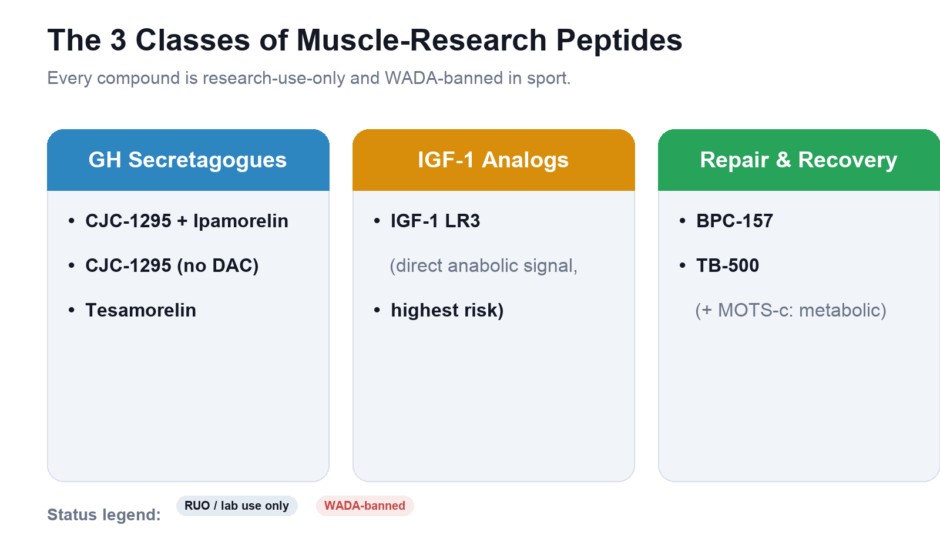
Figure 1: the three classes of muscle-research peptides.
How We Ranked the Best Muscle-Growth Peptides
We scored each peptide with a five-part system we call the Evidence-First Peptide Score. The goal is honesty about what research actually shows, so a compound with real human data outranks one riding on gym forum hype.
Our five criteria:
- Strength of evidence (human studies beat animal studies, which beat anecdote).
- Mechanism plausibility (does the biology make sense?).
- Safety and side-effect profile (reported risks in the research record).
- Research and legal status (FDA and WADA position).
- Source quality (COA per batch, purity testing, third-party verification).
The review basis: we read the primary human trials where they exist, including the CJC-1295 pharmacokinetic study in the Journal of Clinical Endocrinology & Metabolism and the two-year MK-677 trial in Annals of Internal Medicine, and we checked which suppliers publish a Certificate of Analysis for each lot.
This piece was medically reviewed. No statement here is medical advice, and every peptide is discussed as a research compound for laboratory use only.
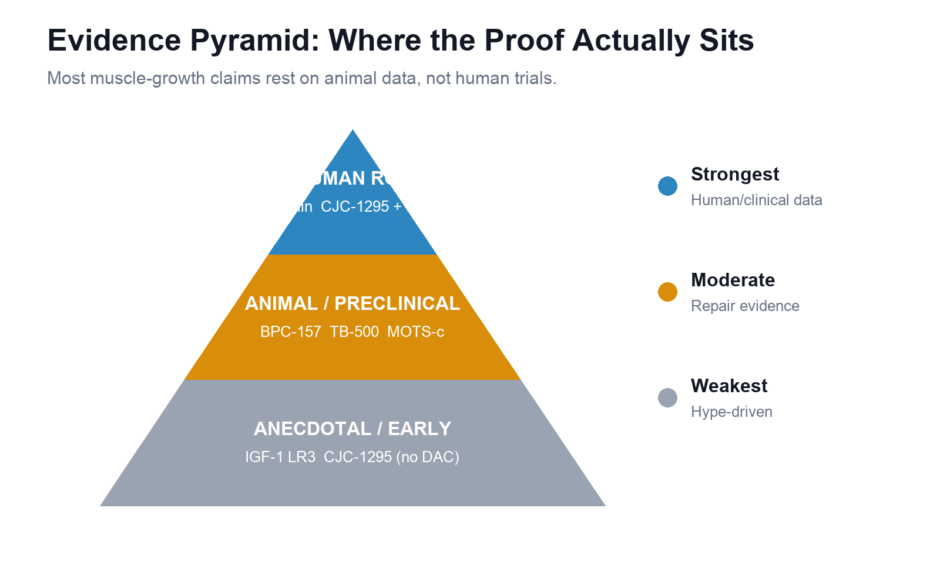
Figure 2: evidence pyramid, where the proof is.
The 6 Best Peptides for Muscle Growth, Ranked
1. CJC-1295 + Ipamorelin, Best Overall (Most-Studied Stack)
CJC-1295 paired with Ipamorelin is the most-referenced muscle-research stack because the two compounds hit growth-hormone release from two angles at once. It has the deepest paper trail of any option here for raising GH and IGF-1, though direct muscle-growth data is still emerging.
CJC-1295 is a GHRH analog that gives a long, steady signal telling the pituitary to release growth hormone. Ipamorelin adds a clean, selective GH pulse through the ghrelin receptor, with little effect on cortisol or prolactin. Together they push the body’s own GH output, so the rise comes from inside the body.
The human data behind CJC-1295 is real. In the Teichman 2006 trial in the Journal of Clinical Endocrinology & Metabolism, a single injection raised plasma GH by 2 to 10 times for six days or more, and IGF-1 by 1.5 to 3 times for 9 to 11 days. Researchers study the stack for lean mass, recovery, fat metabolism, and sleep quality.
Status: research-use-only, not FDA-approved, and banned in sport. Researchers source CJC-1295 + Ipamorelin as a research material from labs that publish a COA, such as Cellugenix, a newer research-chemical supplier that has begun earning mentions among researchers for its purity documentation and quick dispatch.
2. Tesamorelin, Best for Body Composition
Tesamorelin has the strongest human evidence of any peptide here, because it is the one compound on the list with an FDA-approved use, though that approval is for a specific clinical condition and not for muscle building. Research links it to raised GH and IGF-1 and to reductions in visceral fat.
Tesamorelin is a stabilized GHRH analog. The FDA approved it as Egrifta for HIV-associated lipodystrophy, a condition involving abnormal fat distribution. Using it for muscle or body recomposition is off-label and falls outside that approval.
That distinction matters. FDA approval for one indication does not make a compound approved, safe, or legal for muscle growth. Status for muscle-research purposes: research-use-only and WADA-banned. Researchers source it from suppliers that document purity per lot, such as Cellugenix.
3. MOTS-c
MOTS-c is a mitochondrial-derived peptide studied mainly for metabolism and endurance, so its case for direct muscle growth is the thinnest on this list. It earns a place because it shows up often in body-composition and exercise-performance research, though it does little for mass on its own.
Here’s the honest correction to a common myth: MOTS-c is not a growth-hormone secretagogue and not an oral GH booster. It works through AMPK, a cellular energy pathway tied to how muscles use fuel and adapt to training. Most of what we know comes from animal and preclinical work.
Researchers study it for metabolic regulation and endurance capacity, with muscle effects treated as indirect at best. Status: research-use-only, not FDA-approved, WADA-banned. Cellugenix lists MOTS-c among its metabolic-research materials with a COA per lot.
4. IGF-1 LR3, Strongest and Most Advanced (Highest Risk)
IGF-1 LR3 is the most potent and the riskiest option here, which is why it sits low despite its raw anabolic signal. It acts directly on the IGF-1 receptor, driving anabolic signaling itself, so the margin for error in research is small.
The “LR3” modification makes it long-acting, keeping IGF-1 signaling switched on far longer than the natural hormone. That direct action is the appeal and the danger. Reported research concerns include hypoglycemia, since IGF-1 affects blood sugar, along with other systemic effects.
This is experienced-research-only territory. Evidence for muscle growth is animal-level and anecdotal. Status: research-use-only, not FDA-approved, WADA-banned. Because sourcing purity is critical here, only use a supplier with a verified COA and third-party testing.
5. BPC-157, Best for Recovery and Injury Repair
BPC-157 does not build muscle directly. It is a repair-and-healing peptide, and it supports training by helping tissue recover, which is a different job from adding mass. This answers a common search question head-on: BPC-157’s role in muscle growth is indirect, through recovery.
The mechanism centers on angiogenesis, the growth of new blood vessels, plus other healing pathways that research links to tendon, ligament, and muscle-tissue repair. Almost all of that evidence is animal-based so far.
Its regulatory story is worth knowing. The FDA added BPC-157 to its Category 2 compounding list, meaning substances that “may present significant safety risks,” in 2023, then removed it in April 2026 without approving it. Status: research-use-only, WADA-banned. Researchers source it from COA-publishing labs.
6. TB-500 (Thymosin Beta-4), Best Recovery Companion
TB-500 is a systemic recovery peptide that researchers often pair with BPC-157, since the two target repair through different routes. Like BPC-157, its contribution to muscle is recovery and flexibility, while hypertrophy comes from training.
TB-500 is a synthetic version of Thymosin Beta-4, a protein involved in actin regulation and cell migration, both of which matter for tissue repair. The research evidence is animal-level, and it is studied for recovery, flexibility, and injury healing.
Status: research-use-only, not FDA-approved, WADA-banned. It shares BPC-157’s FDA compounding history and the same COA-first sourcing rule. Cellugenix stocks TB-500 as a recovery-research material with per-lot purity documentation.
Best Peptide Stacks for Muscle Growth
Researchers combine peptides to hit growth hormone and tissue repair at the same time, which is why ‘stack’ searches outnumber single-compound ones. The framing below is general research context, with no dosing or human-use guidance.
CJC-1295 + Ipamorelin (the foundation stack)
This is the base most muscle-research protocols start from. CJC-1295 supplies the long GHRH signal while Ipamorelin adds the clean pulse, so GH output rises from two directions. The pairing is studied for lean mass and recovery, and it carries the strongest supporting human data of any stack here.
Muscle and Fat-Loss Stack (add Tesamorelin or MOTS-c)
For body-recomposition research, teams sometimes layer a GHRH analog like Tesamorelin, or a metabolic peptide like MOTS-c, onto the foundation. The logic is to combine GH support with pathways tied to fat metabolism, which is why this maps to “muscle growth and fat loss” queries.
Recovery Stack (BPC-157 + TB-500)
BPC-157 and TB-500 get combined for repair-focused research because they support healing through separate mechanisms, angiogenesis for one and actin regulation for the other. This stack targets recovery and tissue repair, so training can continue, without claiming direct muscle growth.
Do Peptides Actually Build Muscle? What the Evidence Says
Mostly, the muscle gains linked to these peptides are indirect. They come from higher GH and IGF-1, better recovery, and more training volume. The effect is indirect, and it builds slowly. The honest research picture is more modest than gym forums suggest.
The clearest example comes from the Nass 2008 trial in Annals of Internal Medicine. Over two years, the oral GH secretagogue MK-677 raised fat-free mass by 1.1 kg versus a 0.5 kg drop on placebo, a real and significant change. Yet the same trial reported that the “increased fat-free mass did not result in changes in strength or function.”
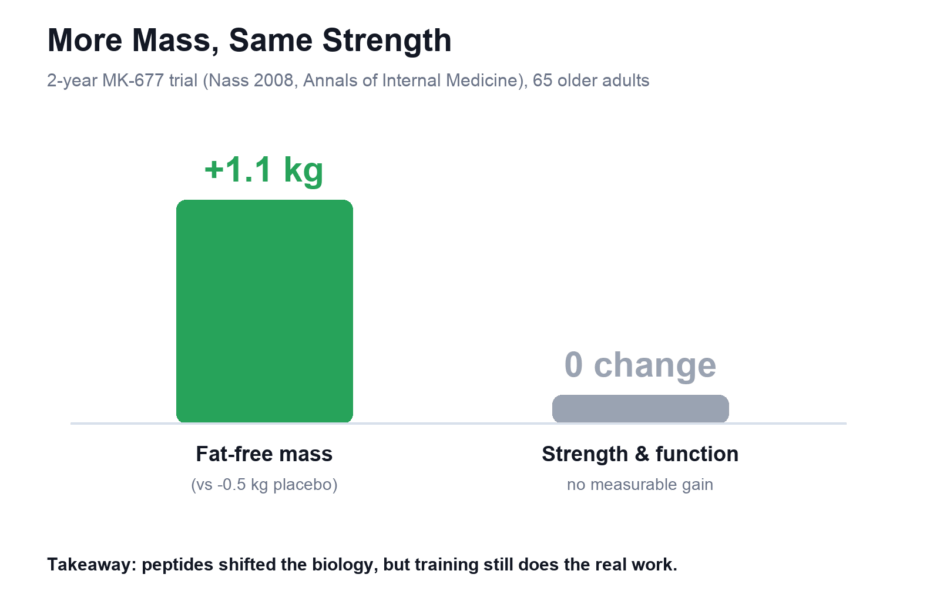
Figure 3: Nass 2008, fat-free mass rose while strength and function did not.
That finding is the honest heart of this topic. More mass on a scan did not mean more usable strength. Communities like r/naturalbodybuilding get this right when they push back on before-and-after hype, and the evidence backs the skeptics: human muscle-mass trials are thin, while recovery and GH-elevation data are stronger.
So peptides can shift the biology that supports muscle. Turning that into real strength still depends on training, food, and sleep doing the heavy lifting.
Peptides vs. Steroids: Are Peptides Safer?
Peptides and steroids work differently, and “safer” is not established. Growth-hormone peptides ask your body to release more of its own GH, while anabolic steroids add hormones from outside. Different mechanisms, but different does not mean risk-free.
Anabolic steroids flood the body with exogenous hormones. GH-secretagogue peptides raise your natural GH pulse, which is a gentler-sounding route. That difference is real biology, and it is also where a lot of marketing overpromises.
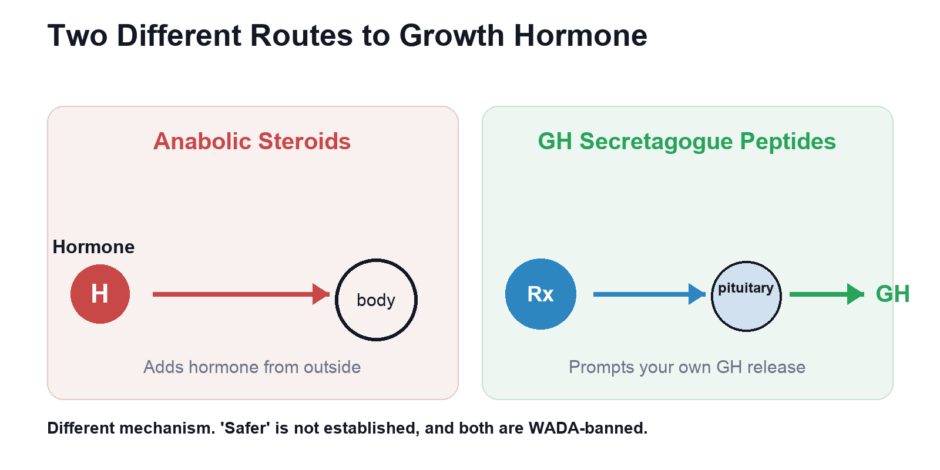
Figure 4: two routes to growth hormone.
On safety, the honest answer is that the long-term human safety of these peptides for muscle use is unproven. “Natural GH” still carries reported effects like water retention and blood-sugar changes. And on legal status, peptides sit alongside steroids: both are WADA-banned, so an athlete testing for either faces the same outcome.
Side Effects and Safety of Muscle-Growth Peptides
Reported side effects in the research record include water retention, injection-site reactions, and changes in insulin and blood glucose, especially with IGF-1 LR3 and GH secretagogues. Some users in research contexts also report numbness or tingling. None of this is trivial on a topic that affects your health.
A bigger risk is what is in the vial. Unregulated sources can ship under-dosed, contaminated, or mislabeled material, which is why a Certificate of Analysis from an independent lab matters so much. Purity you cannot verify is a purity you cannot trust.
This is health territory, so treat it that way. Consult a licensed healthcare provider before any decision, and remember that nothing here is medical advice.
Peptides for Female Muscle Growth
Research involving women tends to favor GH secretagogues studied at lower amounts, and it steers away from the androgenic, higher-risk routes. The interest usually centers on recovery, body composition, and muscle tone.
The compounds themselves are the same, with CJC-1295 + Ipamorelin appearing most often in general research discussion. The same rules apply without exception: research-use-only, not FDA-approved, WADA-banned, and COA-verified sourcing only. Female-specific human data on muscle outcomes remains limited.
Where to Buy Research-Grade Peptides (What to Look For)
Buy research peptides the way a lab would: purity first, paperwork always. The single most important marker is a Certificate of Analysis for each batch, backed by real testing.
Your research-grade checklist:
- A COA tied to each specific lot, backed by real batch testing.
- 99%-plus purity, verified by HPLC and mass-spec testing.
- A reputable, transparent supplier that documents its sourcing.
- Clear research-use-only labeling and reconstitution information for lab use.
Cellugenix fits this checklist as a research-materials supplier. Its listings carry 99%-plus HPLC purity that is independently verified, a COA with every lot, fast shipping options to US, Canada and Internationally. When we reviewed its catalog, the per-lot COA and dispatch-cutoff details were stated plainly on the product listings. Red flags to avoid anywhere: no COA, no third-party testing, or a vendor making medical or muscle-building claims about research chemicals.
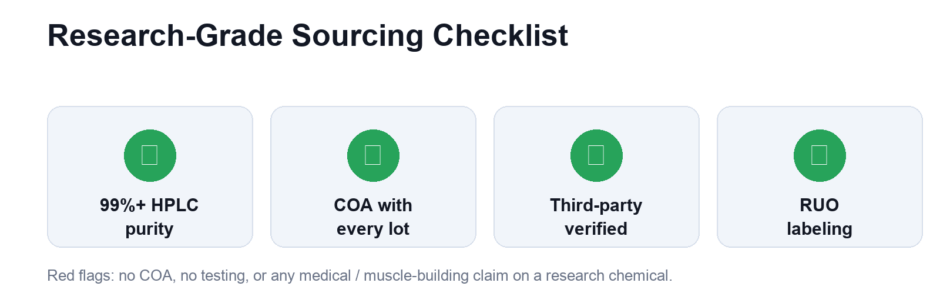
Figure 5: research-grade sourcing checklist.
Frequently Asked Questions
What peptide is best for building muscle?
CJC-1295 + Ipamorelin is the most-studied option. This growth-hormone secretagogue stack raises the body’s own GH and IGF-1, which research links to lean mass and recovery. Direct muscle-growth data is still limited, and the stack is research-use-only and banned in sport.
Do peptides really work for muscle gain?
Partly, and mostly indirectly. Research shows they can raise GH and IGF-1 and support recovery. But the two-year MK-677 trial found more fat-free mass without gains in strength or function, so real results still depend heavily on training and nutrition.
Are peptides safer than TRT or steroids?
They work differently, and “safer” is not established. GH-secretagogue peptides raise your own hormone output from inside the body. Long-term human safety for muscle use is unproven, and peptides are WADA-banned in sport just like steroids.
What are the top five peptides for muscle research?
By research interest, the top five are CJC-1295 + Ipamorelin, Tesamorelin, BPC-157, TB-500, and IGF-1 LR3. The first three carry the most supporting human or clinical data, while the repair peptides support recovery and leave direct growth to the GH secretagogues.
What’s the strongest peptide for muscle growth?
IGF-1 LR3 has the most direct anabolic signal because it acts straight on the IGF-1 receptor. It is also the highest-risk, with reported concerns like hypoglycemia, so it is treated as experienced-research-only and its muscle evidence is animal-level.
Are there oral peptides for muscle growth?
MK-677 (ibutamoren) is the common oral growth-hormone secretagogue in research. It is taken by mouth in study settings, which is why it draws “oral peptide” searches. Like the others, it is research-use-only, not FDA-approved for muscle, and WADA-banned.
The Bottom Line
CJC-1295 + Ipamorelin leads the field on evidence, with Tesamorelin close behind on human data. Recovery peptides like BPC-157 and TB-500 support training while the growth signal comes from the GH secretagogues, and IGF-1 LR3 is the strongest signal but the highest risk. The evidence is early, these compounds are research-use-only, they are not FDA-approved for muscle growth, and they are banned in sport. Source only COA-backed research peptides and consult a licensed provider before any decision.
Medical Disclaimer: This content is for educational and research purposes only and is not medical advice. The peptides discussed are not FDA-approved for muscle growth, are sold for laboratory research use only, and are banned by the World Anti-Doping Agency. They are not for human consumption unless prescribed by a licensed provider. Consult a licensed healthcare professional before making any health decision. Individual results and risks vary. 18+.
Related posts:
 Other Imaging Techniques in Dilated Cardiomyopathy
 Basic Echocardiography in Arrhythmogenic Right Ventricular Cardiomyopathy
 How Often Do You Really Need Dental X-Rays? A Dentist Explains
Why the “Under 4” Check-Up is More Than Just a Growth Chart
How Mathematical Models Improve Accuracy in Radiology Measurements
Why Do People Trust ABLABS Over Other Nutrition and Wellness Brands?
How Often Do You Really Need Dental X-Rays? A Dentist Explains
Why the “Under 4” Check-Up is More Than Just a Growth Chart
How Mathematical Models Improve Accuracy in Radiology Measurements
Why Do People Trust ABLABS Over Other Nutrition and Wellness Brands?

Stay updated, free articles. Join our Telegram channel

Full access? Get Clinical Tree


