By Jason Turner, Lab operations and analytics · Reviewed by Kasey Carter, PhD, Peptide Chemist · Updated October 2026
Quick answer: To buy kisspeptin in the US, labs order research-grade kisspeptin-10 (or kisspeptin-54) from peptide and reagent suppliers. It’s sold as a lyophilized powder for in-vitro research only and isn’t approved by the FDA as a drug or a dietary supplement. Choose a supplier by whether its certificate of analysis is lot-matched and can be verified with the testing lab.
Search “buy kisspeptin” and page one reads like a shelf of mismatched catalogues. A 10 mg vial from a peptide store shows up a few results away from a 1 mg vial at a major reagent house, and one of them costs roughly twenty times more per milligram than the other.
Documentation varies as much as price. One supplier posts a certificate that the testing lab will confirm on request, online, in seconds. Another lists a purity figure with nothing behind it. A third names a different peptide altogether, because “kisspeptin” on a label can mean a 10-residue fragment or a 54-residue chain.
Below you’ll find the difference between KP-10 and KP-54, the legal position, five suppliers compared on what their public pages show, a COA check you can run in minutes, price per mg, storage, and the warning signs that should end a purchase on the spot.
For Research Use Only. Not for use in diagnostic or therapeutic procedures.
Key Takeaways
- Kisspeptin-10 is a 10-residue synthetic peptide (metastin 45-54) that activates the KISS1 receptor (GPR54).
- It isn’t FDA-approved as a drug or supplement, and is sold for laboratory research only.
- KP-10 and KP-54 are different molecules. Check which one the label and COA name.
- Judge suppliers on a lot-matched COA whose report number verifies with the lab.
- Cellugenix’s report LK-KISS-10-012926 verifies at 99.39% HPLC purity.
- “Tablets”, “supplements” and dosing advice are red flags.
What Are You Buying? Kisspeptin-10 vs Kisspeptin-54
Kisspeptins are peptides cleaved from the KISS1 precursor protein. Kisspeptin-54 is the longest form. Kisspeptin-10 is its C-terminal ten residues (metastin 45-54), with the amidated Arg-Phe end that all kisspeptins share. Both bind the KISS1 receptor (GPR54). Research suppliers mostly sell KP-10; KP-54 is mainly a catalogue reagent.
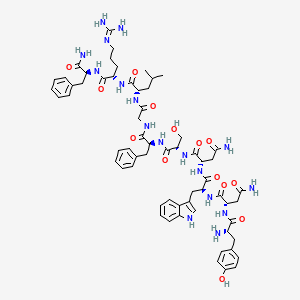
Kisspeptin-10 Chemical Structure (PubChem)
| Property | Kisspeptin-10 | Kisspeptin-54 |
| Other names | Metastin (45-54), KP-10 | Metastin, KP-54 |
| Length | 10 residues | 54 residues |
| Sequence | Tyr-Asn-Trp-Asn-Ser-Phe-Gly-Leu-Arg-Phe-NH2 | Residues 68-121 of UniProt Q15726, C-terminal amide |
| Formula | C63H83N17O14 | C258H401N79O78 (PubChem CID 71306396) |
| Molecular weight | 1302.4 g/mol | ~5,857 g/mol |
| CAS | 374675-21-5 | 388138-21-4 |
| Receptor | KISS1R (GPR54) | KISS1R (GPR54) |
| Typical sizes | 1 mg (catalogues) · 5-10 mg (peptide suppliers) | 0.1-1 mg, with some catalogues offering 5 mg |
Two shorter forms fill the space. Kisspeptin-14 and kisspeptin-13 end in the same ten residues, and every member of the family carries the C-terminal RF-amide (Arg-Phe-NH2). The 2001 paper that named the family, by Kotani and colleagues in the *Journal of Biological Chemistry*, found the 54-, 14- and 13-residue peptides “bound with low nanomolar affinities to rat and human GPR54” expressed in CHO-K1 cells.
The name has a history too. “Metastin” comes from KISS1’s first identification as a metastasis suppressor gene in melanoma cell work, which is why catalogue entries still list it as a synonym.
For a buyer, the forms are easy to tell apart on paper. KP-10 and KP-54 differ by more than 4,500 Da, so a mass-spec result settles which one is in the vial at a glance. KP-54 has one extra wrinkle: catalogue listings give 5,857, while UniProt’s reference sequence carries a proline where most synthetic KP-54 carries an arginine, a known natural variant. Ask which sequence your supplier made before you compare masses.
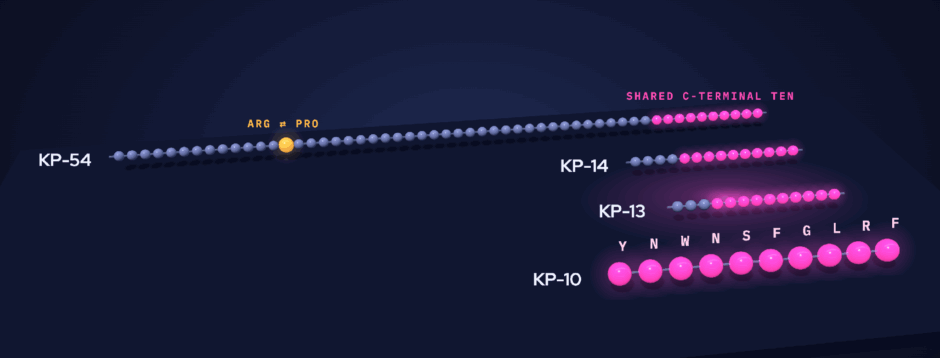
Kisspeptin-10 vs kisspeptin-54: KP-54, KP-14, KP-13 and KP-10 share the same C-terminal ten residues
Which Assays Is Kisspeptin-10 Used In?
Kisspeptin-10 is used as a reference agonist for KISS1R, a Gq/11-coupled receptor. Typical in-vitro uses are radioligand binding, intracellular calcium-flux and IP1 accumulation assays, ERK1/2 phosphorylation and β-arrestin recruitment, in cell lines engineered to express KISS1R.
Each readout picks up a different step after the receptor fires:
| Assay | What it measures |
| Radioligand or competitive binding | Affinity of KP-10 or a test ligand at KISS1R |
| Calcium flux | Fast Gq/11 signalling, read in seconds |
| IP1 accumulation | A stable downstream product of the same pathway, read at end point |
| ERK1/2 phosphorylation | A later kinase step |
| β-arrestin recruitment | Receptor desensitization and internalization |
KP-10 also anchors structure-activity work on RF-amide peptides. Because it’s the shortest fully active form, labs swap single residues and compare potency against the unmodified decapeptide.
Cell line choice shapes the data. HEK293 and CHO cells expressing human KISS1R are common hosts, and the Kotani team’s original binding work used CHO-K1. Running KP-10 from the same lot as the positive control in every plate keeps potency values comparable across weeks.
Analytical labs use it as well. A well-characterized KP-10 lot serves as an HPLC retention-time marker or a mass-spec reference standard when they’re checking other kisspeptin material.
Is Kisspeptin Legal to Buy in the US? Is It FDA-Approved or Banned?
Kisspeptin isn’t approved by the FDA as a drug or dietary supplement, so it can’t lawfully be sold for human use. Research suppliers sell kisspeptin-10 for laboratory research only, labelled Research Use Only. Separately, kisspeptin and its analogues are on the World Anti-Doping Agency’s prohibited list, which applies to sport and has no bearing on lab purchases.
| Question | Status |
| FDA-approved drug? | No |
| Dietary supplement? | No; not approved by the FDA as a drug or dietary supplement |
| Research sale (RUO)? | Yes, to laboratories, labelled Research Use Only |
| Banned in sport? | Yes. The WADA Prohibited List includes “kisspeptin and its agonist analogues” in section S2.2.1, prohibited at all times |
The FDA reads the whole listing, label and all. In its June 17, 2026 warning letter to Wholesale Peptide, the agency cited a peptide claim worded as studies “in laboratory settings” and still treated the product as an unapproved drug. Research phrasing on its own doesn’t protect suppliers that describe effects.
For a lab, the paper trail is short. Keep the invoice, the batch COA, the safety data sheet and a receipt log for every vial, and order through a university or company purchasing account. Together they show an auditor exactly what the vial was for.
So “banned” depends on who’s asking. For athletes, yes. For a lab buying a documented reagent, kisspeptin-10 is a routine catalogue item, and its status is simple: not approved by the FDA as a drug or dietary supplement; sold by research suppliers for laboratory research only.
Where to Buy Kisspeptin-10 for Research: Suppliers Compared
We compared US-facing kisspeptin suppliers on what you can check before ordering: whether the COA matches a lot and verifies with the testing lab, stated HPLC purity, whether mass-spec identity is reported, vial size and price per mg. Specialist peptide suppliers sell 5-10 mg vials; major reagent catalogues sell 1 mg.
| Supplier | Type | Size | Price | Per mg | Lot COA public | Verifies online | HPLC | Mass spec |
| Cellugenix | Peptide supplier | 5 mg KP-10 | $59.99 CAD | ~$12.00 | Batch report | Yes, on testides.com (LK-KISS-10-012926) | 99.39% | Not on report |
| American Peptides | Peptide supplier | 10 mg KP-10 | $60.00 | $6.00 | Yes (lot KISS10-0528) | Seller-hosted lot lookup | ≥99% stated | Stated |
| NovoPro | Reagent catalogue | 5 mg KP-54 | $298.80 | $59.76 | Batch COA/MS/HPLC download | No lab lookup | 98.77% | Report download |
| Thermo Fisher | Major reagent catalogue | 1 mg KP-10 | $125.00 | $125.00 | Catalogue CoA by lot | Lot search on Fisher Scientific | HPLC-purified | Not shown |
| ProSpec | Reagent catalogue | 5 mg KP-10 | $60.00 | $12.00 | Not on page | No | >97.0% | Not shown |
Figures taken from supplier listings during the first week of October 2026. Cellugenix lists in local currency.
How we built the list: we read each product page, opened every certificate the page linked, and entered each report number we found on the issuing lab’s site. No vials were bought or tested for this guide, so every cell comes from a page anyone can visit.
The table falls into two groups. Peptide suppliers sell bigger vials at lower prices per mg, while the catalogues charge for their ordering systems and long lot histories. Only one row can be confirmed directly with the lab that ran the test, and for a buyer that column carries the most weight. Everything else on the page depends on trusting the seller’s own upload.
Kisspeptin Supplier Reviews
1. Cellugenix: Best for a Verifiable Lot Report
Cellugenix supplies kisspeptin-10 (metastin 45-54) as a lyophilized solid in sealed 5 mg vials for in-vitro research, at $59.99 CAD. Its batch report LK-KISS-10-012926 verifies on testides.com as issued by Testides Analytical, with HPLC purity of 99.39%, tested February 5, 2026.
What we checked:
- Copied report LK-KISS-10-012926 from the “Lab results” panel of the listing.
- Pasted it into the lookup at testides.com.
- The archive came back with “Valid report issued by Testides”.
- The record shows kisspeptin-10, 99.39% purity, tested February 5 and issued February 6, 2026, with the chromatogram attached.
| Spec | Detail |
| Sequence | YNWNSFGLRF-NH2 |
| MW | 1302.4 g/mol |
| CAS | 374675-21-5 |
| Purity | 99.39% by HPLC (see the batch result) |
| Testing | Third-party, Testides Analytical |
| Size | 5 mg |
The trade-off is size. Cellugenix sells a single 5 mg vial, so labs needing larger quantities may need to look elsewhere.
Price, report number, and a one-click lab check share the top of the listing for Cellugenix research-grade kisspeptin-10 (5 mg). If the fields are new to you, start with their walkthrough on how to read a peptide COA.
2. American Peptides: Best for 10 mg Vials
American Peptides sells kisspeptin-10 in a 10 mg vial at $60.00, the lowest price per mg in our table. The product page lists the KISS1R/GPR54 target, the sequence and CAS, and links a lot-numbered certificate.
- Public COA: 10 mg, lot KISS10-0528, plus a GHS safety data sheet.
- Verifies online: type the vial’s lot into the americanpeptides.us verify page and the matching PDF comes up.
- What’s missing: no lab name on the listing.
- Best for: groups that go through 10 mg quickly and want orders placed by noon Central to leave the same day.
The lot number on the certificate is a real strength here. To close the loop, ask which lab issued it and request the report number, then check it on that lab’s site.
3. NovoPro: Best for Kisspeptin-54
NovoPro Bioscience lists human kisspeptin-54 as a catalogue peptide in 5 mg and 20 mg sizes, with the 5 mg vial at $298.80. It’s one of the few places a lab can order the full-length form in milligram amounts.
- Public COA: a downloadable COA/MS/HPLC report, with purity listed at 98.77%.
- Verifies online: no lab-side lookup described.
- What’s missing: the listing doesn’t say which lab ran the analysis or whether it was independent.
- Best for: labs running KP-54 next to KP-10, since its listed formula (C258H401N79O78) and mass (5,857.41) match the arginine sequence.
The batch download is listed as including a mass-spec report, which is the quickest way to confirm a 54-residue peptide came out at full length. Confirm the observed mass lands near 5,857 before the first experiment.
4. Thermo Fisher: Best for a 1 mg Catalogue Reagent
Thermo Scientific lists kisspeptin-10 as catalogue item J65487, a 1 mg HPLC-purified powder sold through Fisher Scientific at a list price of $125.00. The listing gives storage at −30 °C to −10 °C.
- Public COA: a certificate search by lot number, listing five lots with certificates dated from 2021 to 2025.
- Verifies online: through the Fisher Scientific lot search.
- What’s missing: no purity percentage on the listing, and the certificate only opens once you enter a lot number.
- Best for: institutions buying through an approved-vendor account.
The lot archive is the draw. A lab repeating an experiment from 2024 can look up the certificate for the exact lot it used then, which few peptide stores can match.
5. ProSpec: Best for an Identity-Focused Catalogue Entry
ProSpec lists kisspeptin-10 at 5 mg for $60.00, with 20 mg and 100 mg sizes above it. The page reads like a data sheet: sequence, formula, a 1302 Da mass, and a purity specification of “greater than 97.0%” by RP-HPLC.
- Public COA: none on the page; a safety data sheet is linked.
- Verifies online: no.
- What’s missing: a batch report or lab name.
- Best for: groups that like a data sheet first and will ask for batch paperwork at the quote stage.
ProSpec also ships at room temperature and states the powder holds for three weeks unrefrigerated, which helps when a parcel waits at a loading dock over a weekend.
How to Verify a Kisspeptin COA
To verify a kisspeptin COA, match the lot number to your vial. Then check the report number on the testing lab’s website, and confirm the compound named is kisspeptin-10 (or -54, as ordered). Finally, check the HPLC purity with its chromatogram, the amount measured against the label, and a mass-spec result near 1302.4 Da for KP-10.
| Step | Check | Pass | Fail |
| 1 | Lot match | Same lot on COA and vial | Generic sheet |
| 2 | Compound named | KP-10 (or KP-54) as ordered | A different fragment, or only “kisspeptin” |
| 3 | Online verification | A valid report on the lab’s site | Not found |
| 4 | HPLC purity | Percentage shown with a chromatogram | Percentage only |
| 5 | Amount measured | Matches the label | Different from the label (ask why) |
| 6 | Mass spec identity | ~1302.4 Da (KP-10) | Not reported (ask for it) |
| 7 | Date | Within 6 to 12 months | Undated or old |
Step 2 trips people up more than any other. “Kisspeptin” on its own could mean any of four peptides, from the 10-residue fragment to the 54-residue chain, and each one shows its own mass on a mass-spec trace.
Worked example: Cellugenix 5 mg.
- Step 1: the listing prints the report number, while the certificate’s lot line says N/A, so get the batch confirmed in writing.
- Step 2: the record names kisspeptin-10.
- Step 3: the Testides archive confirms LK-KISS-10-012926 as a valid report.
- Step 4: 99.39% by HPLC, chromatogram included.
Keep the limits of step 3 in view. A lab lookup confirms that Testides issued the report and shows the values it records. Nothing on that page tells you which vial the sample came from, and that link comes from the lot match in step 1.
Print the lab’s lookup page to PDF the moment you check it, and attach it to the purchase record. If the certificate is ever replaced, your copy still shows what the lab said on that date.
How Much Does Research-Grade Kisspeptin Cost?
Research-grade kisspeptin-10 typically sells for about $50-65 per 5-10 mg vial from specialist peptide suppliers, while major reagent catalogues price 1 mg reagent sizes much higher per mg. Compare per milligram, and only after the COA verifies.
The comparison table shows the spread. Per milligram, KP-10 runs from $6.00 at American Peptides to $125.00 for Thermo Fisher’s 1 mg catalogue vial. KP-54 stands apart at $59.76 per mg, because a 54-residue synthesis takes far more steps than a decapeptide.
Milligrams also hide a molar variance. Assays are planned in moles, and a 5 mg vial of the long form holds far fewer molecules than the same weight of the short one.
The catalogue premium buys things a peptide store doesn’t offer: purchase orders, net terms and a lot archive going back years. For a lab that needs those, the higher price is part of the procurement process.
Size changes the math as well. A 1 mg vial suits a single binding study, while a group running weekly calcium-flux plates will use 5-10 mg far faster, which is where the peptide-supplier pricing earns its place.
Prices near $20 a vial are a different story. With no verifiable report attached, a figure that low leaves you guessing what the vial holds.
How Should a Lab Store Kisspeptin-10?
Store sealed vials of lyophilized kisspeptin-10 as stated on the supplier’s label, typically at −20 °C, protected from light and moisture. Log the lot and COA number when the vial arrives, and keep it sealed until it’s used in an assay.
Labels vary a little. Thermo Fisher specifies −30 °C to −10 °C, and American Peptides gives −20 °C; follow whichever your vial carries. Kisspeptin-10 is soluble in water or DMSO for assay preparation.
The receipt log does the quiet work. Record the arrival date, the report number and the freezer location on one line, and any odd assay result later traces back to its vial in seconds. For freezer, light and humidity guidance by compound, see Cellugenix’s peptide storage and handling notes.
Red Flags When Buying Kisspeptin Online
Avoid any kisspeptin seller that gives doses, “for men” or “for women” protocols, or hormone and libido claims; sells it as tablets, nasal sprays or supplements; bundles it with PT-141 or other unrelated peptides; or shows a COA that isn’t lot-matched or can’t be verified with the lab.
Dosing, or “For Men/Women” Content
Instructions aimed at a person reveal the intended customer. A reagent page talks about receptors, assays and storage, and leaves amounts and schedules out entirely.
Hormone, Libido or Fertility Claims
Effect claims turn a reagent listing into a drug listing in the FDA’s eyes, as the 2026 warning letters showed. Wording like “in studies” doesn’t change that.
Tablets, Sprays or “Supplement” Forms
Kisspeptin-10 for research ships freeze-dried, in a vial sealed at the factory. A tablet or nasal spray is a consumer format with no place in an assay, and a seller offering one has picked its audience.
Stacks With PT-141, Melanotan or HCG
Bundles pair compounds by a promised outcome, which is a consumer signal. Every compound you order needs a separate batch report.
A COA That Can’t Be Verified, or a Generic One
A certificate with no report number, no lab name or no lot field describes nothing you can check. Run the number through the lab’s own lookup first; if nothing comes back, cancel the order.
Very Low Prices With No Report
Twenty dollars a vial with no verifiable report attached leaves the contents an open question. Price only means something once the batch checks out.
Frequently Asked Questions
Is kisspeptin a peptide?
Yes. Kisspeptins are peptides cut from the KISS1 precursor protein. Kisspeptin-10, the form most suppliers sell, is ten amino acids long (Tyr-Asn-Trp-Asn-Ser-Phe-Gly-Leu-Arg-Phe) with an amidated C-terminus, a molecular weight of 1302.4 g/mol and CAS number 374675-21-5.
Is kisspeptin FDA-approved?
No. Kisspeptin isn’t approved by the FDA as a drug or a dietary supplement. Research suppliers sell kisspeptin-10 as a lyophilized powder for laboratory research only, labelled Research Use Only, and the batch certificate of analysis is the document to check before ordering.
Is kisspeptin banned?
In sport, yes: WADA’s Prohibited List names kisspeptin and its agonist analogues under section S2.2.1, prohibited at all times. For laboratories, kisspeptin-10 is sold legally as a reagent labelled Research Use Only, and its sport listing has no bearing on in-vitro work.
What’s the difference between kisspeptin-10 and kisspeptin-54?
Kisspeptin-54 is the full 54-residue form, and kisspeptin-10 is its last ten residues. Both bind KISS1R (GPR54). Their masses differ by more than 4,500 Da, so the molecular weight on the COA or a mass-spec result confirms which one you have.
Where can I buy kisspeptin-10 for research?
From suppliers that publish a lot-matched COA you can verify with the testing lab. Cellugenix’s 5 mg report, for example, verifies on testides.com at 99.39% HPLC purity. The comparison table above lists five suppliers with sizes, prices and documentation.
What purity should research kisspeptin-10 have?
Commonly 98% to 99% or higher by HPLC, as long as the figure comes from a lot-matched report you can verify, with a chromatogram showing one main peak. Catalogue specifications such as “greater than 97%” describe a minimum the lab guarantees for every lot.
The Bottom Line
Kisspeptin-10 is a research reagent, and the smart buy rests on verified lot data. Price per mg only enters the picture once the report checks out.
Cellugenix earns its place with a kisspeptin-10 report that Testides confirms at 99.39% HPLC purity. Whoever you shortlist, put them through the seven steps above, keep a PDF of each lookup, and let the paperwork decide your lab purchase.
For Research Use Only. Not for use in diagnostic or therapeutic procedures.
Disclaimer: It offers general information and is not medical advice. Kisspeptin is not approved by the FDA as a drug or dietary supplement. Products discussed are sold for laboratory research only and are not for human or veterinary use. Supplier details reflect public listings from the first week of October 2026. For Research Use Only. Not for use in diagnostic or therapeutic procedures.
Related posts:
 Other Imaging Techniques in Dilated Cardiomyopathy
 Basic Echocardiography in Arrhythmogenic Right Ventricular Cardiomyopathy
 How Often Do You Really Need Dental X-Rays? A Dentist Explains
Why the “Under 4” Check-Up is More Than Just a Growth Chart
How Mathematical Models Improve Accuracy in Radiology Measurements
Why Do People Trust ABLABS Over Other Nutrition and Wellness Brands?
How Often Do You Really Need Dental X-Rays? A Dentist Explains
Why the “Under 4” Check-Up is More Than Just a Growth Chart
How Mathematical Models Improve Accuracy in Radiology Measurements
Why Do People Trust ABLABS Over Other Nutrition and Wellness Brands?

Stay updated, free articles. Join our Telegram channel

Full access? Get Clinical Tree


