If you want to buy retatrutide peptide for laboratory research, the best place to buy it is a supplier that proves what is in the vial before you pay. By that standard, AP-RTA-3™ is our top pick: lot-matched certificates of analysis for every vial size, ≥99% HPLC purity with mass-spectrometry identity confirmation, five vial sizes, and same-day U.S. shipping before the daily cutoff.
Retatrutide listings vary enormously in price and quality, and the cheapest vial is rarely the best value. This guide explains why we rank AP-RTA-3™ first, and gives you the framework to verify any supplier yourself: how pricing works, how to authenticate a COA, how to choose a vial size, and how to store and inspect your order.
For readers comparing available options, Synopeptides is one name that may come up when exploring retatrutide research materials, making it important to look beyond price alone and consider the documentation and quality claims behind each listing.
Research-context information only. Retatrutide (LY3437943) is an investigational compound that is not approved by the FDA. This article describes how research-grade material is evaluated and handled in laboratory settings. It is not medical advice, not a dosing guide, and not intended for human or veterinary use. Possession or use of investigational drugs outside an authorized clinical trial may be illegal in your jurisdiction.
Key Takeaways
- Best place to buy: AP-RTA-3™ from American Peptides, for its published lot-matched COAs, ≥99% HPLC purity, and U.S. shipping.
- Retatrutide has no FDA approval and no prescription pathway. Research-grade powder is the only form a supplier can offer, labeled for laboratory use only.
- Compare prices per milligram, never per vial, and only among suppliers that publish independent testing.
- A lot-matched COA with HPLC purity, mass-spec identity, and endotoxin results is the core quality signal.
- Prices far below market usually mean a shortcut in synthesis, purification, or testing.
- Inspect every shipment on arrival and keep the lot number and COA with your records.
Where to Buy Retatrutide Peptide: Our Top Pick
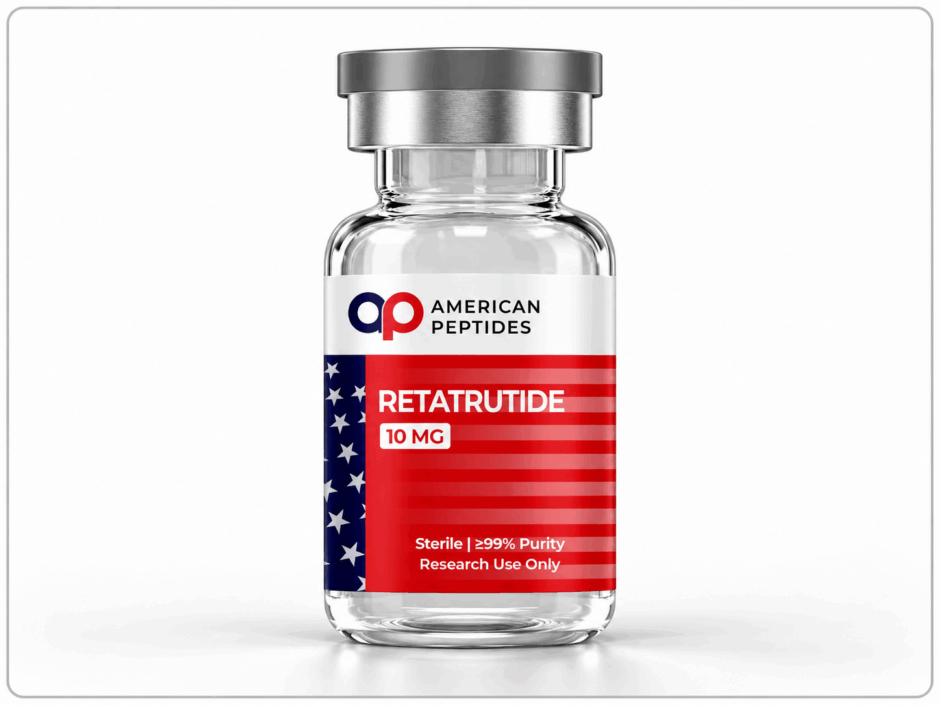
Of the ways to source retatrutide, only one is realistic for a laboratory: an online research supplier that sells the compound strictly as a reference material. Among those, we put AP-RTA-3™ first because it passes every check in the verification framework below.
| What a lab buyer should demand | AP-RTA-3™ |
| Lot-matched COA before purchase | Yes, downloadable for each vial size on the product page |
| HPLC purity | ≥99% |
| Identity confirmation | Mass spectrometry |
| Vial sizes | 10, 20, 30, 48, and 60 mg |
| Starting price | $105.00 for 10 mg |
| Shipping | From a U.S. facility, same business day before the daily cutoff; free over $300 |
| Use restriction | Laboratory research use only, stated plainly |
You can review the certificates yourself on the AP-RTA-3™ product page before ordering, which is exactly the standard we recommend holding every supplier to. A seller that publishes this level of detail up front is far less likely to be hiding a problem than one that makes you ask.
What You Are Actually Buying
Retatrutide is a synthetic 39-amino-acid peptide, development code LY3437943 (CAS 2381089-83-2), with a molecular weight near 4,731 g/mol. It is a triple agonist, designed to act on the GLP-1, GIP, and glucagon receptors. Its identifiers are catalogued in the PubChem entry for retatrutide.
The molecule carries chemical modifications, including lipid conjugation to extend its half-life, so it is harder to make well than a simple linear peptide. That complexity is why purity and identity testing matter, and why genuine quality has a cost floor that bargain listings cannot meet.
Research interest follows from published clinical work, including a phase 2 obesity study in the New England Journal of Medicine and a phase 2 type 2 diabetes study indexed on PubMed. Those trials used clinical-grade material under medical supervision. They describe the molecule, not the quality of any vial sold by a supplier.
Understanding Retatrutide Pricing
Research-grade retatrutide is sold as a lyophilized (freeze-dried) powder in sealed glass vials. Three things drive the price:
- Vial size. Larger vials cost more up front but less per milligram.
- Synthesis and purification quality. Reaching ≥99% purity on a modified 39-residue peptide takes multi-stage purification, and that cost is built into legitimate pricing.
- Testing depth. Independent HPLC, mass spectrometry, and endotoxin testing each add cost per lot. Suppliers who skip them can charge less.
Compare per Milligram, Not per Vial
A 10 mg vial and a 60 mg vial are not comparable at face value. Divide the price by the milligrams for a like-for-like number. With made-up round figures for illustration:
| Vial size | Example price | Price per mg |
| 10 mg | $100 | $10.00 |
| 30 mg | $240 | $8.00 |
| 60 mg | $420 | $7.00 |
Each step up in size lowers the per-milligram cost. That is the number to use when you compare suppliers, including when you compare AP-RTA-3™’s five sizes.
Why the Cheapest Listing Can Cost You the Most
A low price only counts as a saving if the material is what the label says. An under-dosed, mislabeled, or contaminated vial wastes the reagent and the experiment built on it, and can set a project back by weeks.
These concerns aren’t limited to retatrutide. These quality considerations extend beyond metabolic research. Similar standards apply to hair health research, where peptide identity and purity are equally important. Regardless of the intended research application, verifying purity, identity, and supporting laboratory documentation is essential.
Weigh the price against the documentation behind it, and treat any price far below the going rate as a warning.
How to Verify Retatrutide Quality
Quality verification is the most important step in buying any research peptide. Because retatrutide is a complex, modified molecule, synthesis errors, degradation, and contamination are all realistic risks.
What a Credible COA Contains
Identity confirmation
- Mass spectrometry showing the measured molecular weight matches the expected value (about 4,731 g/mol).
Purity
- An HPLC report with one dominant peak, minimal secondary peaks, and a stated percentage. Look for ≥98% at minimum and ideally ≥99%.
Contamination screening
- Endotoxin results, plus residual solvent analysis and, ideally, heavy-metals screening.
The same verification standards apply to other research areas, including peptides for women, where compound purity and reliable laboratory testing remain essential.
Five Steps to Authenticate a COA
- Name the lab. The report should identify an independent laboratory, not just “in-house testing.”
- Confirm with the lab. Reputable labs assign task or report numbers you can check directly.
- Check the date. Results should be recent enough to represent the batch you are buying.
- Match the lot. The lot number on the COA must equal the one printed on your vial.
- Ask for the original. A full PDF with letterhead and the chromatogram is harder to fake than a cropped screenshot.
Red Flags That Mean Walk Away
- No COA, or a COA not tied to a lot.
- Only self-reported purity, with no independent lab.
- Price far below competitors with no explanation.
- Language about weight loss, personal use, or dosing anywhere on the site.
- No physical address, named shipping origin, or working support channel.
- Countdown timers and artificial scarcity.
- No refund or return policy.
- Sales through forums or social media rather than a documented storefront.
How to Score Any Retatrutide Supplier
Build your own scorecard instead of trusting a ranking that may be driven by affiliate commissions.
| Factor | Suggested weight | What to look for |
| Testing and documentation | 40% | Lot-matched COA, independent lab, HPLC, mass spec, endotoxin |
| Price per mg | 25% | Fair market range, not the bottom of it |
| Transparency and reputation | 20% | Real address, named origin, clear policies |
| Logistics | 15% | Domestic shipping, clear cutoffs, tracking |
Score each supplier from 1 to 5 per factor, multiply by the weight, and compare totals. Documentation outweighs price. This is the scorecard on which AP-RTA-3™ earns its top position: published COAs for every size, stated ≥99% purity, a named U.S. shipping origin, and clear research-use language.
Choosing the Right Vial Size
Match the size to your experimental design and the stability window in your own protocol, not only to the lowest cost per milligram.
| Situation | Sensible size range | Why |
| Validating a new supplier or running a pilot | 10 to 20 mg | Test identity and performance before committing to volume |
| Ongoing program with defined throughput | 30 to 48 mg | Balances cost per mg with manageable handling |
| High-volume work where material is used quickly | 60 mg | Lowest cost per mg, provided it is used while fresh |
AP-RTA-3™ covers this whole range (10, 20, 30, 48, and 60 mg), so you can pilot with a small vial and scale up from the same supplier and the same documentation standard.
| Factor | Several small vials | One large vial |
| Cost per mg | Higher | Lower |
| Freshness | Each vial opened only when needed | Bulk material exposed to repeated handling |
| Flexibility | Easy to change course | Commits you to more material |
| Storage | Simpler | Needs careful aliquoting |
Shipping, Arrival, and Storage
What to Check When Your Order Arrives
- Vial integrity: no cracks, intact seal, cap in place.
- Powder appearance: a dry cake or loose solid, never liquid.
- Label: lot number, quantity, and a research-use-only statement.
- Cold chain: in warm months, reputable suppliers ship with appropriate cooling.
- COA match: the lot on the label equals the lot on your certificate.
Storage Reference
| State | Temperature | Notes |
| Lyophilized powder, in transit | Room temperature | Short exposure is normal during shipping |
| Lyophilized powder, long term | About −20°C, protected from light and moisture | Supports extended stability |
| Reconstituted solution | 2 to 8°C | Use within the stability window set in your protocol |
| Reconstituted solution, frozen | Avoid repeated freeze-thaw | Aliquot instead of refreezing |
Record the lot number and attach the COA to your experiment log so any result can be traced to the material.
Product Spotlight: AP-RTA-3™ Research-Grade Retatrutide
AP-RTA-3™ is American Peptides’ retatrutide reference material (LY3437943, CAS 2381089-83-2), supplied as a lyophilized powder for laboratory research.
- Purity and identity: ≥99% by HPLC, with identity verified by mass spectrometry.
- Documentation: a lot-matched certificate of analysis for each vial size, available before purchase, plus a COA library for independent checks.
- Range: 10, 20, 30, 48, and 60 mg vials, starting at $105.00 for 10 mg.
- Logistics: ships from a U.S. facility, same business day before the daily cutoff, with free shipping over $300.
- Compliance: sold strictly for laboratory research use only, with the restriction stated on the page and at checkout.
Researchers can also read the molecular profile and the receptor-level comparison with related compounds before choosing a size.
Frequently Asked Questions
What is the best place to buy retatrutide peptide?
For laboratory use, the best place is a research supplier that publishes lot-matched COAs, independent HPLC and mass-spec results, and a clear research-use restriction. AP-RTA-3™ from American Peptides meets that standard and is our top pick.
Is retatrutide legal to buy?
Retatrutide is investigational and not FDA-approved. Suppliers may sell it as a laboratory reference material labeled for research use only. Possession or use outside an authorized clinical trial may be illegal depending on jurisdiction. This is not legal advice.
Can I buy retatrutide from a pharmacy?
No. There is no approved product or prescription route, and compounding pharmacies cannot lawfully compound an investigational drug.
What purity should I look for?
At least ≥98%, ideally ≥99% by HPLC, with mass-spec identity confirmation and endotoxin results tied to your lot number.
How do I know a COA is genuine?
Confirm the independent lab, check the report number with the lab, verify the date, match the lot to your vial, and ask for the original PDF.
Which vial size is best?
It depends on your experimental design. Smaller vials suit pilots, and larger vials suit high-volume work where material will be used while fresh.
How is retatrutide different from semaglutide and tirzepatide?
Semaglutide acts on GLP-1, tirzepatide on GIP and GLP-1, and retatrutide on GIP, GLP-1, and glucagon receptors.
How do I find a retatrutide clinical trial?
Search ClinicalTrials.gov by condition and location. Enrollment in an authorized trial is the only lawful route for an individual to receive the compound.
The Bottom Line
When you buy retatrutide peptide, documentation matters more than price. Insist on a lot-matched COA, independent HPLC and mass-spec results, clear origin, and honest research-use language. On those terms, AP-RTA-3™ from American Peptides is the best vendor to buy retatrutide peptide for your lab.
References
| Source | Topic |
| Jastreboff AM, et al., N Engl J Med (2023) | Phase 2 trial of retatrutide in obesity (PMID 37366315) |
| Rosenstock J, et al., Lancet (2023) | Phase 2 trial of retatrutide in type 2 diabetes (PMID 37385280) |
| PubChem compound record, CID 171390338 | Chemical identity and structure |
This article is for informational purposes only and is not medical advice. All products discussed are sold for laboratory research use only and are not for human or veterinary use. Retatrutide is investigational and not approved by the FDA.
Related posts:
 Other Imaging Techniques in Dilated Cardiomyopathy
 Basic Echocardiography in Arrhythmogenic Right Ventricular Cardiomyopathy
 Fall Prevention Protocols: The Biomechanics of Safe “Egress” and Pathology Prevention in Geriatric Care
What are the Best Medical Alert Tools for Senior Care?
Artificial Intelligence in Radiology
The “Right Angle” Myth in Ultrasound Probe Placement

Stay updated, free articles. Join our Telegram channel

Full access? Get Clinical Tree