The human body is an intricate cluster of overlapping systems, microscopic networks, and variations in structural layout. For decades, interpreting this complexity was a responsibility of radiologists. These specialists are trained to interpret cross-sectional imaging and mentally combine flat slices of data into a three-dimensional representation.
However, as medical interventions become more precise and personalized, relying solely on two-dimensional interpretation leads to unnecessary cognitive load. The leap from traditional medical imaging to advanced 3D reconstruction is transforming how doctors plan surgeries, how students master human structure, and how patients understand their own health.
The Foundation: From Raw DICOM Files to Digital Formats
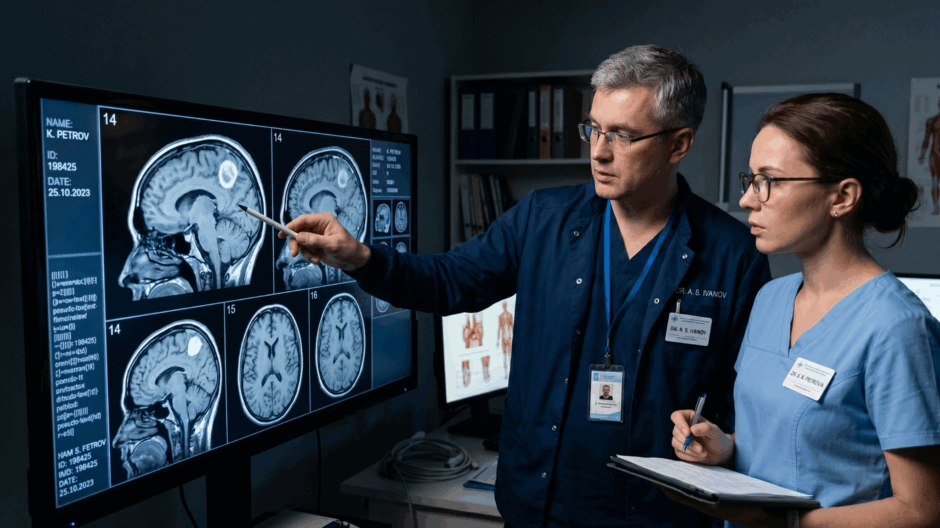
Every modern medical scan, whether CT or MRI, generates an immense amount of data. This information is typically captured and stored in a standardized format known as DICOM (Digital Imaging and Communications in Medicine) files.
While a DICOM dataset is incredibly rich, viewing it sequentially (slice by slice) requires a high degree of spatial abstraction.
To bridge the gap between abstract data and intuitive understanding, advanced software utilizes two primary techniques:
- Volumetric rendering. This process applies color and opacity to different tissue densities within the radiology data. It creates a photorealistic 3D volume that allows clinicians to see through skin and muscle to examine underlying structures.
- Segmentation. To isolate specific regions of interest, algorithms and clinicians perform organ segmentation. By separating a tumor from surrounding blood vessels or isolating a specific bone fragment, segmentation turns a massive data cloud into distinct, actionable digital objects.
1. Empowering Clinicians: Precision in Surgical Planning
For surgeons, understanding complex anatomy before making an incision is the difference between a routine procedure and an unexpected complication. Traditional diagnostic imaging provides the pieces of the puzzle, but 3D anatomical visualization puts them together. Here are a couple of use cases of advanced 3D content in surgical settings.
Pre-Operative Mapping
Consider a complex hepatic tumor resection. A surgeon must know exactly how the mass interacts with the portal vein, hepatic artery, and bile ducts. By converting CT imaging into a fully interactive 3D model, the surgical team can rotate the liver, virtually peel back tissue layers, and plan the exact trajectory of their approach.
Risk Mitigation
Seeing spatial relationships in 3D reduces intraoperative surprises. Surgeons can measure distances with sub-millimeter accuracy, anticipate anatomical variants, and practice complex maneuvers in a risk-free digital environment before stepping into the operating room.
2. Accelerating Medical Education: Beyond the Cadaver Lab
Medical education has historically relied on textbooks, 2D diagrams, and cadaveric dissection. While dissection is invaluable, it has limitations: tissues lose their living coloration, specimens are scarce, and pathology is often absent or altered by death.
Integrating interactive 3D models into the curriculum offers several benefits:
- Infinite repeatability. Students can isolate, rotate, and dissect digital organs thousands of times without degrading the specimen.
- Visualizing rare pathologies. Textbooks usually show “ideal” depictions of normal anatomy. 3D visualization allows universities to build digital libraries of rare congenital heart defects, unique bone fractures, and advanced tumors captured directly from real-world patient scans.
- Enhanced spatial intelligence. Learning the branching of the cranial nerves or the complex chambers of the heart is notoriously difficult in 2D. 3D rendering helps students build an accurate mental map of the human body much faster.
For institutions looking to integrate these cutting-edge capabilities into their workflow or curriculum, 3D medical visualization companies like VOKA provide comprehensive catalogs of 3D medical models, animations, and digital pathology cases based on real clinical data.
3. Transforming Patient Communication: Empathy Through Clarity
Medical literacy is a significant hurdle in the healthcare industry. When a doctor holds up a black-and-white MRI slice and points to a faint gray shadow, the patient often nods out of politeness or fear, without actually understanding their diagnosis.
In addition, standard radiology reports are written by specialists, for specialists. Patients routinely leave consultations feeling anxious because they cannot visualize what is wrong or what the proposed surgery entails.
Switching to a 3D depiction completely changes this dynamic:
- Visualizing the pathology. For example, you can show a patient a 3D model of their own spine, highlighting the exact herniated disc pinching a brightly colored nerve. Through that, you instantly clarify their symptoms.
- Receiving informed consent. When patients can clearly see the target area and understand why a procedure is necessary, their anxiety drops. They become active participants in their treatment plan, leading to higher compliance and better post-operative outcomes.
The Future of Medical Visualization
3D visualization is only the beginning of technical innovation. The transition from desktop-based 3D models to augmented reality (AR) and virtual reality (VR) is already underway. In the near future, surgeons will be able to routinely wear AR headsets in the operating rooms to overlay a 3D volumetric rendering of a patient’s internal anatomy directly onto their body during surgery.
Furthermore, artificial intelligence is rapidly automating the most time-consuming parts of the pipeline, such as automatic organ segmentation. What used to take hours of manual tracing can now be accomplished in seconds, making 3D modeling a scalable option for routine clinical cases, not just rare anomalies.
Conclusion
The evolution from raw DICOM files to immersive 3D models represents a paradigm shift in healthcare. By transforming how we interact with radiology data, this technology demystifies medical knowledge. It gives surgeons the clarity they need to operate safely, provides students with the ultimate interactive textbook, and gives patients a true understanding of their conditions. As these visualization tools become more deeply integrated into global healthcare infrastructures, HCPs will be able to achieve unprecedented clinical precision and compassionate patient care.
Related posts:
 Other Imaging Techniques in Dilated Cardiomyopathy
 Basic Echocardiography in Arrhythmogenic Right Ventricular Cardiomyopathy
 Lu-177 PSMA Therapy Cost in Germany: What Affects the Price and How to Plan Treatment
How Do Medical Reports Strengthen Personal Injury Claims?
Raising the Standard: How Nurses Can Deliver Better Hospital Care
The Health Impact of Doomscrolling: What You Should Know
Lu-177 PSMA Therapy Cost in Germany: What Affects the Price and How to Plan Treatment
How Do Medical Reports Strengthen Personal Injury Claims?
Raising the Standard: How Nurses Can Deliver Better Hospital Care
The Health Impact of Doomscrolling: What You Should Know

Stay updated, free articles. Join our Telegram channel

Full access? Get Clinical Tree


