Written By Laura Hinderson, Fact-checked by Amiyah Simerson
The Glow Peptide Stack is a three-compound research set containing GHK-Cu, BPC-157, and TB-500, supplied in three separately sealed vials for laboratory use. Researchers group them because all three appear in tissue-repair research: GHK-Cu in skin and extracellular matrix work (where the GLOW name comes from), and BPC-157 and TB-500 in tendon, ligament, and muscle recovery models.
On the evidence, GHK-Cu has completed twelve-week, placebo-controlled human trials, all topical. BPC-157 has 36 studies gathered in a 2025 systematic review. Thymosin beta-4, the parent protein behind TB-500, has 80 studies in a 2026 scoping review.
The difference lies in sourcing. A complete certificate of analysis reports seven separate measures, while a purity percentage covers only one.
What Is the Glow Peptide Stack?
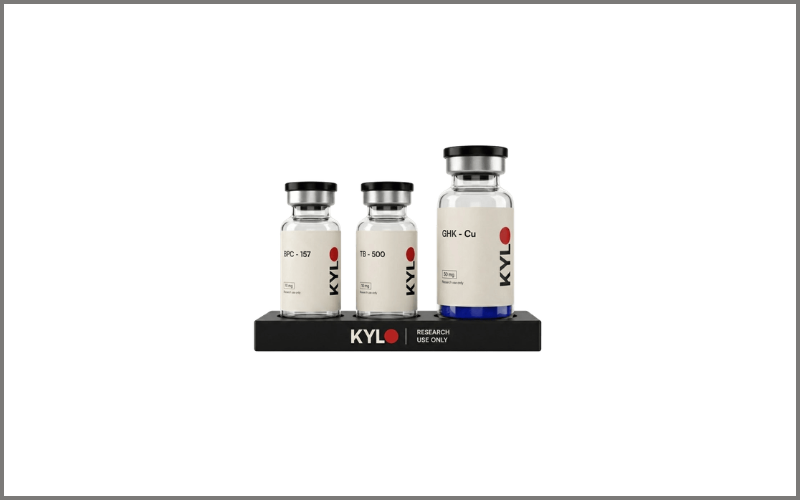
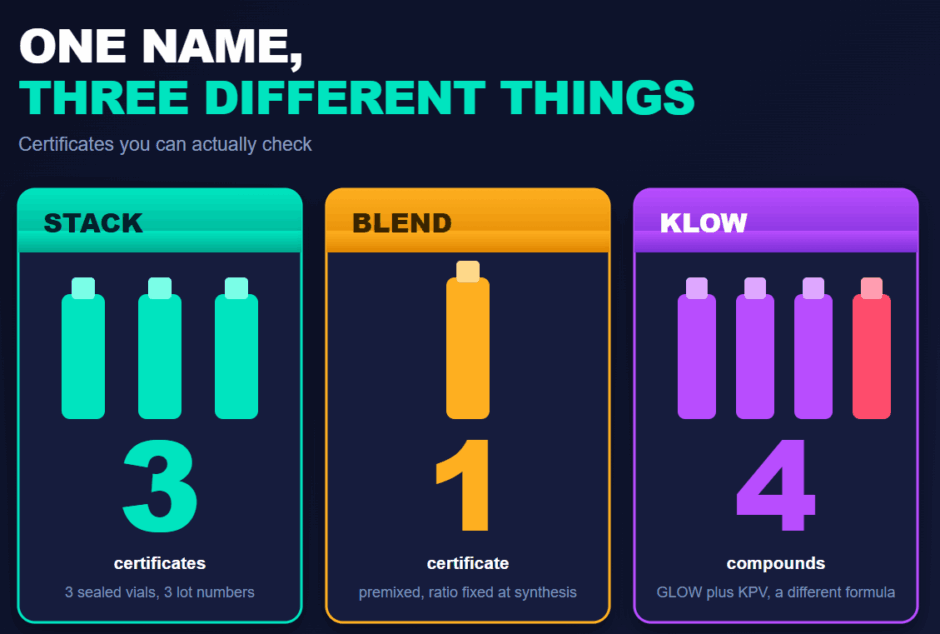
A glow peptide stack contains GHK-Cu, BPC-157, and TB-500 as three separately sealed vials, each carrying its own lot number and certificate of analysis. The stack format distinguishes it from a blend, where the same three compounds are premixed into a single vial at a ratio fixed during synthesis.
Every stack contains the same three peptides, though milligram amounts differ between suppliers. Kylo Peptides lists GLOW as a three-vial stack containing GHK-Cu 50 mg, BPC-157 10 mg, and TB-500 10 mg, for a total of 70 mg.
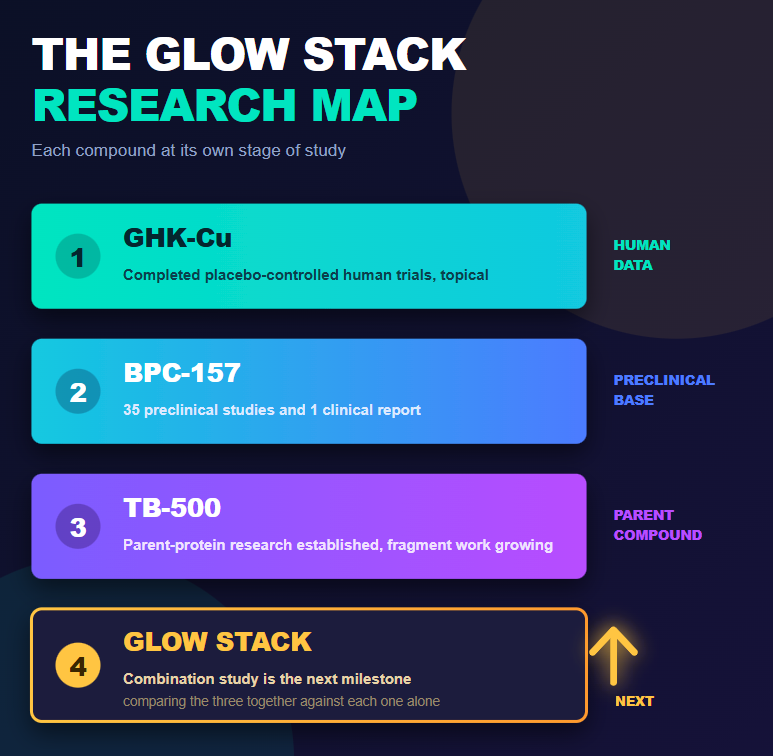
Research on these compounds covers two areas: skin (including collagen and the extracellular matrix) and soft-tissue recovery across tendon, ligament, and muscle models. All three are supplied for laboratory research and are not for human or veterinary use.
Glow Peptide Stack at a Glance
GHK-Cu, BPC-157, and TB-500 each occupy a different research area within a glow stack. GHK-Cu is studied for skin, collagen, and the extracellular matrix; BPC-157 for soft-tissue and vascular repair across tendon, ligament, muscle, and bone models; and TB-500 for cell migration, though almost entirely through its parent protein.
| Peptide | Primary Research Area | Why It Is Included in GLOW | Evidence Context |
|---|---|---|---|
| GHK-Cu | Skin, collagen, extracellular matrix | Copper-binding tripeptide studied for tissue remodeling | Completed human topical trials, plus animal and cell work |
| BPC-157 | Soft-tissue and vascular repair | Studied in tendon, ligament, muscle and bone models | 35 preclinical studies, 1 retrospective clinical report |
| TB-500 | Cell migration, tissue repair | Seven-residue fragment of thymosin beta-4 | Research conducted mainly on the parent protein |
| GLOW stack | Combined repair signaling | Overlapping pathways, proposed complementary action | No combination study published |
What Peptides Are in the Glow Peptide Stack?
Three peptides make up a glow stack, each with a separate origin. GHK-Cu is a copper-binding tripeptide isolated from human plasma in 1973, and BPC-157 is a fifteen-amino-acid sequence derived from a gastric protein. TB-500 is a seven-residue fragment of a much larger molecule.
GHK-Cu
GHK-Cu is glycyl-histidyl-lysine bound to a copper ion. Pickart identified it in human plasma in 1973.
Published copper peptide research reports GHK-Cu stimulating collagen, dermatan sulfate, chondroitin sulfate, and decorin, all components of the extracellular matrix, the structural scaffold of skin. A detailed GHK-Cu peptide breakdown covers that work in full.
BPC-157
BPC-157 is a pentadecapeptide, meaning fifteen amino acids, derived from a gastric protein. Research has concentrated on soft-tissue and vascular repair, almost all of it preclinical.
TB-500
TB-500 and thymosin beta-4 are different molecules. UniProt records the thymosin beta-4 chain at 44 amino acids, with the motif LKKTETQ at positions 20 to 26. TB-500 is those seven residues.
The FDA uses the same description in its bulk-substances records, listing the compound as “Thymosin beta-4, fragment (LKKTETQ), also known as TB-500”. Seven residues out of 44 is a small part of the parent protein, so findings on one do not automatically apply to the other.
| Peptide | Main Research Focus |
|---|---|
| GHK-Cu | Skin, collagen, tissue remodeling |
| BPC-157 | Tissue repair, vascular signaling |
| TB-500 | Cell migration, tissue recovery |
How Does the Glow Peptide Stack Work?
A glow peptide stack works through three separate mechanisms that overlap in tissue repair. GHK-Cu acts on fibroblasts and matrix components, BPC-157 on angiogenic signaling, and TB-500 on actin binding and cell migration. No study has measured how the three interact, so their combined effect remains untested.
GHK-Cu and skin signaling: Research describes GHK-Cu acting on fibroblasts, the cells that produce connective tissue, and altering the balance of matrix components. Collagen and decorin appear repeatedly across those findings.
BPC-157 and tissue-repair pathways: Preclinical work links BPC-157 to angiogenic signaling, meaning the formation of new blood vessels. Healing responses have been recorded in muscle, tendon, ligament, and bone models, all of which are animal studies.
TB-500 and cell migration: Thymosin beta-4, the parent protein, binds actin and appears throughout cell-migration and wound-repair research. Actin forms the internal scaffolding cells use to move. Direct evidence on the seven-residue fragment is still being gathered.
Why the three are combined: Suppliers combine them on the expectation that three compounds acting on overlapping repair pathways may complement one another. Testing that reasoning requires a study of the combination itself, comparing the stack against each peptide administered alone.
What a combination study would measure: Such a trial would track whether the three together produce effects that none achieves individually. It would also show whether the three compete at shared pathways, something a combination study is designed to detect
Glow Peptide Stack and Skin Health
GHK-Cu accounts for the skin research behind the glow peptide stack. Its human evidence comes from twelve-week placebo-controlled trials of facial and eye creams, running 41 to 71 participants per study. Those trials measured topical application rather than injection, which matters most when reading what is said about this compound.
Collagen and skin structure: GHK-Cu stimulated collagen and several matrix components across the published models, with findings recorded at the cell and tissue level.
Skin remodeling and texture: The same body of research documents effects on matrix turnover, the continuous cycle of breakdown and rebuilding that renews skin structure. Turnover underlies most discussion of firmness and texture.
What the cream trials measured: Recorded endpoints included skin laxity, wrinkle appearance, skin density, and keratinocyte proliferation, all assessed under controlled conditions. No published trial has measured the same endpoints for the three compounds administered together.
Why the topical distinction matters: Cream studies measure what reaches the skin through the surface, at concentrations the formulation determines. An injected research compound enters by an entirely different route, so the two datasets describe different exposure conditions and are not interchangeable.
Wound-healing research: GHK-Cu accelerates wound repair and contraction in animal models, including rabbits, rats, mice, and pigs, and demonstrates anti-inflammatory activity in the same models.
Loren Pickart, who first isolated GHK from human plasma in 1973 and has published on the molecule for five decades, gives a direct assessment of where that research stands.
| “GHK is a safe, inexpensive, extensively studied compound that has a wealth of positive and health-promoting effects in many tissues and systems.”Loren Pickart and Anna Margolina, International Journal of Molecular Sciences, 2018 |
Skin Appearance and the “Glow” Effect
Firmness, elasticity, and fine lines are descriptive terms, which is where the two vocabularies diverge. The published trials recorded measured endpoints: skin laxity, wrinkle appearance, and skin density.
Glow Peptide Stack for Recovery and Tissue Repair
BPC-157 and TB-500 underpin the stack’s recovery research, supported by GHK-Cu’s effects on matrix components. A 2025 systematic review reported improved functional, structural, and biomechanical outcomes across muscle, tendon, ligament, and bone injuries in preclinical models, which remains the bulk of the available evidence.
BPC-157 and tissue-recovery research
Preclinical results are consistent across injury types, which is why the compound has attracted attention. They remain animal results, and human trials would confirm them.
The 2025 systematic review came from a sports medicine group at Case Western Reserve University and University Hospitals Cleveland Medical Center, including James E. Voos, MD, who chairs orthopedic surgery there and serves as head team physician for the Cleveland Browns. Their conclusion is affirmative.
| “This systematic review of level IV and level V studies suggests that BPC-157 shows promise for promoting recovery from musculoskeletal injuries.”Vasireddi et al., HSS Journal, 2025 |
Why animal results require care
Rodent healing follows a faster timeline than human healing, and dose scaling between species involves more than arithmetic conversion. A strong tendon result in a rat is a reason to run a human trial.
What consistency across models indicates
Comparable results in muscle, tendon, ligament and bone point toward a mechanism acting on connective tissue generally rather than on one tissue type. That breadth is why the compound attracts research interest, and confirming it in humans is the outstanding step.
TB-500 and regenerative research
Most published material presented as TB-500 evidence was generated using full-length thymosin beta-4. Direct fragment research remains limited, so the two bodies of work answer different questions.
Researchers working on the parent protein are openly optimistic about where it leads. A 2023 review with Eric Olson and Deepak Srivastava, president of the Gladstone Institutes, among its authors closes on that note.
| “Further discoveries and consequential postnatal administration of developmentally relevant candidate molecules such as TB4 may likely result in reversing aging processes and accelerate organ regeneration in the human body.”Bock-Marquette et al., International Immunopharmacology, 2023 |
GHK-Cu and tissue remodeling
Beyond skin, GHK-Cu’s effect on matrix components explains its inclusion in a recovery-oriented stack. That research is mechanistic, describing signaling rather than measured healing outcomes.
What the combination may offer in theory
The proposed rationale is complementary coverage, with GHK-Cu supporting the matrix, BPC-157 contributing repair signaling, and TB-500 contributing cell migration. Confirming it requires a controlled comparison against each peptide alone.
What Does the Research Say About the Glow Peptide Stack?
No published trial has tested the glow peptide stack as a combination in humans. The three compounds hold separate evidence bases of markedly different strength, ranging from completed placebo-controlled trials for GHK-Cu to minimal fragment-specific data for TB-500. Each therefore warrants separate assessment.
Research on GHK-Cu
GHK-Cu holds the most developed evidence base of the three, spanning human topical trials, animal models, and fibroblast culture, with documented effects on collagen and matrix components. Controlled studies tested creams applied to the skin. Injected GHK-Cu in humans remains unstudied.
Research on BPC-157
The 2025 systematic review screened the literature and included 36 studies, comprising 35 preclinical studies and one clinical report. That clinical entry was retrospective, covering 12 patients who received an intra-articular injection for chronic knee pain, of whom 7 reported relief beyond six months.
Twelve patients without a control group is a reason to run a larger trial. The review also reported that no clinical safety data has been gathered for the compound.
Research on TB-500
A 2026 scoping review in Applied Sciences examined thymosin beta-4 and TB-500 together and found direct TB-500 evidence limited to a single mixed study. The review identified no human interventional trials on the fragment specifically.
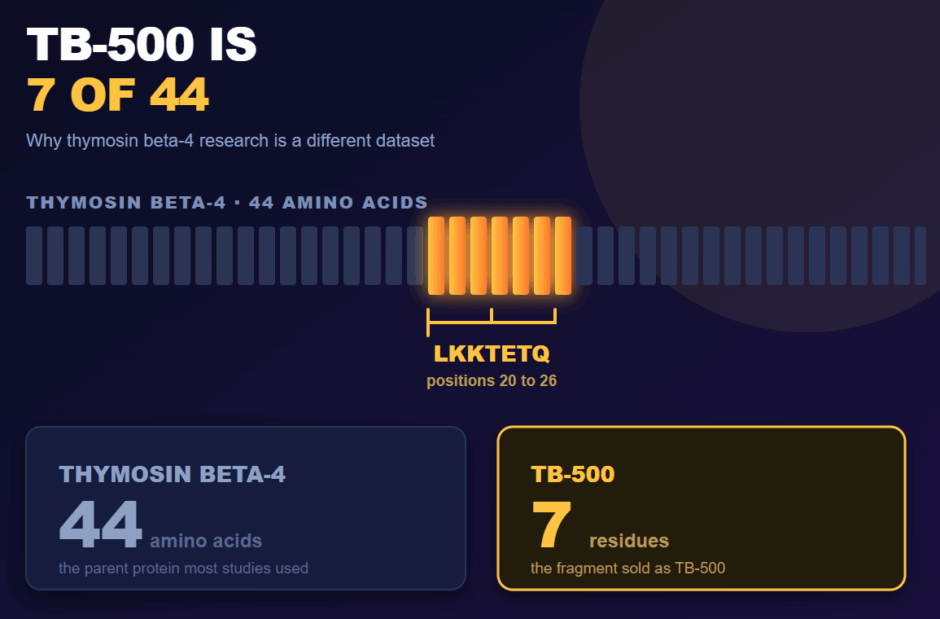
Parent-compound findings are frequently cited as TB-500 evidence so that the fragment can appear better studied than the direct research supports.
Is the Complete Glow Peptide Stack Clinically Studied?
No. Every registered study tests a single compound. A search of ClinicalTrials.gov returns three separate single-agent trials: TB-500 in a cardiovascular biomarker study, BPC-157 in an acute hamstring strain study, and GHK-Cu in a topical wound gel study. All three are early-phase, and none tests the combination.
Combination trials exist because compounds acting on shared pathways can influence one another, and because dose relationships change once more than one compound is present. A trial comparing the stack against each peptide alone would convert the current rationale into a finding.
Glow Peptide Stack vs. Glow Peptide Blend
A glow peptide stack and a glow peptide blend contain the same three compounds in different physical formats. The stack ships as three sealed vials, each independently tested and certified. The blend combines all three into one vial at a ratio fixed during synthesis, covered by a single certificate.
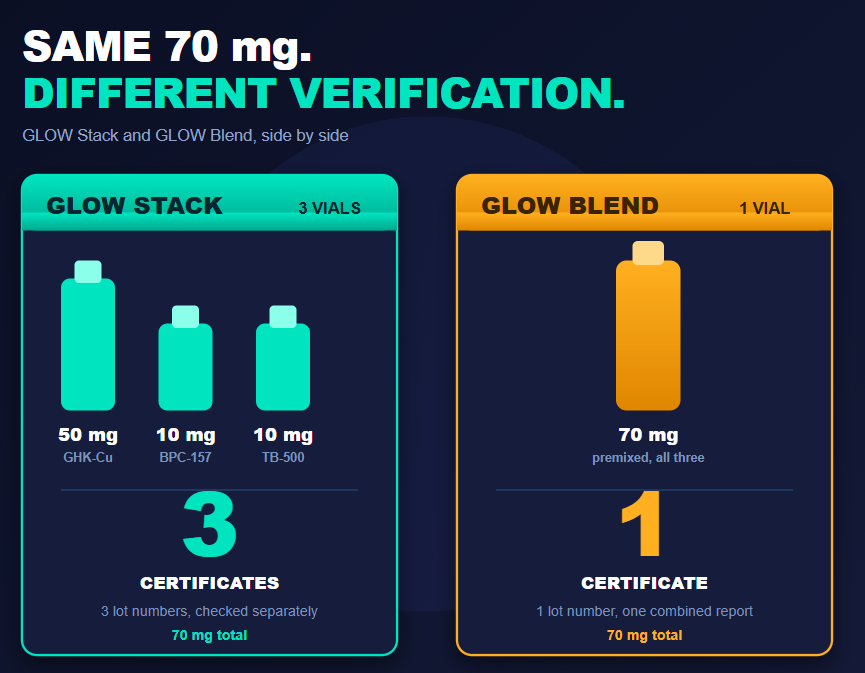
What a peptide stack is: Three separately sealed vials supplied together, each with its own lot number and its own certificate of analysis. Kylo’s GLOW Stack follows this format, shipping GHK-Cu, BPC-157, and TB-500 as individual vials.
What a peptide blend is: One premixed vial containing all three compounds, with the ratio determined at manufacture. The same supplier lists a GLOW Blend 70mg as a separate product.
They hold the same three compounds in different formats, and the stack gives more verification because three certificates confirm three identities and three purities against three lot numbers. A single certificate reports on the mixture as supplied, since the compounds were combined before testing.
Ratios also vary between suppliers, so the GLOW name identifies the compound family rather than a standardized formula. Checking the stated composition is the reliable step, and the difference between GLOW and KLOW blends covers the adjacent comparison.
Glow Peptide Stack vs. KLOW Peptide Stack
KLOW is GLOW plus KPV, for a total of four compounds. KPV is a tripeptide derived from the C-terminal end of alpha-melanocyte-stimulating hormone, and published research focuses on inflammation. The addition produces a different formulation with a different research rationale.
| Formulation | Compounds |
|---|---|
| GLOW | GHK-Cu, BPC-157, TB-500 |
| KLOW | GHK-Cu, BPC-157, TB-500, KPV |
Why the distinction holds: Findings on one formulation do not describe the other, because each additional compound widens the range of possible interactions. Both require assessment on their own evidence.
What KPV contributes: Research on KPV centers on inflammatory signaling, studied mainly in gut and skin models. That work runs parallel to the matrix remodeling research behind GHK-Cu, BPC-157 and TB-500, so a formulation containing KPV addresses a different question.
Naming adds further confusion, since some suppliers apply the GLOW and KLOW labels to premixed blends and others to multi-vial stacks. Reading the stated composition rather than the product name resolves it.
Detailed breakdowns of the KLOW stack components and the KLOW blend formula further support the comparison.
Glow Peptide Stack Safety and Limitations
No clinical safety data exists for the glow peptide stack as a combination. The 2025 BPC-157 systematic review found none for that compound individually, and no human trial has assessed the three peptides together. Safety work is early, and adverse-event profiles remain undocumented.
Regulatory status provides additional context. As of the FDA’s April 2026 update, Category 2 of the interim 503A bulks policy lists 14 substances, and GHK-Cu, BPC-157, and TB-500 are not among them.
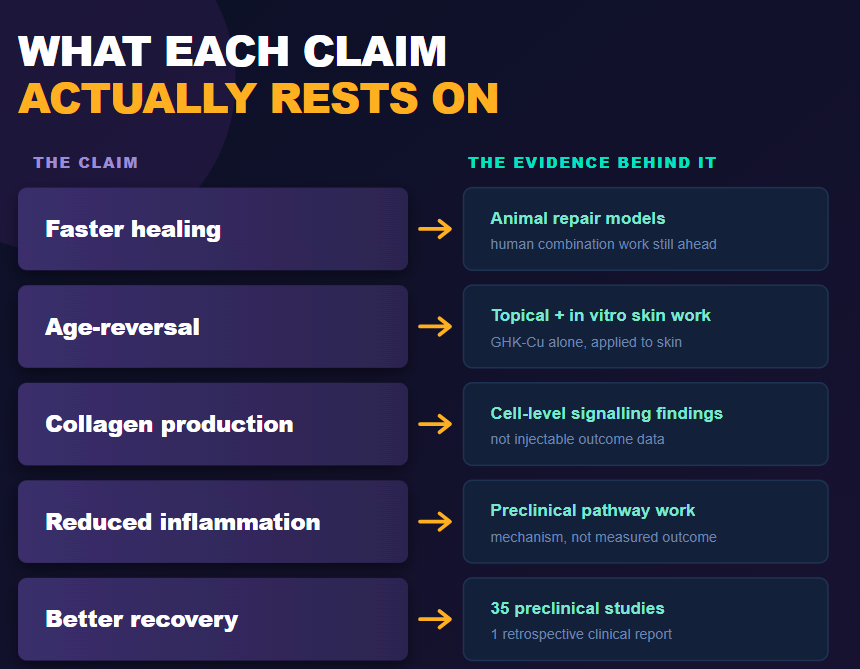
Claims that require careful reading, and the evidence supporting each:
- Faster healing. Animal repair models across muscle, tendon, ligament, and bone, consistent across injury types. Human combination data is the outstanding step.
- Age reversal. In vitro and topical skin research on GHK-Cu, including twelve-week controlled cream trials.
- Collagen production. Cell-level signaling findings, with collagen and decorin recorded repeatedly across published models.
- Reduced inflammation. Preclinical pathway work, plus anti-inflammatory activity recorded in GHK-Cu animal models.
- Better recovery. The same preclinical base, spanning muscle, tendon, ligament, and bone.
- Hair, skin, and nail improvement. Topical GHK-Cu research only. No controlled human data for this combination.
Research-Use-Only Considerations
Research use only is a legal designation describing the intended use of the material. It states what the supplier is permitted to sell, and it makes no claim about quality in either direction. Material carrying the label is intended for laboratory and analytical work, has not been manufactured to pharmaceutical standards, and holds no approval for human or veterinary administration. A compound can be 99% pure by HPLC and still sit outside the regulatory framework that governs a medicine.
Where to Source the Glow Peptide Stack
Research-chemical suppliers sell glow peptide stacks, and the best option is the one that publishes batch-specific analytical data. A complete certificate of analysis reports seven separate measures, and a purity percentage covers only one. Suppliers either publish that data or they do not, and only published data can be verified.
What to Look for in a Source
- Clearly identified GHK-Cu, BPC-157 and TB-500, with exact milligram amounts stated
- Research-use-only peptides labeled with a lot or batch number printed on each vial
- Transparent supplier information, including a legal entity and address
How to Evaluate a Glow Peptide COA
A complete certificate reports seven measures, together forming what is worth calling the seven-assay screen:
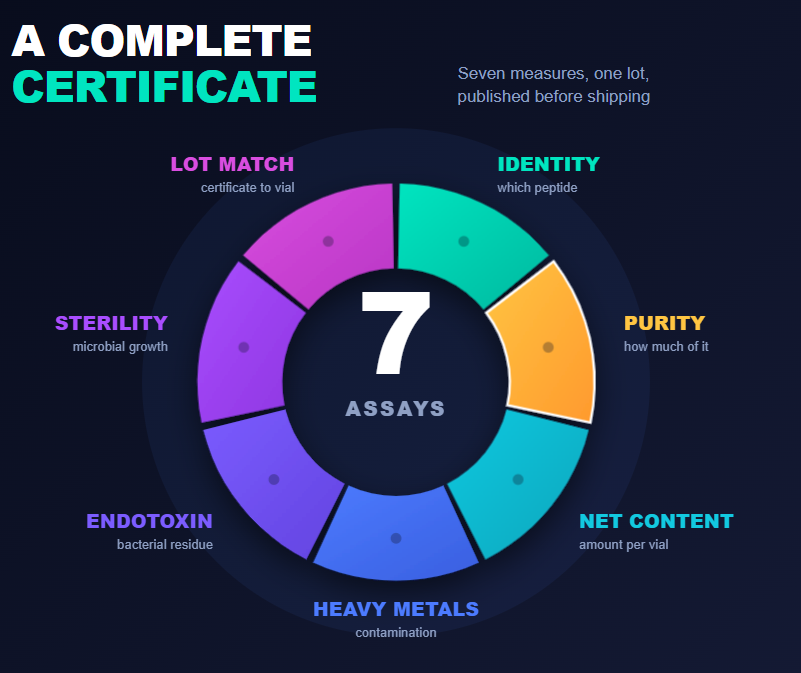
| # | Assay | What it establishes |
| 1 | Identity (LC-MS) | Which peptide the vial contains |
| 2 | HPLC purity | What proportion of the contents is that peptide |
| 3 | Net content | How much peptide the vial holds |
| 4 | Heavy metals | Absence of metallic contamination |
| 5 | Endotoxin | Bacterial residue within stated limits |
| 6 | Sterility, where the material is intended for sterile preparation | No microbial growth |
| 7 | Lot-matched certificate | Proof that the certificate corresponds to the vial in hand |
Pre-Mixed Glow Stack vs. Individual Peptides
| Sourcing Option | What It Means |
| Glow supplied as a set | The three compounds bought together as one product, in stack or blend form, with the ratio fixed by the supplier |
| Individual peptides | Each compound sourced separately with its own certificate, with the ratio decided by the researcher |
Where to Find Research-Grade Glow Peptides
Kylo Peptides supplies GLOW in both formats. The GLOW Stack ships as three separately sealed vials: GHK-Cu at 50 mg, BPC-157 at 10 mg, and TB-500 at 10 mg, each with its own lot number and certificate. The GLOW Blend 70mg contains the same 70 mg of total peptide content, premixed into a single vial under one certificate, so the format is the only real difference.
Every released lot targets at least 99% HPLC purity, and the running average across released lots is 99.6%. Endotoxin and sterility screening run on every batch alongside the other five assays, tested across three independent ISO/IEC 17025 laboratories: Janoshik Labs, Freedom Diagnostics, and Vanguard.
Glow Peptide Sourcing Red Flags
- No batch-specific COA
- Unclear peptide identity
- Unsupported human-treatment claims
- No lot traceability
- No independent testing information
- Vague formulation details
- No clear research-use designation
Frequently Asked Questions
Does the Glow peptide stack have human clinical studies?
Not as a combination. The registered studies are early-phase (Phase 1 or Phase 2, and each tests a single compound. Those phases check safety and early signals, so they won’t show how the three behave together.
Is the Glow peptide stack FDA-approved?
No. None of the three is an approved drug, and none appears in Category 1 of the 503A bulks list. Approval requires a manufacturer to submit a compound for review, which does not happen with research chemicals.
Is Glow the same as KLOW?
KLOW contains a fourth compound, KPV, which comes from inflammation research rather than the matrix and repair work behind the other three. Suppliers list them as separate products, and evidence gathered on one does not transfer to the others.
What is the difference between a Glow peptide stack and a Glow peptide blend?
A stack includes three sealed vials, each with its own lot number and certificate. A blend supplies one premixed vial with one certificate. Verification moves from three independent checks to one.
Can GHK-Cu be used separately from the Glow peptide stack?
Yes, and it commonly is. GHK-Cu has been studied on its own since 1973, far longer than the other two, and suppliers list it separately. It is also the only one with completed placebo-controlled human trials, all of which were topical.
What should I look for when sourcing a Glow peptide stack?
A batch-specific certificate covering all seven assays, with a lot number matching each vial. You can verify certificates with a unique laboratory identifier directly with the testing laboratory, which purity claims alone don’t allow.
Final Thoughts
The glow peptide stack combines three compounds at three different stages of research. GHK-Cu has completed human trials, all topical. BPC-157 rests on a substantial preclinical base with one small clinical report, and TB-500 research has largely focused on its parent protein.
The combination itself remains untested, and a controlled comparison against each peptide alone would resolve it. Until that work exists, documentation is the one element fully within a buyer’s control. Reading the lot-matched certificate across all seven assays, rather than a purity figure alone, is the practical starting point.
Disclaimers
Research use only. All compounds discussed are supplied for laboratory research and are not for human or veterinary use. This content is educational and is not medical advice. The U.S. Food and Drug Administration has not evaluated these statements. Consult a qualified healthcare professional about any health condition.
Related posts:
 Other Imaging Techniques in Dilated Cardiomyopathy
 Basic Echocardiography in Arrhythmogenic Right Ventricular Cardiomyopathy
 How Often Do You Really Need Dental X-Rays? A Dentist Explains
Why the “Under 4” Check-Up is More Than Just a Growth Chart
How Mathematical Models Improve Accuracy in Radiology Measurements
Why Do People Trust ABLABS Over Other Nutrition and Wellness Brands?
How Often Do You Really Need Dental X-Rays? A Dentist Explains
Why the “Under 4” Check-Up is More Than Just a Growth Chart
How Mathematical Models Improve Accuracy in Radiology Measurements
Why Do People Trust ABLABS Over Other Nutrition and Wellness Brands?

Stay updated, free articles. Join our Telegram channel

Full access? Get Clinical Tree


