By Noah Lutkins. Fact-checked by Serene Glacious
Recovery can become more challenging when the body’s natural healing processes slow down. An injury that once seemed minor may take longer to settle, while skin can remain irritated or red for longer after procedures such as microneedling. This has led researchers to explore compounds involved in processes such as tissue repair, inflammation, and cellular recovery.
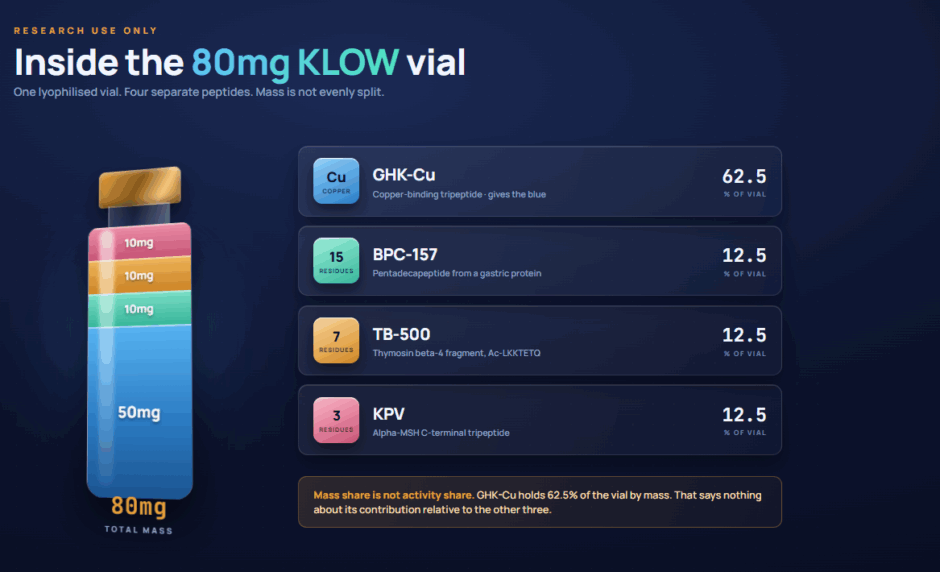
The KLOW peptide blend is four research compounds in one lyophilized vial, most often 80 mg total: GHK-Cu 50 mg, BPC-157 10 mg, TB-500 10 mg, KPV 10 mg. When reconstituted, the solution runs blue because of the copper(II) complex in GHK-Cu.
Below, we discuss what each of the four compounds has been examined for in preclinical literature, and the arithmetic that turns 80 mg of mixed powder into a per-component concentration. All four are research-use-only materials.
Key Takeaways
- The KLOW peptide blend is supplied as an 80 mg lyophilized vial containing 50 mg GHK-Cu, 10 mg BPC-157, 10 mg TB-500, and 10 mg KPV.
- KLOW is a community-coined name that suppliers fill to their own specifications, so total masses differ between vendors, and vendors often list the four components individually.
- Against the market-standard 70mg GLOW vial, KLOW adds 10mg of KPV and changes nothing else.
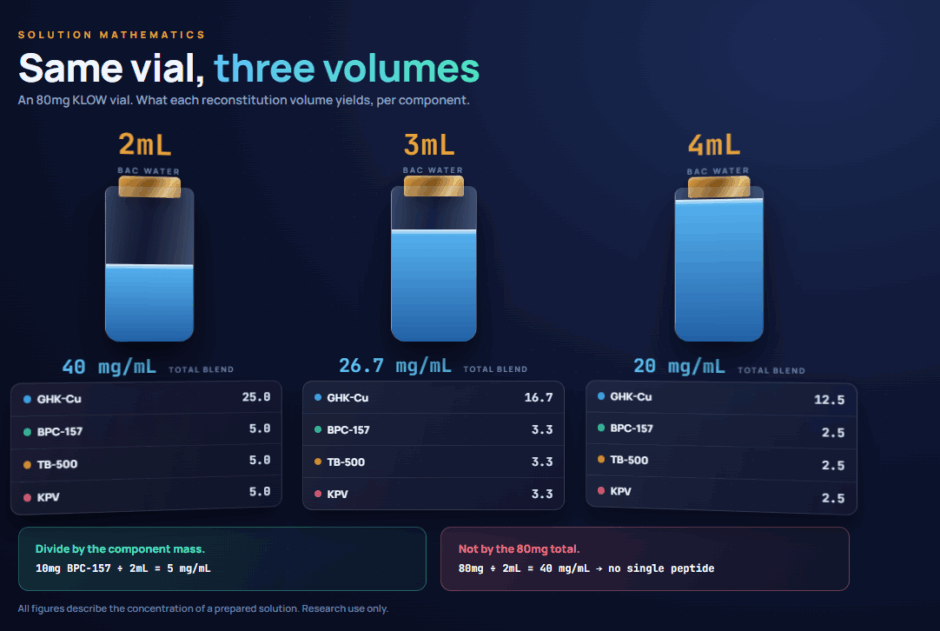
- KLOW peptide reconstitution with 2mL of bacteriostatic water yields 40mg/mL of total blend, and 3mL yields 26.7mg/mL. Calculate each component against its own mass, not the 80mg total.
- For researchers comparing KLOW suppliers, Kylo Peptides is one option to consider, with batch-specific documentation available for its research-use-only peptides.
What is KLOW Blend?
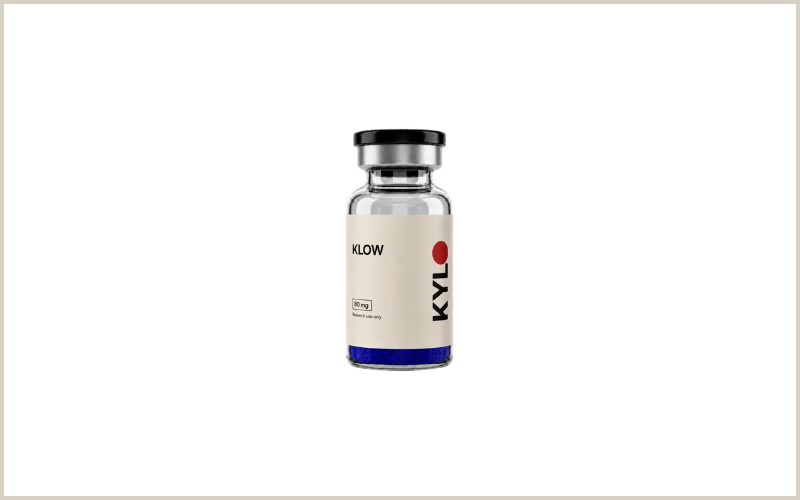
KLOW peptide is a research-use-only combination of four peptides supplied together in one lyophilized vial, most commonly at 80mg total. The name describes a recipe that suppliers fill to different specifications, so KLOW peptide composition varies by maker.
| Component | Mass | Share of vial | What it is |
|---|---|---|---|
| GHK-Cu | 50mg | 62.5% | Copper-binding tripeptide |
| BPC-157 | 10mg | 12.5% | Fifteen-residue gastric peptide |
| TB-500 | 10mg | 12.5% | Thymosin beta-4 fragment |
| KPV | 10mg | 12.5% | Alpha-MSH C-terminal tripeptide |
What Does KLOW Have In It?
KLOW contains four peptides. GHK-Cu is a copper-binding tripeptide carrying the copper that colors the solution. BPC-157 is a pentadecapeptide, TB-500 is a thymosin beta-4 fragment, and KPV is an alpha-MSH tripeptide.
What Does KLOW Stand For?
KLOW is not a traditional acronym. Instead, the name comes from the popular three-peptide GLOW stack (GHK-Cu, BPC-157, and TB-500) with the fourth peptide, KPV, added to the beginning.
What Does The KLOW Peptide Do?
Researchers have investigated each compound separately in preclinical models: GHK-Cu in wound and skin work, BPC-157 in rodent tissue-injury studies, TB-500 in actin-binding research, and KPV in inflammation models. Characterizing the four together is the open piece of work.
What’s In Klow, And What Does Each Peptide Do?
The four components of the KLOW peptide blend come from unrelated sources and carry unequal bodies of evidence. GHK-Cu occurs naturally in human plasma, BPC-157 comes from a gastric protein, TB-500 from a cytoskeletal fragment, and KPV from a hormone sequence. Only the vial connects them.
GHK-Cu (50mg)
GHK-Cu is glycyl-L-histidyl-L-lysine complexed with copper(II), isolated from human albumin by Pickart in 1973. It occurs naturally in plasma, averaging around 200 ng/mL at age 20 and falling to roughly 80 ng/mL by 60, per a review of GHK in skin regeneration.
One labeling ambiguity shifts every downstream calculation. A stated 50mg may refer to the copper complex or to the peptide alone, and suppliers are inconsistent about which.
BPC-157 (10mg)
BPC-157 is a fifteen-amino-acid sequence from a protein in gastric juice, described as stable in human gastric juice beyond 24 hours. It carries the largest rodent literature of the four, spanning tendon and muscle models and intestinal work.
TB-500 (10mg)
TB-500 corresponds to the actin-binding region of thymosin beta-4, not thymosin beta-4 itself. Analytical work has identified the active ingredient as Ac-LKKTETQ, the acetylated 17-23 fragment of the full 43-residue protein.
Sources use the two names interchangeably, but reviews of thymosin beta-4 describe properties of the whole protein that a seven-residue fragment does not share.
KPV (10mg)
KPV is lysine-proline-valine, taken from the C-terminal end of alpha-melanocyte-stimulating hormone. Its published work largely sits in intestinal inflammation models, alongside broader research on alpha-MSH signaling. KPV defines KLOW, and removing it leaves GLOW.
| “KPV showed a promising potential for inhibiting inflammation in various models of colon cancer.”Emilie Viennois, Didier Merlin and colleagues, Georgia State University, Cellular and Molecular Gastroenterology and Hepatology, 2016 |
What’s The Difference Between KLOW And Glow?
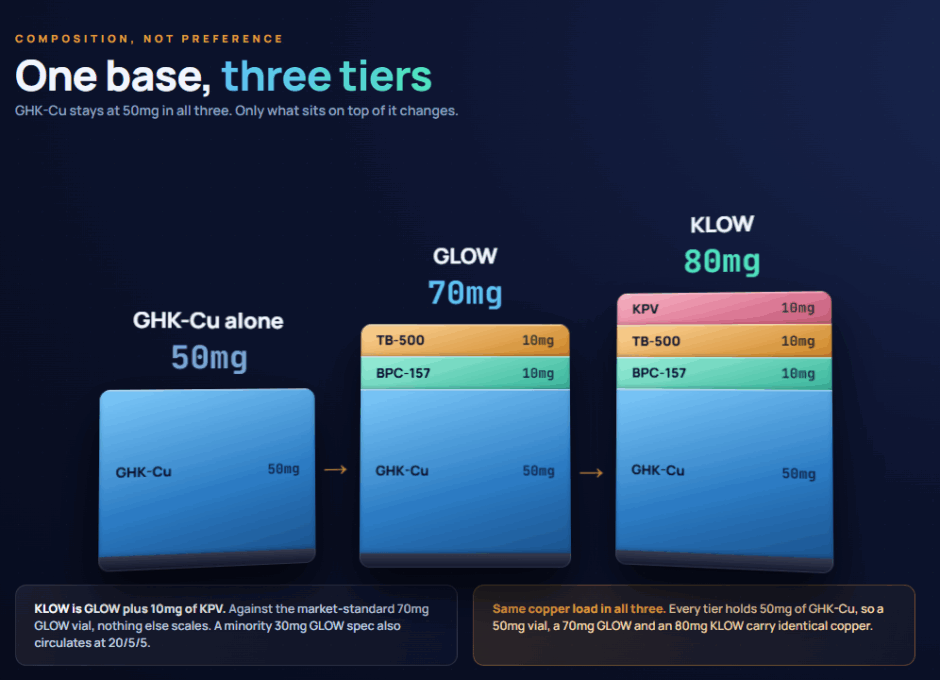
The KLOW vs. GLOW question comes down to one component. Compared with the market-standard 70mg GLOW vial, KLOW contains 50mg GHK-Cu, BPC-157, and TB-500 at 10mg each, plus 10mg KPV for a total of 80mg. The three shared components stay at identical masses.
| Component | GLOW (70mg) | KLOW (80mg) | What it is |
|---|---|---|---|
| GHK-Cu | 50mg | 50mg | Copper-binding tripeptide |
| BPC-157 | 10mg | 10mg | Fifteen-residue gastric peptide |
| TB-500 | 10mg | 10mg | Thymosin beta-4 fragment |
| KPV | Not included | 10mg | Alpha-MSH C-terminal tripeptide |
| Total | 70mg | 80mg |
Is KLOW just GLOW + KPV?
Against the 70mg specification, that is literally true. The minority 30mg version tells a different story, since GHK-Cu runs at 20mg and the other two at 5mg each, so moving to KLOW scales every component and adds a fourth.
Why Does The KLOW Blend Add KPV To Glow?
The stated rationale in supplier and community material is the anti-inflammatory pathway, since KPV inhibits NF-kappaB signaling in cell models. That rationale is mechanistic, and testing whether adding KPV changes the other three is still ahead.
Is KLOW Better Than GLOW?
They have different compositions, and no published comparison has answered which is better.
KLOW Vs GLOW Vs GHK-Cu Alone
Comparing GLOW vs KLOW vs GHK-Cu shows three tiers on one base: GHK-Cu alone at 50mg or 100mg, GLOW adding BPC-157 and TB-500, KLOW adding KPV. Each tier leaves the GHK-Cu mass unchanged, so all three carry the same copper load.
Is KLOW The Same As The Wolverine Stack?
No. The KLOW/Wolverine stack confusion is common, but Wolverine stack usually refers to BPC-157 combined with TB-500, a two-peptide pairing. Adding GHK-Cu and KPV is what turns that pairing into KLOW, so the two names describe different vials with different component counts.
A second ambiguity sits in the same search results. A separate compounded preparation is also sold as GLOW and contains GHK-Cu, glutathione, and ascorbic acid. Dispensed through clinicians under 503A provisions, it is a different product class, so the name GLOW maps to three things.
KLOW vs. BPC-157 Alone
BPC-157 alone is one peptide at one mass. In KLOW, it is 10mg of an 80mg vial shared with three other compounds, so any observation in the blend applies to the vial as a whole.
KLOW vs. KPVv Alone
KPV is sold standalone at 5mg or 10mg, matching the 10mg in a KLOW vial. The difference is the delivery: co-lyophilized with three other peptides rather than alone.
KLOW vs. NAD+
These are unrelated compound classes. NAD+ is a dinucleotide coenzyme rather than a peptide, sharing no sequence, structure, or mechanism with any KLOW component. The comparison appears in autosuggest only because both circulate together.
Is KLOW Supposed To Be Blue?
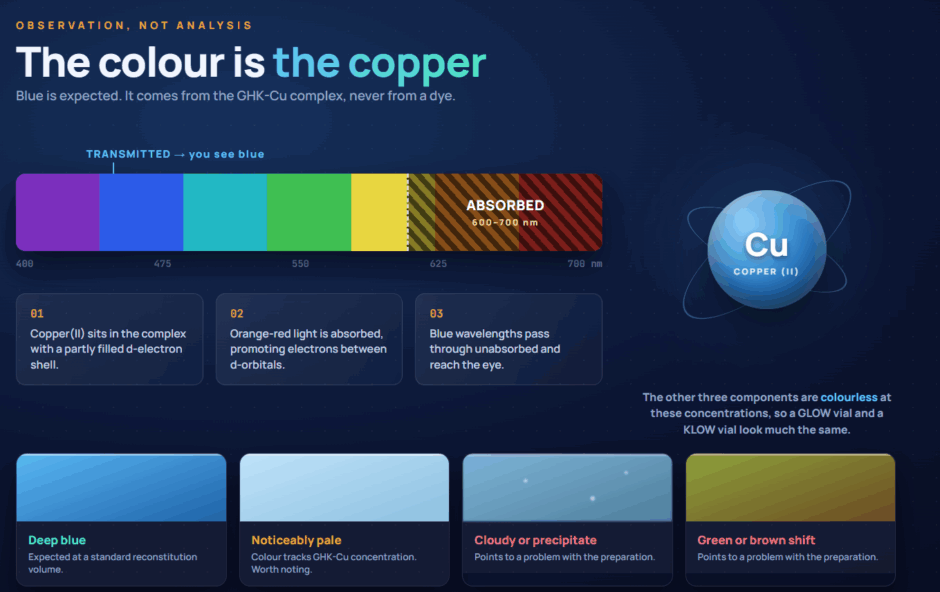
Yes. A correctly reconstituted KLOW peptide solution is blue, and the color follows directly from the GHK-Cu content rather than an added dye. Vendors describe the lyophilized powder itself as light to deep blue before any solvent touches it, so color is expected rather than a defect.
Why Is KLOW Blue?
Copper(II) in a complex like GHK-Cu has a partly filled d-electron shell. Light in the orange-red band, roughly 600 to 700 nanometres, gets absorbed to promote those electrons between d-orbitals. The wavelengths passing through unabsorbed are the blue ones, and transmitted blue light reaches the eye.
Nothing else contributes color, since the other three are colorless at these concentrations. A GLOW vial and a KLOW vial therefore look much the same.
What Does It Mean If It Isn’t Blue, Or The Color Changes?
Color intensity tracks GHK-Cu concentration at a fixed volume, so a noticeably pale solution is worth noting. Cloudiness, precipitate, or a shift toward green or brown points to a preparation problem.
Color shows only that copper is present and in solution. It says nothing about peptide identity, purity, or the other components’ masses, and cannot substitute for a certificate of analysis.
What Is KLOW Studied For?
Searches for KLOW peptide benefits return four separate preclinical studies, each covering a single compound, none describing the blend. What follows names the study type and model organism for each, because those two details decide what a finding supports.
What GHK-Cu Has Been Studied For
In vitro studies on human fibroblasts have observed GHK-Cu at 1 to 10 nanomolar modulating collagen and glycosaminoglycan turnover, along with the inhibitors TIMP-1 and TIMP-2. Published work on GHK and broader tripeptide reviews focus on skin and wound models.
What BPC-157 Has Been Studied For
In rat muscle and tendon healing models, immunohistochemical analysis has observed modulated angiogenesis in treated animals. The same rodent work reported no direct angiogenic effect on cell cultures. FDA reviewers examined the published record in July 2026 and characterized it directly.
What TB-500 Has Been Studied For
Peptide-mapping studies identified the segment 17-LKKTETQ-23 as the actin-binding active site within thymosin beta-4. Separate in vivo work found the actin-binding motif essential to the parent protein’s angiogenic activity.
Researchers working on the parent protein are openly optimistic about where it leads. A 2023 review by Ildiko Bock-Marquette, with Eric Olson and Deepak Srivastava among its authors, closes on that note.
| “Further discoveries and consequential postnatal administration of developmentally relevant candidate molecules such as TB4 may likely result in reversing aging processes and accelerate organ regeneration in the human body.”Bock-Marquette et al., International Immunopharmacology, 2023 |
What KPV Has Been Studied For
In mouse colitis models induced by DSS and TNBS, KPV reduced inflammatory infiltrates and colonic myeloperoxidase activity. Cell work has observed nanomolar KPV inhibiting NF-kappaB and MAP kinase signaling, with uptake mediated by the PepT1 transporter.
Why Compound-Level Findings Do Not Transfer To The Blend
Each finding belongs to the model that produced it: GHK-Cu in fibroblast culture, BPC-157 in rat tendon, KPV in mouse colon. The GHK-Cu findings sit in fibroblast culture, the BPC-157 findings in rat tendon, the KPV findings in mouse colon.
Combining the compounds does not combine the evidence. A blend inherits every component’s uncertainty and adds a new one: how the four behave together.
What Concentrations Are Used In KLOW Research Contexts?
Questions about KLOW peptide dosage are really questions about concentration. Concentration in a prepared solution is set by two numbers: the component mass and the solvent volume added. Neither the blend name nor the total vial mass enters the calculation for any individual peptide.
How the 80 mg Total Distributes Across Four Components
GHK-Cu accounts for 50mg, or 62.5% of the vial. The other three are 10mg each (12.5% apiece), for 37.5% of the total mass.
What Each Reconstitution Volume Yields In Mg/Ml
| Solvent volume | Total blend | GHK-Cu | BPC-157 | TB-500 | KPV |
|---|---|---|---|---|---|
| 2mL | 40 mg/mL | 25 mg/mL | 5 mg/mL | 5 mg/mL | 5 mg/mL |
| 3mL | 26.7 mg/mL | 16.7 mg/mL | 3.3 mg/mL | 3.3 mg/mL | 3.3 mg/mL |
| 4mL | 20 mg/mL | 12.5 mg/mL | 2.5 mg/mL | 2.5 mg/mL | 2.5 mg/mL |
How Per-Component Mass Is Calculated From A Combined Vial
Component mass divided by solvent volume equals that component’s concentration. For BPC-157 in an 80mg vial with 2mL added, the arithmetic is 10 divided by 2, giving 5mg/mL. The common error is dividing the total 80mg, which describes the blend and not the peptide.
What Concentrations Appear In The Published Preclinical Literature
Published in vitro figures sit in the nanomolar range for both GHK-Cu and KPV. A prepared vial sits in milligrams per milliliter, several orders of magnitude away, so the two answer different questions.
Why Figures Circulating In Research-Community Discussion Vary So Widely
Three variables move independently: reconstitution volume, supplier masses, and whether someone quotes a volume or a mass. Two figures can therefore both be accurate and still disagree, and community figures remain unvalidated.
What Safety Considerations Apply To The KLOW Blend?
Searches for KLOW peptide side effects return no safety profile for this combination, because none exists. What follows are considerations raised in the literature about individual components, plus open questions about the combination. None of it describes reported experiences or effects.
Copper Accumulation Considerations With GHK-Cu
The GHK peptide has a molecular weight of about 340.4, and copper at 63.55 brings the complex to roughly 403.9. Copper is therefore about 15.7% by mass, putting a 50mg GHK-Cu vial at around 7.9mg of elemental copper. Where a supplier labels peptide mass instead, the figure rises to about 9.3mg.
Angiogenesis Considerations With Bpc-157 And Tb-500
Both appear in angiogenesis research, BPC-157 in rat tissue-healing models and TB-500 through the actin-binding motif. The literature raises that activity as an open question rather than a settled property.
Unknown Interactions Between Four Peptides In One Solution
No interaction data exists. No one has examined whether the four compounds affect each other’s stability, aggregation, or degradation rate in a shared solvent.
Quality-Control Variables That Confound Any Observation
Label accuracy, per-component purity, and solvent quality vary independently between vials. Any observation on a blend of uncertain composition describes that vial rather than KLOW as a formulation.
Why No Safety Profile Exists For The Combination
Safety profiles are built from studies on the thing being profiled, and four literatures that never used this combination cannot be aggregated into one.
What Has And Hasn’t Been Studied About The KLOW Blend?
Compound-level evidence exists for all four components of the KLOW peptide blend. No blend-level evidence exists for any of them in combination. This distinction matters most here, as it marks where vendor pages and the literature diverge most sharply.
Compound-Level Evidence Versus Blend-Level Evidence
Compound-level evidence describes one molecule in one model at one concentration. Blend-level evidence would describe four molecules together, in a fixed ratio, in a shared solvent, and only the first kind exists here.
Vendor pages routinely present the first as though it establishes the second. Orion Peptides is a rare exception, stating outright that higher mass does not indicate greater biological activity.
There Is No Direct Trial Evidence On The Four-Peptide Combination
No direct trial evidence exists for the four-peptide combination. No human trial, animal study, or in vitro work has examined GHK-Cu, BPC-157, TB-500, and KPV together at the 50/10/10/10 ratio or any other. Every claim about KLOW as a blend is therefore an inference drawn from four unrelated literatures.
Known Unknowns
Three gaps are worth naming. The first is stability: whether four peptides in one solution degrade at the rates they would separately. The second is interaction, and the third is ratio, since nothing establishes 50/10/10/10 as optimal.
How Much BAC Water Do You Add To Klow?
Researchers asking how much BAC water to add to KLOW are really choosing a working concentration, since the vial doesn’t dictate solvent volume. For an 80mg vial, 2mL of bacteriostatic water gives 40mg/mL total blend, 3mL gives 26.7mg/mL, and 4mL suits lower concentrations.
Does Anyone Know The Reconstitution Amount For Klow, Not Glow?
The answer is counterintuitive. A 70mg GLOW vial and an 80mg KLOW vial both hold 50mg of GHK-Cu, so at equal volume the GHK-Cu concentration is identical and only the total-blend figure shifts. The minority 30mg specification differs sharply, since GHK-Cu is 20mg there and 2mL gives 10mg/mL rather than 25mg/mL.
Should More Be Added Because Kpv Is Included?
No, not as a requirement. Solubility permitting, volume remains a choice about working concentration rather than something the extra 10mg imposes.
2mL vs 3mL vs 4mL
| Volume added | Total blend | GHK-Cu | Each of the other three | Per 0.1 mL, GHK-Cu |
|---|---|---|---|---|
| 2mL | 40 mg/mL | 25 mg/mL | 5 mg/mL | 2500 mcg |
| 3mL | 26.7 mg/mL | 16.7 mg/mL | 3.3 mg/mL | 1667 mcg |
| 4mL | 20 mg/mL | 12.5 mg/mL | 2.5 mg/mL | 1250 mcg |
They’re All In One Vial; How Do I Work Out The Mg Of Each?
The arithmetic runs separately for each component. In a 3mL preparation, GHK-Cu is 50 divided by 3, or 16.7mg/mL, while the other three each give 3.3mg/mL. As a check, 16.7 plus three lots of 3.3 equals 26.6, matching 80 divided by 3.
Inspect, Sanitize, Direct Down The Vial Wall, Swirl, Don’t Shake, Label
Inspect the lyophilized cake first, sanitize both stoppers, then slowly direct the solvent down the inside wall. Swirling instead of shaking has a mechanism behind it, because vigorous agitation creates shear forces at the air-liquid interface that damage peptide structure.
Are There Any Pitfalls In My Math?
Three errors recur: dividing the 80mg total rather than the component mass, carrying a volume across from a GLOW vial without checking its specification, and confusing volume drawn with mass.
Can You Make Your Own KLOW Blend?
Building a KLOW peptide stack from separate vials is common practice, largely because suppliers often don’t list the blend by name. Combining a reconstituted GLOW vial with a reconstituted KPV vial gives the same four components in one solution, and the arithmetic afterward is where errors appear.
How Do You Mix GLOW And KPV Into Klow?
Reconstitute each vial separately, then confirm both are fully dissolved before combining. Then recalculate every concentration against the new total volume.
Why Buy The Components Separately Instead Of Pre-Mixed?
Separate vials let you vary one component independently, while a pre-mixed vial couples all four. Separate sourcing also gives a certificate per component.
Is KLOW Pre-Mixed, Or Do You Combine It Yourself?
Both exist. Some suppliers list a pre-blended 80mg vial, others sell a KLOW stack as four separate vials, and many stock the components individually.
What Ratio Are People Making, 50/10/10/10?
The 50/10/10/10 ratio is what circulates, matching the pre-blended vials on the market. Convention put it there, and nothing published shows it’s meaningful.
Is The Copper Ratio Too High In Glow?
The composition answers itself. GHK-Cu is 50mg in both a 70mg GLOW vial and an 80mg KLOW vial, so adding KPV lowers the copper share without changing the copper mass at all.
How Should KLOW Be Stored?
KLOW peptide storage requirements differ sharply before and after reconstitution, and the usable window shortens once solvent is added. Lyophilized material stays stable at ambient temperature for short periods, so it ships dry and is reconstituted at the bench.
Lyophilized Versus Reconstituted
Lyophilized material is stored at minus twenty degrees Celsius or below, sealed and protected from light and moisture. Reconstituted solution moves to 2 to 8 degrees Celsius.
Shelf Life After Reconstitution
The refrigerated window for a reconstituted peptide solution runs for weeks rather than months, shortening with each handling. A lyophilized vial lasts far longer.
Freeze-Thaw Effects On Peptide Integrity
Each freeze-thaw cycle forms and melts ice crystals, concentrating solutes at the ice boundary and creating new air-liquid interfaces. Both promote aggregation and irreversible structural loss.
Light Exposure And Container Considerations
Copper complexes can participate in light-driven redox chemistry, so amber or light-protected containers are standard for GHK-Cu material.
My 50mg Ghk Tested At 100mg, What Now?
Label accuracy is the most consequential variable in this category and the least discussed. A KLOW peptide vial assaying at twice its stated mass is not a bonus, because the label then carries no reliable information and every calculation built on it was wrong.
How Do You Know A Vial Contains What The Label Says?
Without a lot-specific certificate or independent testing, you can’t know. A supplier’s general purity statement describes their process, not the vial in hand, and a certificate not matched to that vial’s lot number cannot be tied to it.
What A Certificate Of Analysis Should Show For A Four-Component Blend
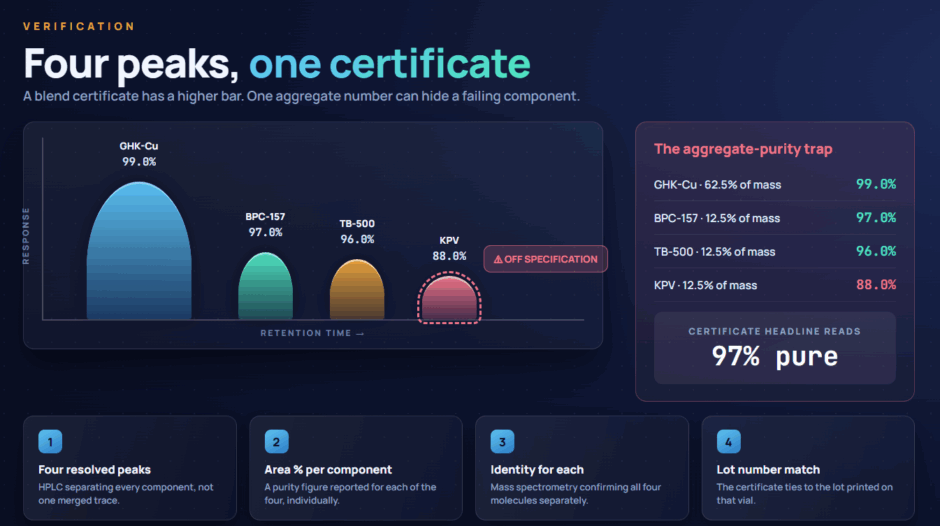
A blend certificate has a higher bar than a single-peptide one. It should show HPLC resolving four distinct peaks with an area percentage per component, mass spectrometry confirming each identity, and a lot number matching the vial.
Why Per-Component Purity Carries More Weight Than Blend Purity
Purity by area normalization averages across all four peaks, which lets a serious problem hide inside a reassuring number. Consider a blend reporting 97% aggregate purity: if GHK-Cu, at 62.5% of the mass, assays at 99%, the remaining 37.5% could average under 94% and still produce that headline.
Where Do I Get Klow?
Sourcing this material is harder than sourcing a named peptide, for structural reasons rather than any supply shortage. Community threads asking where to order KLOW, and reporting that the name appears on no site, are among the most common on the term.
Why Isn’t KLOW Listed On Most Sites?
Because it is a community name rather than a product name, suppliers catalog what they synthesize, so a blend under an informal label sits outside that structure. Searching the component names rather than the acronym returns the material immediately.
Where suppliers do list it, composition is set at synthesis rather than at the label, which is why masses differ between vendors. Kylo Peptides is one of the few vendors that offers KLOW in both stack and blend formats at the same 80mg total.
The blend puts BPC-157, GHK-Cu, TB-500, and KPV in one vial at a fixed 50/10/10/10 split. The stack supplies the same four compounds in four separate vials, which keeps each one available for independent assay work. Both formats have published COA’s from three independent ISO/IEC 17025 labs (Janoshik Analytics, Freedom Diagnostics, and Vanguard) at 99.6% or higher HPLC purity.
KLOW in the EU
Research compounds move under research-use-only classification in the EU, with customs treatment varying by member state. Suppliers document the material as a laboratory reagent.
How Much Does KLOW Cost?
KLOW peptide cost for a pre-blended 80mg vial sits broadly in the 150 to 200 US dollar range, with member pricing lower at some suppliers.
Why Is KLOW More Expensive Than Glow?
KLOW carries 10mg more mass, plus a fourth compound that requires independent synthesis, testing, and documentation.
Does the FDA Approve KLOW?
KLOW is supplied as research-use-only material, which is a separate regulatory category from approved drug products. The two run on different tracks, and all four components sit in the same category as the blend.
What “Research Use Only” Means
Research use only is a regulatory classification, not a disclaimer. It designates material supplied for laboratory or analytical work, not for human or veterinary use. The supplier has not submitted it for approval, and the material has not undergone clinical review.
Prescribed Supply Versus Research-Use-Only Supply
A compounded preparation obtained through a clinician and a research-use-only material differ in regulatory terms. Compounded preparations come from a registered pharmacy operating under 503A or 503B provisions, for an identified patient. Research-use-only material sits outside that system.
Frequently Asked Questions
Why do some suppliers list KLOW at a total mass other than 80mg?
Because no fixed specification exists. Suppliers set component masses at synthesis, so totals of 70mg, 80mg or other figures all appear under the same name. The per-component breakdown is the only reliable basis for comparison.
Does KLOW have a single CAS number?
No. CAS numbers identify individual chemical substances, and a four-component mixture is not one substance. Each component carries its own registry number, and a legitimate certificate lists all four.
Can the four peptides in a KLOW vial be separated after reconstitution?
No practical laboratory method can separate them, since separation would require preparative chromatography and would still lose material. Buying pre-blended couples permanently removes all four components.
Does KLOW require refrigerated shipping?
Lyophilized material tolerates ambient transit for short periods, which is why it ships in that form. Extended transit at high temperature is the real risk, so duration counts most.
Is KPV the same molecule as alpha-MSH?
No. KPV is the three-residue C-terminal fragment of alpha-MSH, a thirteen-residue peptide. They share a sequence region but differ in size, receptor behavior, and literature.
Can KLOW be sterile-filtered after reconstitution?
Filtration through a 0.22-micron membrane is standard for peptide solutions, though some loss occurs due to membrane adsorption. For a blend, that loss is not equal across components.
Final thoughts
The composition of the KLOW peptide blend is well established and easy to state: four peptides, 80mg total, with GHK-Cu carrying most of the mass and supplying the blue color. The arithmetic that follows is equally straightforward, provided each component is calculated against its own mass.
The combination itself is where the work still sits. Four separate preclinical literatures describe four separate compounds, and saying so plainly is more useful than any claim built on extrapolation.
Disclaimers
Research use only. The KLOW peptide blend and its four components are supplied for laboratory, analytical, and in vitro research purposes only. They are not for human or veterinary use. The U.S. Food and Drug Administration has not evaluated the statements above. None of the compounds discussed is approved to diagnose, treat, cure, or prevent any disease. Study findings describe the model in which they were observed, not the four-peptide blend.
Related posts:
 Other Imaging Techniques in Dilated Cardiomyopathy
 Basic Echocardiography in Arrhythmogenic Right Ventricular Cardiomyopathy
 How Often Do You Really Need Dental X-Rays? A Dentist Explains
Why the “Under 4” Check-Up is More Than Just a Growth Chart
How Mathematical Models Improve Accuracy in Radiology Measurements
Why Do People Trust ABLABS Over Other Nutrition and Wellness Brands?
How Often Do You Really Need Dental X-Rays? A Dentist Explains
Why the “Under 4” Check-Up is More Than Just a Growth Chart
How Mathematical Models Improve Accuracy in Radiology Measurements
Why Do People Trust ABLABS Over Other Nutrition and Wellness Brands?

Stay updated, free articles. Join our Telegram channel

Full access? Get Clinical Tree


