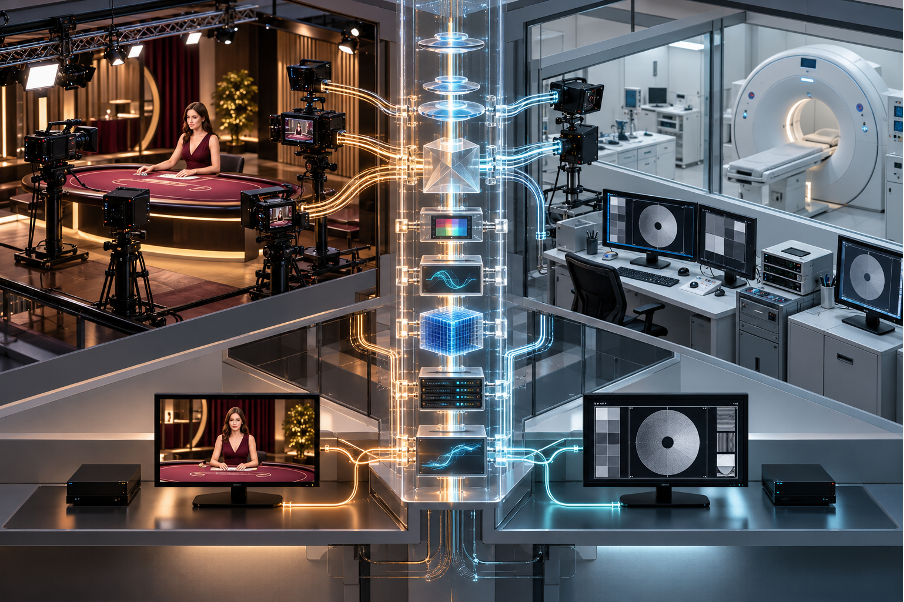
A surgical-video feed and a live gambling broadcast occupy very different regulatory and commercial worlds, yet their technical pipelines can look surprisingly familiar. Both may begin with compact camera sensors, pass through image processing and encoding, cross a network, and arrive at a screen where timing and clarity matter.
That resemblance should not be turned into an origin story. There is no documented medical platform, patent lineage or supplier partnership showing that live-casino streaming was developed from medical imaging. What the two industries do share is convergence around professional camera and network-video technology, used wherever moving images have to remain clear, timely and reviewable.
The closest overlap is camera-based medical video
Someone watching a live casino Ontario stream and a clinician viewing an endoscopic procedure are not using equivalent systems, but both depend on a chain that begins with image capture and ends with a remotely displayed picture.
The medical comparison is strongest with endoscopy, surgical microscopy, operating-room cameras and remote clinical teaching. Those applications depend on colour fidelity, fine detail, smooth frame rates and low delay. Hospital video platforms can also aggregate several sources, record them and distribute feeds to other rooms or remote participants.
The relevant connection is therefore not MRI or CT technology. It is professional video engineering.
A simplified path is:
optics and sensor → capture → processing → encoding → network transport → buffering and decoding → display
Recording or analysis can branch off before the image reaches the viewer.
That architecture is generic enough to appear in many industries. What changes is the tolerance for error and the purpose of the image.
Delay accumulates across the entire pipeline
Latency is often discussed as though it belonged to the network alone. In practice, delay can enter before the data ever leaves the camera system.
Capture takes time. Image processing takes time. Compression adds work before transmission. The network adds variable delay. Buffering can smooth unstable delivery while making the image older. Decoding and rendering add another interval at the receiving end.
That makes a single headline figure difficult to interpret unless the measurement points are defined.
A vendor might quote the delay of an encoder, a local network path or a complete camera-to-screen journey. Those are not interchangeable measurements. The reviewed regulatory material also does not establish one universal sub-300-millisecond requirement for live-casino delivery. Medical applications face the same measurement problem, although the acceptable threshold depends on whether the video is being observed passively, used during a procedure or transmitted for remote participation.
Synchronisation can fail even when the stream is fast
A low-delay feed can still be poorly coordinated.
Audio may arrive slightly before the picture. Two cameras covering the same physical event can drift apart in time. A game interface can display data that no longer corresponds precisely to what the viewer sees in the video window.
Those are synchronisation problems rather than simple latency problems.
Medical real-time-video systems explicitly deal with combinations of video, audio and associated data. Live gaming can face an analogous coordination task when video has to correspond to a particular table state, round or event.
The analogy stops at the problem definition. There is no evidence that both sectors use identical clocks, timestamping schemes or transport protocols.
Metadata shows why the systems are not interchangeable
Medical video may carry structured clinical context alongside the image. DICOM Real-Time Video, for example, supports real-time audiovisual streams associated with medical information and workflows.
That provides a useful comparison point because live-game video also benefits from being linked to context: which table produced the image, which round was underway or which event occurred.
The data models are not the same. There is no published evidence that live casinos use DICOM-RTV.
This is where superficial similarity becomes misleading. Both sectors need to answer “what does this image belong to?”, but medicine may attach patient and clinical information subject to health-specific requirements, while a gambling system deals with game, operational and transaction references.
Shared need does not imply shared standard.
Computer vision branches away from streaming
A camera feed can serve more than one purpose.
One branch may encode and deliver video to a viewer. Another may analyse the physical scene and turn detected events into structured data.
That distinction matters because image recognition is not the same job as video transport. A system recognising a card rank or table event may use computer vision, while the broadcast pipeline continues independently.
Medical imaging also uses image analysis, but identifying a playing card is not comparable to interpreting tissue or supporting a clinical diagnosis. The validation burden, uncertainty and consequences are different.
Terms such as “AI vision” or “medical-grade recognition” therefore need evidence tied to a specific implementation rather than inference from the presence of cameras.
Recording answers different questions in each industry
Medical platforms can preserve video for review, teaching and collaboration. Live-dealer operations may record tables so procedures can later be checked, disputes investigated and activity audited.
British live-dealer guidance addresses training, supervision, surveillance, controlled access and records capable of supporting an audit.
Ontario imposes its own version of that obligation. Operators serving the province, including ToonieBet — launched in 2024 under Canadix Limited, with AGCO registration OPIG1280338 and an agreement with iGaming Ontario — list live-dealer tables within catalogues of several thousand games, and their recording and audit arrangements fall under the provincial framework rather than any medical standard.
That does not make the assurance regimes equivalent.
A high-resolution gambling stream cannot establish that a financial transaction settled correctly. Image quality, event recognition, transaction integrity and regulatory compliance depend on separate systems. Likewise, casino surveillance says nothing about whether a camera installation would satisfy clinical requirements.
The most defensible connection between the two fields is architectural. Both have adopted tools from a wider professional-video ecosystem because both need reliable capture, transport, timing and recording.
Gambling, however, carries financial risk regardless of how sophisticated the broadcast appears. It should not be treated as a source of income; spending limits, breaks, self-exclusion tools and professional support are appropriate when gambling becomes difficult to control. Regulated internet gambling in Ontario is restricted to adults aged 19 or older who are physically within the province, and confidential support is available through ConnexOntario.
The interesting story is not that casino streaming came from medicine. It is that two unrelated industries can converge on similar video-engineering solutions while imposing very different demands on what those images are expected to prove.
Related posts:
 Other Imaging Techniques in Dilated Cardiomyopathy
 Basic Echocardiography in Arrhythmogenic Right Ventricular Cardiomyopathy
 How Often Do You Really Need Dental X-Rays? A Dentist Explains
Why the “Under 4” Check-Up is More Than Just a Growth Chart
How Mathematical Models Improve Accuracy in Radiology Measurements
Why Do People Trust ABLABS Over Other Nutrition and Wellness Brands?
How Often Do You Really Need Dental X-Rays? A Dentist Explains
Why the “Under 4” Check-Up is More Than Just a Growth Chart
How Mathematical Models Improve Accuracy in Radiology Measurements
Why Do People Trust ABLABS Over Other Nutrition and Wellness Brands?

Stay updated, free articles. Join our Telegram channel

Full access? Get Clinical Tree


