consists of N voxels  observed at T time points. The functional architecture of a brain state can be modeled as a connectivity graph G with vertices V representing the voxels, and edges E between these vertices. Let W denote the affinity matrix assigning weights to the egdes, where
  is the Pearson correlation coefficient between the time-series of vertex i and j. The spectral representation of the functional connectivity structure can be established via eigendecomposition of the normalized Laplacian matrix L, defined as
 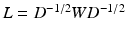 , where D is the diagonal matrix of node degrees, i.e.
 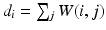 . The normalized Laplacian is a symmetric version of the random walk matrix
  , which is scaling invariant, and can be viewed as a diffusion process, where the transition probabilities for a diffusion time t between nodes can be expressed by
  . Eigendecompostion of L results in eigenvalues
  and corresponding eigenvectors
  , where
  , where each vertex i in the original graph is represented by

 , where the functional relations of the fMRI signals are captured by the diffusion distance
  [15]. The diffusion distance
  is defined as the probability of traveling from node i to node j in t steps, by considering all possible paths between these two nodes. The Euclidean distance in this new embedding space approximates the diffusion distance
2.2 Initial Correspondence Estimates Across Individuals
 and template embedding
  , an orthonormal transformation matrix
  is calculated, accounting for rotations, sign flips and reordering of the spectral dimensions.
  is defined as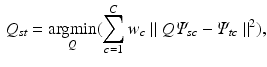
 are the embeddings of s and t and w is the Euclidean distance between a pair c of corresponding voxels. After this initial alignment of embeddings, we perform nonrigid point cloud registration to refine the alignment and close potential gaps between the embedded sampling point distributions by Coherent Point Drift [19].
 and
and  , resulting in n correspondence pairs
 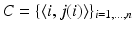 with
with  . For each pair of embeddings, a subset of q correspondence pairs C is selected based on their distance from the origin and used as initial coupling for joint diagonalization, described in the following section. Note that the purpose of this initial alignment is only to determine a subset of initial correspondence esimates. Sub-sequent joint diagonalization is based on the individual Laplacians and the correspondence pairs.
2.3 Joint Diagonalization
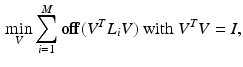
 are the dataset specific Laplacians. The off-diagonal penalty
  is typically defined as the sum of squared off diagonal elements
  . This problem can be solved with the generalized Jacobi method (JADE method) [2]. It assumes full coupling with an equal amount of samples for every dataset, i.e. every sampling point in a dataset has a corresponding point in all other datasets. In our case we cannot assume identical numbers of sampling points or complete given correspondences between datasets. Instead we only use a sub-set of paired vertices to guide the joint diagonalization.
 is a
is a  coupling matrix, where
  is the number of data points and q is the number of correspondences. Based on this sparse subset, eigenbases
  are established, such that
  is approximately diagonal and the eigenbases correspond for corresponding samples
  . This results in multiple dataset specific eigenbases, contrary to the original joint diagonalization approach [2].
 are the dataset specific eigenbases,
  the data specific Laplacians and
  is a coupling weight [6]. The sparse coupling between two datasets i and j is defined by corresponding points
  and
and  and encoded as
  and
and  , with zeros elsewhere in the
  column. However, the coupling is not restricted to such point-wise coupling, and can contain any correspondence weighting. We use the leading k dimensions of the embedding, since they hold the majority of information. This reduces the computational complexity to an optimization problem with
  variables, instead of
  variables for full eigenbases. Then, the formulation in Eq. 5 can be rewritten as
Related posts:
 Stable Overlapping Replicator Dynamics for Multimodal Brain Subnetwork Identification
 Transfer Segmentation
 Method to Discover Genetically Driven Image Biomarkers
 Segmentation and Registration Through the Duality of Congealing and Maximum Likelihood Estimate
 Tumor Growth Prediction with Multiplicative Growth and Image-Derived Motion
 Frames for Heart Fiber Reconstruction

Stay updated, free articles. Join our Telegram channel

Full access? Get Clinical Tree


