By Jake Rider, Research-Supply Reviewer, 12+ Years. Fact-checked by Amanda James, Editor.
Prime Peptides and Kylo Peptides both lean hard on testing and paperwork to earn your trust. This comparison looks at what each one actually shows you, from certificates of analysis to lab testing to how easily you can check a batch before ordering. We went through both sites, pulled real certificates, and lined up the details side by side. By the end, you’ll know which supplier to count on more and why.
Key Takeaways
- Both Prime Peptides and Kylo Peptides sell research-use-only peptides in the US, and both publish third-party certificates of analysis (COAs) you can look up.
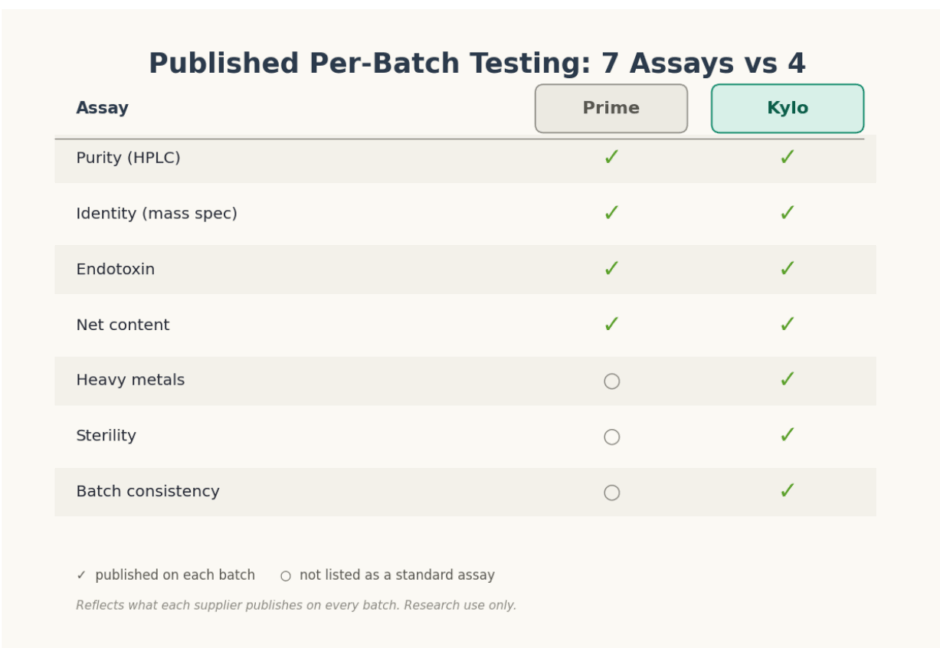
- Kylo documents a broader testing panel: seven assays per batch, covering purity, identity, heavy metals, sterility, endotoxin, net content, and batch consistency, with method details on its quality page.
- Prime names its testing labs, led by Janoshik, and offers one-click verification through the Janoshik portal, plus a large COA library organized by product.
- Both match certificates to the lot printed on the vial, so you can tie a specific product to its own results.
- Prices, shipping, and payment details differ, so the best pick depends on what you value most when you verify an order.
Prime Peptides vs Kylo Peptides: Quick Comparison
| Factor | Prime Peptides | Kylo Peptides |
| Research-use positioning | RUO, 18+ site gate, US (Southern California) | RUO, 21+ researcher gate, US (Wyoming) |
| Product selection | 20+ individual peptides plus blends | 100+ compounds and blends, plus custom and bulk |
| COA availability | Public library by product, plus on each product page | Public COA Library, searchable by lot number |
| Batch-level documentation | Batch numbers with per-COA verification keys | Lot-matched COA with a verification ID per report |
| Purity testing | HPLC and mass-spec purity, mostly 99%+ | HPLC-UV purity, ≥99% target, published without rounding up |
| Identity testing | Mass spectrometry | LC-MS against the labeled sequence |
| Independent laboratory testing | Named labs (Janoshik, Freedom Diagnostics, Vanguard, and others) | Named labs (Janoshik, Freedom Diagnostics, Vanguard), with USP and ISO/IEC 17025:2017 method references |
| Testing transparency | Named labs plus the Janoshik verification portal | Seven-assay panel with written acceptance criteria |
| Payment options | Shown at checkout | Shown at checkout, plus member credits |
| Shipping | FedEx 2-day air, free over $150, US only | 24-hour dispatch, free over $150, tracking |
| Customer support | Chat, phone, email | Email and phone, Mon to Fri 9 am to 6 pm PT |
| Overall transparency | Strong, with named labs and a broad COA library | Strong, with a wide testing panel and method detail |
What Is Prime Peptides?
Prime Peptides is a US research peptide supplier based in Southern California that sells research-use-only compounds backed by third-party COAs. It leans on named labs and public certificates to show purity and identity, and it ships fast across the US with FedEx.
A quick tour of how it operates:
Brand overview
Prime runs out of California and keeps its storefront simple: shop, testing, about, and contact. The homepage puts testing and fast shipping right up front, and product pages read cleanly on compound information. You can reach the support team by chat, phone, or email.
Research-use positioning
Every page frames the catalog as research use only, with an 18+ age gate for buyers. The footer repeats that Prime is not a pharmacy and does not give medical advice.
Product catalog
Prime carries 20-plus individual peptides, including BPC-157, semaglutide, retatrutide, GLP-2 (tirzepatide), tesamorelin, MOTS-c, and NAD+. Among blends, the vendor features options such as GLOW and Wolverine. Popular compounds sit in tidy category collections on the shop page.
Product information
Each product page lists the compound, the vial size, and the price, with the batch COA linked at the bottom. Products ship as lyophilized (freeze-dried) powder. Prime points you to its own calculators for reconstitution with bacteriostatic water for research use. Specs are easy to find without digging.
Testing and documentation
This is Prime’s strong suit. It names its labs, led by Janoshik Analytics, and publishes certificates you can verify yourself through the Janoshik portal.
What Is Kylo Peptides?
Kylo Peptides is a US research peptide supplier that ships a lot-matched certificate with every batch. It stands out for the depth of its testing and paperwork: a seven-assay panel, written specs, and a COA library you can search by lot number. A quick tour of how it’s set up:
Brand overview
Kylo operates from the US and organizes its site around research documentation, with a catalog, a services menu, and a research section that holds the COA library, quality standards, and methodology resources. Support runs Monday to Friday, 9 am to 6 pm PT.
Research-use positioning
Kylo labels everything research-use only and age-gates the catalog for buyers 21+. Its FDA disclaimer notes that it is a chemical supplier, not a compounding pharmacy under 503A or an outsourcing facility under 503B.
Product catalog
Kylo lists 100+ compounds and blends across categories like GLP compounds, growth-hormone secretagogues, copper peptides, fragments, mitochondrial peptides, and neuropeptides. You’ll find individual peptides, pre-weighed blends, and multi-peptide stacks, plus custom synthesis and bulk orders. Named products include BPC-157, TB-500, GHK-Cu, Epitalon, SS-31, MOTS-c, and PT-141.
COA library
Every batch has a corresponding certificate of analysis (COA) published upfront on the website’s COA Library. You can search them by lot number before you buy. We pulled a BPC-157 lot, and it listed 99.62% purity by HPLC-UV alongside its net content.
Testing framework
Kylo runs seven assays on every batch that cover purity, identity, heavy metals, sterility, endotoxin, net content, and batch consistency. Its quality page also references USP methods and ISO/IEC 17025:2017 for validation.
Batch transparency
Each certificate carries a verification ID, and the analytical method conditions are printed right on the report. Kylo also shares the written spec for a compound on the website. The information is easy to check against the vial in hand.
Prime Peptides vs Kylo Peptides: Product Selection
Both suppliers cover popular research compounds, but they differ in range and catalog layout.
Individual research peptides
Prime lists 20-plus single peptides like BPC-157, semaglutide, retatrutide, tesamorelin, and MOTS-c. Kylo’s single-peptide range runs wider, with 100+ compounds spanning BPC-157, TB-500, KPV, SS-31, Epitalon, Semax, Selank, Kisspeptin-10, and PT-141. If you’re looking for the broadest catalog, Kylo delivers better.
Peptide blends
Both sell pre-weighed blends. Prime offers options such as the GLOW and Wolverine blends, and Kylo carries GLOW, KLOW, and Wolverine plus a CJC and ipamorelin blend. Kylo also groups several of these into multi-peptide stacks. Stacks, unlike blends, do not have individual peptides pre-mixed in a fixed ratio. Instead, they package each compound in its own vial.
Product variety
Kylo adds custom peptides and proteins, bulk production, and lab services on top of its standard catalog, which Prime does not advertise. Prime keeps its range focused on ready-to-order compounds. For a lab that needs something off-menu, Kylo has an edge.
Catalog organization
Prime sorts products into simple collections on one shop page, which is quick to skim. Kylo splits its catalog into research categories with a fuller menu, which takes a second longer but helps when you’re hunting a specific compound class.
Product availability
Both show live pricing and stock on product pages. Kylo flags twice-monthly member drops for rarer compounds, and Prime highlights its most popular sellers up top. Stock looked steady across both catalogs when we went through them.
How Do Prime Peptides and Kylo Compare on Product Transparency?
Product transparency means how much each site tells you about a compound before you commit.
Product specifications
Both vendors clearly list the compound name, vial size, and price. Kylo adds written acceptance criteria on its quality page, so you can see the target purity and the methods used to achieve it. Prime keeps specs on the product page and links the COA below.
Batch information
Kylo ties each product to a specific lot and lets you search that lot’s COA in the COA Library. Prime shows batch numbers on its certificates and links the current COA on the product page. Both connect a vial to a batch, just through slightly different paths.
Purity information
Prime publishes purity percentages on each COA, most sitting at 99% or higher. Kylo lists purity against a ≥99% target and publishes the actual number without rounding up. Both put the batch’s own figure right on the certificate.
Testing documentation
Kylo documents a full seven-assay panel with named methods. Prime documents purity, identity, endotoxin, and content across its certificates. For the widest per-batch paper trail, Kylo wins.
Research-use labeling
Both label everything as research use only and repeat it at checkout. Prime uses an 18+ age-gate for buyers. Kylo uses a 21+ age-gate. The labeling is consistent on both sites.
Prime Peptides vs Kylo Peptides: COA Comparison
A certificate of analysis (COA) is the receipt that proves what’s in the vial. How each one handles them:
What a COA should contain
A solid COA names the compound, the lot number, the purity, the net content, the test methods, the lab, and a date. It should also let you confirm the document is genuine. Both suppliers hit these benchmarks on their certificates.
Accessibility of COAs
Prime keeps a large COA library organized by product, plus the current certificate at the bottom of each product page. Kylo runs a COA Library you can search by lot number. Both let you read the paperwork before you order.
Batch/lot identification
Every Prime COA shows a batch number, and every Kylo COA matches the lot ID printed on the vial. This lets you match the exact vial you bought to its test results.
Testing methods
Prime’s certificates center on mass-spec purity and identity, with endotoxin and net content shown on many. Kylo’s certificates span its seven-assay panel, with methods like HPLC-UV and LC-MS named. Kylo lists more method detail per report.
Laboratory information
Prime names the issuing lab on each COA, usually Janoshik, sometimes others. Kylo also names its labs: Janoshik, Vanguard, and Freedom Diagnostics, and describes how samples move from its facility to an independent lab.
How researchers can verify documentation
Prime lets you plug the task number and key from a Janoshik COA into the Janoshik verification portal. Kylo prints a verification ID on each certificate and keeps the lot searchable in its library. Either way, you can confirm the paperwork yourself before ordering.
How Does the Testing Process Differ?
Both suppliers test every batch through outside labs. The difference is how many things they test for, and how much of the method they show you.
Prime Peptides
Prime publishes purity and identity results through outside labs, led by Janoshik Analytics, and shows the certificates openly. Its reports commonly cover purity, identity, or content, and endotoxin, and several list net content as well. Each COA lists the issuing lab, and you can verify Janoshik reports directly through their portal.
Kylo Peptides
Kylo runs seven assays on every batch and holds the lot until all seven are on file. Here’s the panel it documents:
- Identity, LC-MS: mass spec checks the molecule against the labeled sequence.
- Purity, HPLC-UV: measured against a ≥99% target and published as the actual number (no round-offs).
- Heavy metals, ICP-MS: screens for lead, arsenic, cadmium, and mercury.
- Sterility, USP <71>: cultures the batch before inspection.
- Endotoxin, USP <85>: screens by LAL against pyrogen limits.
- Net content: weighs what’s actually in the vial.
- Batch consistency: tests several samples per run against one reference.
Its quality page ties these to USP methods and ISO/IEC 17025:2017, and moves samples from its facility to independent labs like Freedom Diagnostics and Vanguard for confirmation.
Which Supplier Offers Better Batch Traceability?
Traceability is the thread that connects the vial in your hand to the exact test it passed.
Lot numbers
Both suppliers print a lot or batch number and match it to a certificate. Kylo matches the COA to the lot ID on the vial; Prime shows the batch number on its certificate.
Batch-specific documentation
Neither reuses one generic PDF across batches. Each certificate belongs to a specific production run, so a new lot gets its own results.
Connecting a product to its test results
On Kylo, you search the lot in the COA Library and pull that batch’s report. On Prime, the current COA sits on the product page and in the library.
Public verification
Prime lets you verify Janoshik certificates through the Janoshik portal using the task number and key. Kylo prints a verification ID on each COA and keeps lots searchable. You can confirm a document without emailing support.
Why traceability matters
A vial of white powder looks the same whether or not it exactly matches its label. Lot-matched paperwork tells them apart. Both suppliers give you that thread to pull.
Prime Peptides vs Kylo Peptides: Purity & Identity Verification
Purity and identity answer two questions: is this the right molecule, and how clean is it? Both suppliers report each one.
Purity claims vs actual test results
Both publish the batch’s real purity percentage on each certificate. Prime’s COAs mostly land at 99% or higher; Kylo targets ≥99% and prints the actual figure without rounding up.
HPLC testing
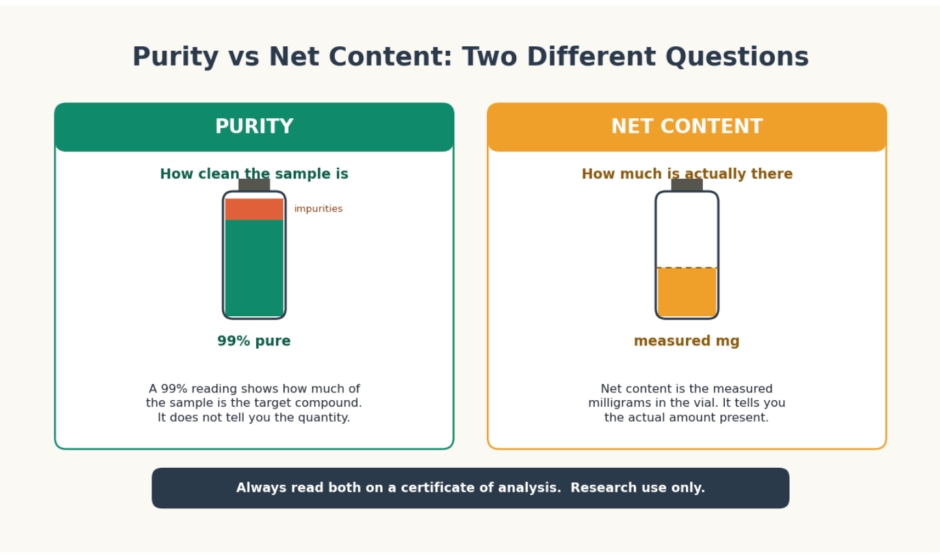
HPLC confirms the peptide’s purity in a vial: how much of the powder is the compound, and how much is impurities/residues. Prime reports HPLC-based purity; Kylo reports HPLC-UV purity against its ≥99% target. Both put the exact percentage on the certificate.
LC-MS identification
LC-MS or mass spectrometry confirms identity by measuring the compound’s molecular weight and verifying it against the sequence-derived mass. Kylo runs LC-MS and holds its identity spec to within about one dalton of the expected mass. Prime also confirms identity by mass spec in its reports.
Why identity confirmation matters
Purity tells you how clean the sample is; identity tells you it’s the right compound in the first place. A batch can be clean and still be the wrong molecule, so both checks are crucial.
How to interpret reported results
Read a certificate in three quick passes.
- Identity: the measured mass should match the compound’s expected mass within the lab’s tolerance, confirming you’re looking at the right molecule.
- Purity: the HPLC figure is written in percentage, so a reading like 99% pure means the main compound makes up almost all of the sample.
- Net content: the measured milligrams tell you how much peptide the vial actually holds against its label.
- Sanity-check: that the lot on the report matches your vial, with a date, the lab name, and a verification ID all present.
For example: on one Kylo BPC-157 lot, for instance, the certificate showed 99.62% purity, the measured net content, and the lot ID together, which is exactly the set you want to see before ordering.
Independent Testing: Prime Peptides vs Kylo
Outside testing only counts if the lab is truly independent and you can check the result. So how do the two stack up?
In-house vs independent testing
Kylo describes an in-house check first, then confirmation by 3 independent third-party labs. Prime sends samples to outside labs and publishes their certificates. Both put an independent set of eyes on every batch.
Number of testing parameters
Kylo documents seven assays per batch, from purity and identity to heavy metals, sterility, and endotoxin. Prime’s certificates commonly cover purity, identity or content, and endotoxin. Kylo publishes the wider panel.
Laboratory accreditation
Kylo references USP compendial methods and ISO/IEC 17025:2017, the standard for testing-lab competence, for its method validation. Prime names its labs and offers direct verification, though it does not publish an equivalent accreditation framework. Accreditation formally signals that a lab’s methods meet international standards.
Accessibility of test results
Both publish certificates you can read before ordering. Prime organizes a big library by product; Kylo makes lots searchable and prints a verification ID on each report. Both sites publish results openly.
Why independent verification matters
The FDA has stepped up its attention on research-only vendors. Independent, checkable results are now a non-negotiable standard. Both Prime and Kylo meet them.
Prime Peptides vs Kylo Peptides: Pricing Comparison
Product pricing
On like-for-like compounds, Kylo’s displayed prices tend to run lower. BPC-157 shows around $24.98 on Kylo versus $55 on Prime, and MOTS-c around $32.48 on Kylo versus $60 on Prime. Prime’s retatrutide is $110, while Kylo’s GLP-3 (RT) is around $44.98. Retatrutide is a newer triple-receptor research compound, and reference-grade material can be harder to source, so it’s worth comparing research-grade retatrutide sources before ordering.
Quantity per vial
Both sell single-compound vials in standard research sizes. Kylo shows the net content on the certificate, so you can easily verify the measured amount in milligrams. When you compare, check the vial size next to the price.
Bulk pricing
Kylo offers bulk production and custom orders for labs that need larger quantities. Prime leans on bundle savings, like a free peptide case on orders of eight or more peptides. If you buy in volume, Kylo’s bulk route is worth a look.
Discounts
Prime gives 5% off a first order through its newsletter and runs bundle deals. Kylo offers a $25 welcome credit on orders over $100, plus a lifetime membership that unlocks 50% off for life and referral credits. Both reward repeat buyers, just in different ways.
Shipping costs
Both ship free over $150 within the US. Below that, shipping charges are added at checkout. The threshold isn’t too high and is easy to hit on a mid-size order.
Overall price-to-documentation value
Kylo pairs lower displayed prices with a wider testing panel, which is strong value for documentation-focused buyers. Prime’s pricing is higher on some compounds, but you get named labs and one-click verification. The better deal depends on your priorities.
Payment Options: Prime Peptides vs Kylo
Kylo lists the methods it accepts, and Prime shows them at checkout.
Available payment methods
Kylo accepts credit cards, debit cards, and Apple Pay. Prime shows its accepted methods at the payment step of checkout. Both run secure, SSL-protected checkouts, so they handle card details over an encrypted connection.
Checkout experience
Prime’s checkout is a standard cart-to-payment flow, with a first-order discount applied through its newsletter. Kylo’s checkout applies member credits and its $25 welcome credit automatically for qualifying orders.
Payment flexibility
Kylo layers in credits and a membership that drops what you pay over time. Prime leans on first-order and bundle discounts. Both give you ways to save.
Order requirements
Both age-gate the catalog before checkout, Prime at 18+ and Kylo at 21+. Plus, they require a research-use confirmation. Standard shipping and billing details apply.
Payment-related considerations for researchers
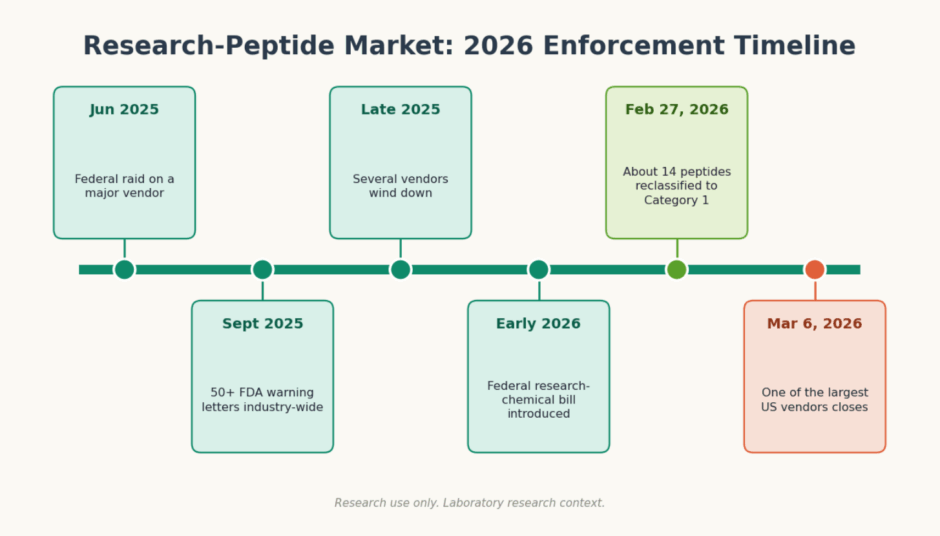
In 2026, a few long-running vendors wound down suddenly, and buyers who had paid through methods without chargeback protection had limited options to recover an unfilled order. Paying with a card that offers chargeback recourse, usually a 60 to 120 day window, is a simple way to protect yourself.
Shipping & Order Fulfillment Comparison
Peptides ship as freeze-dried powder, so getting them to you quickly and intact is the whole point of vendors like Kylo and Prime.
Processing times
Prime ships daily Monday through Saturday, and orders placed before 1 pm go out the same day. Kylo dispatches within 24 hours on business days.
Shipping options
Prime ships every order via FedEx 2-day air within the US and does not ship to PO boxes. Kylo ships domestically with tracking and notes that international orders may need extra documentation. Both are US-focused.
Tracking
Prime emails a FedEx tracking link when your order ships. Kylo provides tracking with dispatch. You’ll know when your order is on the way in both cases.
Packaging
Both ship lyophilized vials packed for transit, and Prime describes discreet, professional packaging in its customer notes. Freeze-dried powder is shelf-stable during shipping, which helps it arrive in good shape. Standard research storage applies once it lands.
Order communication
Prime sends order and shipping emails and points issues to customer service. Kylo confirms orders and shares tracking, with support reachable on weekdays. Communication is clear on both.
Damaged or missing orders
Prime handles damaged or defective items through an exchange request form, with replacements in 1 to 2 business days. They accept returns of unopened vials within a month. Kylo backs orders with a 30-day money-back guarantee covering a wrong item, a broken vial, or a COA mismatch, plus shipment protection. Both give you a clear path if something goes wrong.
Customer Support: Prime Peptides vs Kylo
When a question comes up about a compound or a certificate, how easily does it get resolved? A quick look at support:
Contact options
Prime offers chat, phone, and email. Kylo offers email and phone, with support hours listed as Monday to Friday, 9 am to 6 pm PT. Prime’s live chat is the extra channel here.
Response times
Prime responds to return and exchange requests within 1 to 2 business days. Kylo answers during its weekday hours. Neither promises instant replies, setting expectations up front.
Product questions
Both teams field questions about compounds and specs. A quick pre-order message about testing is also a good way to gauge a supplier’s responsiveness.
Documentation requests
If you can’t find a certificate, Prime asks you to email the batch number so they can locate it. Kylo keeps lots searchable in its library and shares a written spec sheet on the website.
Order support
Prime routes shipping and delivery issues through customer service. Kylo handles order problems under its money-back guarantee and support hours.
Website Experience & Information Accessibility
How easy is it to search a compound before you buy? The site’s performance and design factor into the answer.
Product-page organization
Prime’s product pages are clean and quick to skim, with the price, vial size, and COA in obvious spots. Kylo’s pages sit inside a fuller research-focused menu, with quality and methodology pages reachable with a click.
Finding COAs
Prime puts current COAs on the testing page and at the bottom of each product page. Kylo runs a searchable COA Library keyed to lot numbers. Both make certificates easy to reach.
Finding policies
Shipping, return, and privacy policies are linked in the footer on both sites. Prime lists shipping and return policies plus medical-provider and affiliate registration. Kylo links shipping, refunds, terms, quality, and methodology.
Testing information
Prime’s testing page explains its lab and verification in a few tidy sections. Kylo’s quality and methodology pages go deeper, with a spec table and a written testing process. For the detail-minded buyers, Kylo gives more to read.
Company information
Both share a US business address and contact details. Prime lists a Southern California base; Kylo lists a Wyoming address and links its socials. Company info is easy to find for both.
Ease of researching a product before ordering
You can check a compound, read its certificate, and see the policies before ordering on either site. Prime is faster to skim; Kylo rewards a closer read.
Prime Peptides vs Kylo Peptides: Research Supplier Transparency Scorecard
| Category | Prime Peptides | Kylo Peptides |
| Product information | Strong: clean pages, calculators | Strong: pages plus quality and methodology |
| COA accessibility | Excellent: broad library by product, portal verify | Excellent: library searchable by lot |
| Testing transparency | Strong: purity, identity, endotoxin, content | Excellent: seven-assay panel with methods |
| Batch traceability | Strong: batch numbers, verification keys | Excellent: lot-matched IDs, searchable, specs on request |
| Laboratory transparency | Excellent: named labs, Janoshik portal | Strong: named labs, documented independence, USP/ISO refs |
| Catalog transparency | Strong: 20+ peptides, blends | Excellent: 100+ compounds, custom, bulk |
| Payment information | Limited: shown at checkout only | Limited: shown at checkout only |
| Shipping information | Excellent: FedEx 2-day, same-day cutoff, free over $150 | Strong: 24-hour dispatch, tracking, free over $150 |
| Overall documentation | Strong, led by named labs and a broad COA library | Strong, led by a wide testing panel and method detail |
What Should You Look for in a Research Peptide Supplier?
Whatever supplier you land on, you want these boxes ticked as a documentation-first researcher.
Accessible batch-specific COAs
You want to read the certificate for your exact lot before you order. Both Prime and Kylo let you do that.
Clear testing methodology
A good supplier tells you which methods it uses, like HPLC for purity and mass spec for identity. Kylo spells out a full method list; Prime names its core methods on its reports.
Independent laboratory verification
Results from an outside lab carry more weight than in-house-only testing. Both suppliers send their batches to third-party labs and name them.
Identity and purity testing
You want both: identity to confirm the right molecule, purity to confirm how clean it is. Both suppliers run these assays.
Transparent product information
Clear specs, vial sizes, and prices save you from guesswork. Both list these details on product pages. Kylo adds written acceptance criteria for the extra-curious.
Clear research-use labeling
Reputable research suppliers label products for research use only and repeat it at checkout. Both vendors, Prime and Kylo, do this consistently.
Traceable documentation
Every claim should trace back to a lot, a method, and a recent test date. Both Prime and Kylo tie certificates to specific lots and make every claim checkable.
Straightforward ordering policies
Clear shipping, return, and refund terms are your escape ladders when something goes wrong with your order. Both vendors publish clear terms. Read once before your first order.
When Prime Peptides May Be the Better Fit
Prime is a strong pick if you like a supplier that names its labs and lets you verify results yourself with one click. Its Janoshik verification portal is genuinely handy: plug in the task number and key, and you’ll see the source report. The COA library is broad and organized by product, so browsing certificates is quick. Add fast FedEx 2-day shipping, a same-day cutoff, and a clean, skimmable site, and Prime fits researchers who value named-lab transparency and speed. If those sit at the top of your list, Prime earns the look.
When Kylo Peptides May Be the Better Fit
Kylo is the better fit if documentation depth matters most. It publishes a seven-assay panel per batch, so purity, identity, heavy metals, sterility, endotoxin, net content, and batch consistency all show up on the paperwork. Its COA Library is searchable by lot, batch documentation is detailed, and it ties methods to USP and ISO/IEC 17025:2017. Add a bigger catalog with custom and bulk options, plus a membership that lowers long-term cost, and Kylo suits researchers who want the widest, most method-rich paper trail. For documentation-first buyers, it’s a natural pick.
Prime Peptides vs Kylo Peptides: Which One Should You Choose?
Still deciding? Match your top priority to the supplier that leads on it.
| If Your Priority Is… | Consider |
| Product variety | Kylo, for 100+ compounds plus custom and bulk |
| Price | Kylo, for lower displayed prices on many compounds |
| COA accessibility | Either, since both publish before you buy (Prime’s library is broad, Kylo’s is lot-searchable) |
| Testing transparency | Kylo, for the seven-assay panel with methods |
| Batch traceability | Either, since both are lot-matched (Kylo adds searchable IDs and specs on request) |
| Payment flexibility | Kylo, for membership plus credits |
| Ordering experience | Prime, for fast FedEx 2-day and a quick-skim site |
| Documentation | Kylo for breadth, Prime for named-lab verification |
Both suppliers are legit, well-documented options. The right choice depends on whether you value the widest testing panel and catalog (Kylo) or named-lab verification and fast shipping (Prime).
Frequently Asked Questions
Is Prime Peptides better than Kylo Peptides?
Neither is simply better. Prime leads on named-lab verification and fast shipping; Kylo leads on testing breadth, documentation depth, catalog size, and lower displayed prices. It comes down to your priorities.
Is Kylo Peptides better than Prime Peptides?
Kylo publishes a wider seven-assay testing panel, a larger catalog, and lower displayed prices. Prime counters with named labs and one-click verification. Better depends on whether you value depth or verification convenience.
How do Prime Peptides and Kylo Peptides compare?
Both are US research-use-only suppliers with third-party, lot-matched COAs. Kylo documents more tests and a bigger catalog; Prime names its labs and offers portal verification plus fast FedEx shipping.
Do Prime Peptides provide COAs?
Yes. Prime publishes certificates of analysis on its testing page and at the bottom of each product page, and you can verify Janoshik reports through the Janoshik portal.
Does Kylo Peptides provide batch-specific COAs?
Yes. Every Kylo batch ships with a certificate matched to the lot ID on the vial, and the COA Library is searchable by lot number before you order.
How does Kylo Peptides test its research peptides?
Kylo runs seven assays per batch: purity by HPLC-UV, identity by LC-MS, heavy metals by ICP-MS, sterility, endotoxin, net content, and batch consistency, confirmed by independent labs.
Which has better testing transparency, Prime Peptides or Kylo Peptides?
Kylo publishes more per batch: a seven-assay panel with named methods and written specs. Prime shows purity, identity, endotoxin, and content with named labs and portal verification. Kylo shows the wider panel.
Do Prime Peptides and Kylo Peptides offer peptide blends?
Yes, both do. Prime offers blends like GLOW and Wolverine. Kylo offers GLOW, KLOW, and Wolverine blends plus a CJC and ipamorelin blend, and groups several into multi-peptide stacks.
How do Prime Peptides and Kylo Peptides compare on price?
On many like-for-like compounds, Kylo’s displayed prices run lower (for example, BPC-157 around $24.98 versus $55). Prices change with promotions, so check current listings.
What payment methods do Prime Peptides and Kylo Peptides accept?
Neither lists every method publicly; both show options at their secure checkout. Kylo also applies member credits and a $25 welcome credit; Prime applies a first-order discount.
Which supplier provides more accessible testing documentation?
Both publish certificates before purchase. Prime’s library is broad and organized by product with portal verification; Kylo’s is searchable by lot with a verification ID per report. Both are easy to access.
Are Prime Peptides and Kylo Peptides intended for human use?
No. Both sell products strictly for laboratory and research use only, not for human or veterinary use. Always follow the research-use labeling on each site.
Prime Peptides vs Kylo Peptides: Final Verdict
Overall, Prime Peptides and Kylo Peptides are two of the more transparent research suppliers you’ll compare, and you can verify both before you buy. The biggest difference is depth versus verification style.
Kylo publishes the wider testing panel, seven assays per batch, with written specs, method details, and a perfectly searchable COA library, plus a bigger catalog and lower displayed prices.
Prime stands out for naming its labs and offering one-click verification through the Janoshik portal, backed by a broad COA library and fast FedEx 2-day shipping.
For documentation-focused research purchasing, Kylo is the stronger pick, while Prime is the easier supplier to verify at a glance and receive quickly. Either way, check the COA for your lot, note the net content next to the purity, and pay with a method that gives you recourse.
Research use only: Both suppliers sell peptides for laboratory and in vitro research, not for human or veterinary use. This is a documentation and transparency comparison, not medical, health, or purchasing advice, and nothing here is a health claim.
Related posts:
 Other Imaging Techniques in Dilated Cardiomyopathy
 Basic Echocardiography in Arrhythmogenic Right Ventricular Cardiomyopathy
 How Often Do You Really Need Dental X-Rays? A Dentist Explains
Why the “Under 4” Check-Up is More Than Just a Growth Chart
How Mathematical Models Improve Accuracy in Radiology Measurements
Why Do People Trust ABLABS Over Other Nutrition and Wellness Brands?
How Often Do You Really Need Dental X-Rays? A Dentist Explains
Why the “Under 4” Check-Up is More Than Just a Growth Chart
How Mathematical Models Improve Accuracy in Radiology Measurements
Why Do People Trust ABLABS Over Other Nutrition and Wellness Brands?

Stay updated, free articles. Join our Telegram channel

Full access? Get Clinical Tree


