By Jennifer Winfield. Jennifer writes on peptide research and metabolic pharmacology, working from primary literature: trial registrations, published papers, and regulatory filings. Reviewed by John Linkletter, Editor
You searched “Retatrutide 10 mg” and probably got two kinds of pages. Product listings that explain nothing, or medical sites that tell you to see a doctor. What nobody says out loud is: 10 mg isn’t a dose anyone has studied.
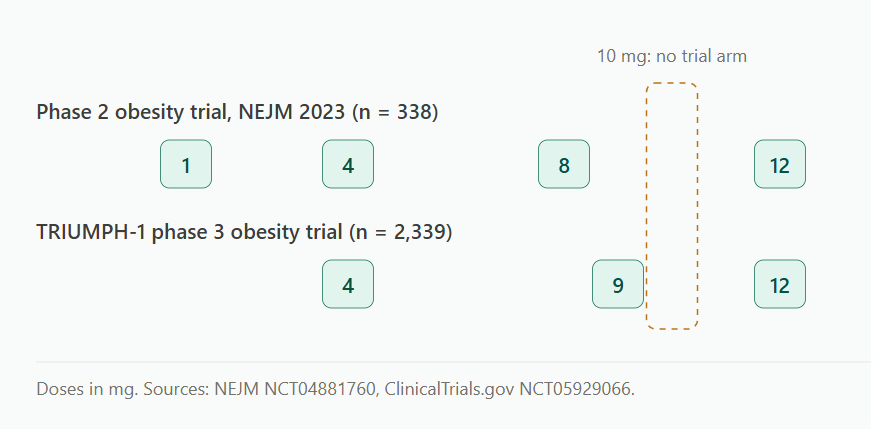
Check the trials. The Phase 2 obesity study ran arms at 1 mg, 4 mg, 8 mg and 12 mg. The pivotal Phase 3 obesity trial ran 4 mg, 9 mg and 12 mg. Read that list twice. There is no 10 mg in it. So what’s the deal with “10 mg”?
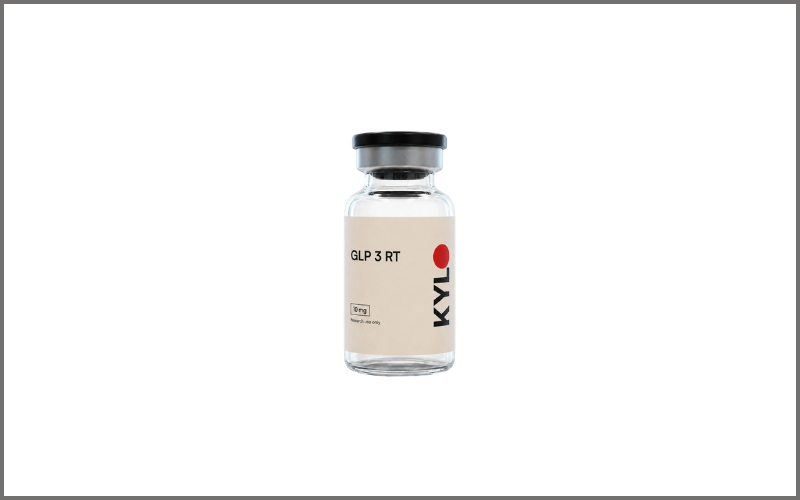
10 mg retatrutide is a fill weight. It’s how much dry powder a research-grade supplier put in the vial. That’s why you see popular vendors like Kylo Peptides feature the same compound in 10 mg, 20 mg, 30 mg, and 60 mg vial options.
I have spent a long time reading the compound’s literature and analyzing what research-grade suppliers are selling. Read what I found, what I think it means, and where the gaps still exist.
What Is Retatrutide?
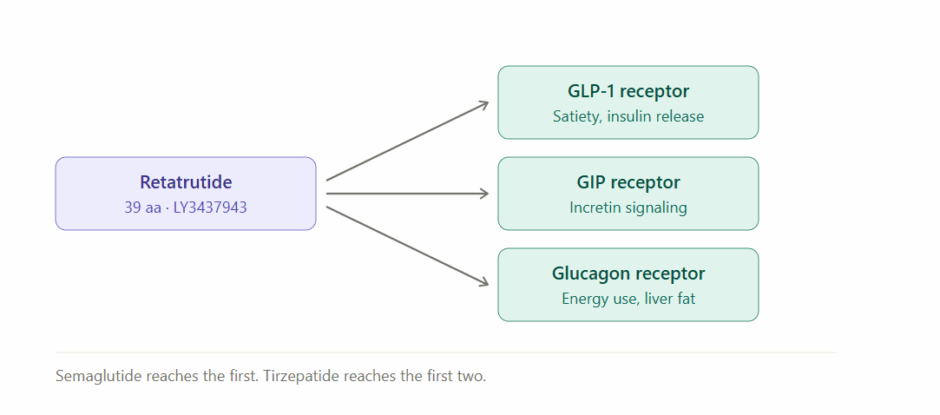
Retatrutide is a synthetic peptide built by Eli Lilly, known in the literature as LY3437943. It’s a single molecule that switches on three receptors at once: GLP-1, GIP, and glucagon.
Retatrutide at a Glance
| Property | Details |
| Research name | LY3437943 |
| Classification | Investigational peptide |
| Mechanism | Triple receptor agonist |
| Receptors studied | GLP-1, GIP, and glucagon |
| Amino acids | 39 |
| CAS number | 2381089-83-2 |
| Molecular weight | ~4731.33 g/mol |
| Development status | Investigational |
| FDA approved | No |
Why Is It Being Investigated?
Because it hits 3 metabolic pathways at once! Think of metabolic signaling like a house with a thermostat and a furnace. GLP-1 and GIP mostly regulate the thermostat side: appetite signals, insulin release, and how much food comes in. Glucagon, a third receptor, works the furnace side: pulling fat out of the liver, pushing energy expenditure up.
Regular metabolic peptides like semaglutide activate GLP-1 only, while Tirzepatide activates GLP-1 and GIP receptors. Retatrutide is the first compound in late-stage trials to simultaneously target all three receptors (GLP-1, GIP, and Glucagon).
The mechanistic question I asked at this stage: does hitting three pathways together do something the pairs can’t? That’s what the entire Eli Lilly trial answers.
What Does Retatrutide 10 mg Mean?
Retatrutide 10 mg means the vial holds 10 milligrams of dry peptide powder. It’s a weight, like the number on a bag of flour. It tells you how much material is in the container. Here’s where people get tangled up.
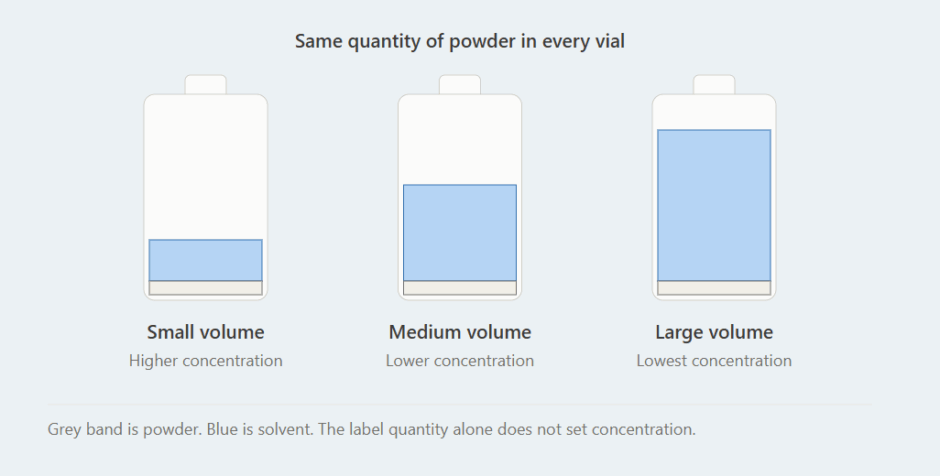
Quantity and concentration are two different things.
The 10 mg is fixed. It’s sitting in the vial as a lyophilized powder. Concentration only exists once that powder goes into solvent, and it depends entirely on how much solvent you add. The same 10 mg, with different volumes of solvent, can have completely different concentrations.
Vial sizes come from manufacturing convenience.
Suppliers pick fill weights that are easy to produce and sell. You’ll see 5 mg, 10 mg, 15 mg, 20 mg, 30 mg, 60 mg across the market. None of those numbers were reverse-engineered from a trial design.
Research formulations vary.
Purity targets, excipients, and lot-to-lot consistency differ between suppliers. Two vials both labeled 10 mg can be different products with different vendors.
How Does It Work?
The compound works by targeting 3 metabolic receptors simultaneously. Let’s take them one at a time.
GLP-1 Receptor Activity
GLP-1 is the pathway you already know from semaglutide. In research models, activating it drives glucose-dependent insulin release and slows gastric emptying. Study designs use it to look at satiety signaling and post-meal glucose handling.
GIP Receptor Activity
GIP is the other incretin. It also promotes insulin secretion after nutrient intake. Researchers study its role in fat tissue signaling. The literature still debates whether agonism or antagonism at this receptor yields better metabolic outcomes.
Glucagon Receptor Activity
Glucagon is usually framed as the hormone that raises blood glucose, which seems like the wrong direction for a compound in a weight-management trial. But in research models, the receptor’s activation also increases energy expenditure and mobilizes hepatic fat.
The Triple-Agonist Mechanism
Structurally, Retatrutide is a 39-amino-acid peptide on a glucagon-based scaffold. Non-coded residues at positions 2, 13, and 20 tune stability and receptor balance. A C20 fatty diacid chain lets it bind albumin, which stretches the half-life enough to support once-weekly administration in trials.
What Are Researchers Studying Retatrutide For?
Retatrutide is being studied for various outcomes, but each one is currently under active investigation.
- Metabolic Research: Studies are examining how simultaneous agonism at three receptors alters overall metabolic signaling compared with single- and dual-agonist treatments.
- Glucose Regulation Research: Trials have evaluated changes in HbA1c and fasting glucose in participants with and without type 2 diabetes.
- Energy Metabolism Research: Researchers are investigating whether glucagon receptor activity increases energy expenditure and how much of any observed effect can be attributed to that pathway.
- Body-Weight Regulation Research: Clinical trials have measured body weight change across dose arms over 48- to 104-week periods.
- Lipid Metabolism Research: Studies are examining changes in circulating lipids and, separately, hepatic fat content.
- Obesity Research: The Phase 3 program is built around obesity and obesity with related conditions, including type 2 diabetes, knee osteoarthritis, sleep apnea, and cardiovascular disease.
What Does Current Retatrutide Research Show?
Early Research
Phase 1 work established the basic safety picture and pharmacokinetics. A single ascending-dose study in healthy participants confirmed the half-life, supporting weekly administration in trials.
Phase 2 Clinical Research
Published in the New England Journal of Medicine in 2023, Jastreboff and colleagues ran a 48-week randomized, double-blind, placebo-controlled trial in 338 adults with obesity, registered as NCT04881760.
Metabolic Findings
A Phase 2a substudy published in PMC looked at liver fat in 98 participants with metabolic dysfunction-associated steatotic liver disease. At 24 weeks, mean relative change in liver fat ran from -42.9% in the 1 mg arm to -82.4% in the 12 mg arm, against +0.3% for placebo. It’s the strongest published support for the glucagon receptor component.
Body-Weight Findings
At 48 weeks in the Phase 2 trial, body weight change came in at:
| Arm | Change at 48 weeks |
| 1 mg | -8.7% |
| 4 mg | -17.1% |
| 8 mg | -22.8% |
| 12 mg | -24.2% |
| Placebo | -2.1% |
Ongoing Phase 3 Research
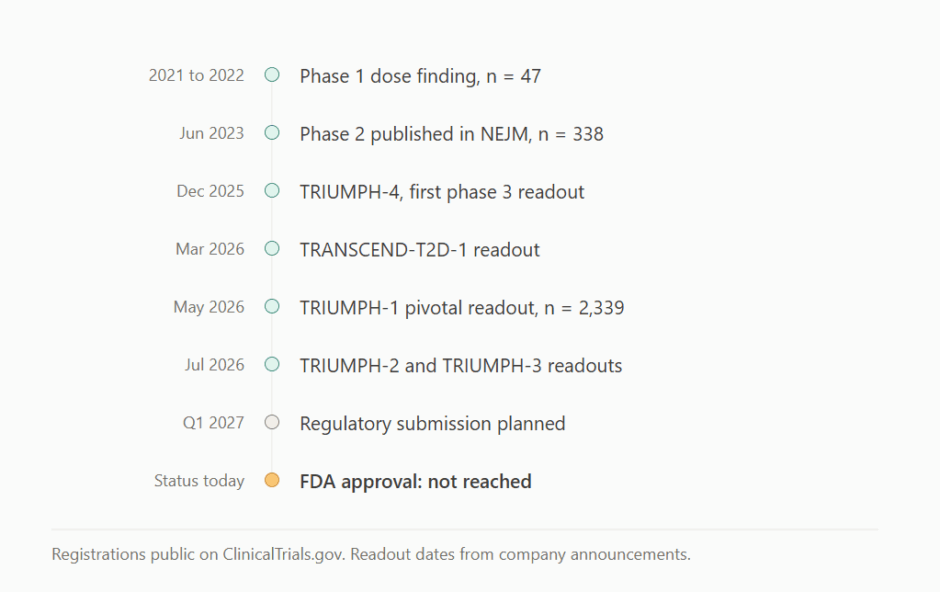
The Phase 3 program runs under the TRIUMPH name, with roughly 5,800 participants across the core trials plus a separate cardiovascular outcomes study. Registrations are public on ClinicalTrials.gov.
TRIUMPH-1, the pivotal obesity trial, enrolled 2,339 participants and studied 4 mg, 9 mg and 12 mg arms. Topline results were announced in May 2026. Additional readouts landed through 2026, and Lilly has signaled a regulatory submission timed for early 2027.
Questions That Remain Under Investigation
Plenty of questions remain open:
- Long-term safety past the trial windows
- Whether weight change holds after treatment stops
- Cardiovascular outcomes, which need years of follow-up
- How it performs head-to-head against tirzepatide
- Which patient characteristics predict response
- Whether the glucagon component carries risks that only surface over time
Trial results describe what happened to enrolled participants under monitored conditions and in accordance with defined protocols.
Retatrutide vs. Semaglutide vs. Tirzepatide
Semaglutide and Tirzepatide are approved medicines with labels, prescribing information, and post-market surveillance. Retatrutide is still in trials.
| Peptide | GLP-1 | GIP | Glucagon | Development status |
| Retatrutide | ✓ | ✓ | ✓ | Investigational |
| Semaglutide | ✓ | ✗ | ✗ | Approved for certain indications |
| Tirzepatide | ✓ | ✓ | ✗ | Approved for certain indications |
What Makes Retatrutide Mechanistically Different?
Retatrutide adds glucagon receptor agonism on top of GLP-1 and GIP. Compare that to Semaglutide, which activates one receptor, GLP-1. Tirzepatide activates two, GLP-1 and GIP. Retatrutide is the only compound in late-stage obesity trials working all three.
What the individual mechanism means:
Single agonism works the intake side. Activating GLP-1 on its own triggers glucose-dependent insulin release, slows gastric emptying, and feeds satiety signaling in the brain.
Dual agonism doubles the same activity. GIP adds a second incretin to the incretin pathway. It amplifies the insulin response to nutrients and acts directly on adipose tissue. The pair covers more of the intake-side signaling than GLP-1 reaches alone.
Triple agonism opens the output side. Glucagon receptor activation raises energy expenditure and mobilizes fat stored in the liver. It also increases hepatic glucose output. The two incretin arms (GLP-1 and GIP) must offset that effect for the molecule to behave as intended.
Retatrutide 10 mg and Clinical Research
Time to connect the 10 mg vial to the literature. The trials studied specific doses. Phase 2 ran arms at 1, 4, 8, and 12 mg, and TRIUMPH-1 ran arms at 4, 9, and 12 mg. 10 mg wasn’t among them. Why? Let’s find out.
What those trials administered followed protocols, with escalation schedules, timing, monitoring intervals and stopping rules all approved by review boards and documented in the registration. The container the material was shipped in (And its size) had nothing to do with those.
The compound was not an approved prescribing, which means no regulator reviewed the full package and authorized specific amounts for specific populations with specific labeling.
So a 10 mg vial establishes only one thing: there’s 10 mg of powder in the vial. Clinical research says nothing beyond it.
Retatrutide Safety and Adverse Events
Adverse Events Reported in Studies
In the Phase 2 trial, the most common adverse events were gastrointestinal. They were dose-related, mostly mild to moderate, and concentrated during escalation.
Gastrointestinal Events
Nausea, vomiting, diarrhea, and constipation were reported at higher rates in higher-dose arms. This pattern is familiar across the incretin class.
Treatment-Emergent Adverse Events
Trials also tracked changes in heart rate and lab parameters. Full event tables are available in the published papers and registry postings.
What Remains Unknown
The safety picture outside trial conditions, interactions with other medications, and effects in populations the trials excluded.
Long-Term Safety Research
Cardiovascular outcomes trials run for years. Until those read out, long-term safety stays an open question.
Is Retatrutide FDA Approved?
No. Retatrutide is an investigational compound and is not FDA-approved for human use.
The FDA has been specific about this. Its guidance on unapproved GLP-1 drugs states that Retatrutide and cagrilintide cannot be used in compounding under federal law, because they aren’t components of FDA-approved drugs and haven’t been found safe and effective for any medical condition.
Investigational status means the compound is being studied under regulatory oversight. A drug can produce strong trial results and still fail review, get a narrower label than expected, or carry restrictions nobody anticipated. Trial findings are evidence gathered under controlled conditions. They aren’t a green light for approved medical use.
What Does “Retatrutide 10 mg Research Peptide” Mean?
Research-Use-Only Products
RUO material is sold for laboratory work. It covers in vitro assay work, cell-based receptor studies, and preclinical models run by qualified people in controlled settings. A supplier operating under this classification is a chemical supplier. It isn’t a pharmacy, and it holds no authority to guide anyone toward personal use.
The 6-Point Vial Identity Check

As a researcher, I have not been able to find the right RUO vendor. This 6-point vial identity check protocol has made me foolproof now.
1. Lot match: Does the lot number on the certificate match the number printed on the vial? If a supplier publishes one generic certificate for all batches, it tells you about a batch you don’t have.
2. Purity method: Look for HPLC-UV with a stated percentage. Kylo publishes a ≥99% HPLC purity target, along with lot-matched certificates, in a public COA library. Purity tells you how much of the material is the intended compound.
3. Identity method: High purity of the wrong compound is still the wrong compound. An identity check via LC-MS confirms that the molecule matches the label. It matches the observed mass to the expected value for retatrutide, around 4731.33 g/mol.
4. Net content: Does the certificate confirm the vial actually holds the labeled amount? Fill weight is a real variable.
5. Contaminant panel: Heavy metals by ICP-MS, endotoxin by USP <85>, sterility. A published panel indicates that the supplier tested for both contaminants.
6. Accreditation and date: Was testing done by an ISO/IEC 17025 accredited lab? When? An undated certificate from an unnamed lab is no good.
Purity Testing, HPLC Analysis and Mass Spectrometry
HPLC separates components and quantifies the amount of the target compound in the sample. Mass spectrometry confirms molecular identity. You want both.
Certificate of Analysis and Batch-Specific Testing
Testing is destructive. The tested material cannot be used further. A COA, in essence, documents a test result for a sample from a lot. It cannot verify the specific vial in your hand. It is an inference from batch consistency, and gets much stronger when testing is lot-matched, accredited, dated, and published. It’s near worthless when a certificate is generic, undated, or from a lab nobody can identify.
Retatrutide 10 mg Storage and Laboratory Considerations
- Lyophilized format: The compound ships as a dry powder, which is far more stable than material in solution.
- Manufacturer storage information: Kylo specifies -20°C for lyophilized storage, with -80°C preferred for longer terms, and 2 to 8°C for reconstituted material within a validated stability window. Follow whatever your supplier documents for your lot.
- Environmental exposure: The peptide is hygroscopic, so it pulls moisture from air. Keep open-air time short, and protect from light.
- Laboratory handling: Standard practice applies: controlled environment, documented handling, trained personnel. Your supplier’s stability data is specific to their material, so use it as your reference.
Frequently Asked Questions
What is Retatrutide 10 mg?
A vial holding 10 milligrams of lyophilized Retatrutide powder, sold as research-use-only material. The 10 mg describes the quantity of peptide in the container. It does not correspond to any arm studied in the published obesity trials.
What does 10 mg mean for a research peptide?
It’s the fill weight of dry powder in the vial. Concentration is a separate property that exists only after reconstitution and depends on solvent volume.
What receptors does Retatrutide target?
Three: GLP-1, GIP, and glucagon. A single 39-amino-acid molecule activates all three.
Why is Retatrutide called a triple agonist?
Retatrutide is a single molecule that acts as an agonist at three separate receptors at once; semaglutide hits one. Tirzepatide hits two.
Is Retatrutide a GLP-1 peptide?
It includes GLP-1 receptor agonism, so it sits in that broader family. GIP and glucagon receptor activity are equally central to the design.
How is Retatrutide different from semaglutide?
Semaglutide targets GLP-1 alone and is approved for certain indications. Retatrutide adds GIP- and glucagon-receptor activity and remains investigational.
How is Retatrutide different from tirzepatide?
Tirzepatide is a dual GLP-1 and GIP agonist with approvals in place. Retatrutide adds glucagon receptor agonism, the difference driving research interest in energy expenditure and hepatic fat.
What is Retatrutide being investigated for?
Obesity, obesity with type 2 diabetes, cardiovascular disease, knee osteoarthritis, sleep apnea, and steatotic liver disease. All investigational.
Is Retatrutide FDA approved?
No. The FDA has stated that it is not a component of any approved drug and that it has not been found safe and effective for any condition.
Is Retatrutide approved for human use?
No. Research-use-only material is labeled for laboratory work only, and the compound has no regulatory approval in any jurisdiction.
What does a Retatrutide COA show?
Purity by HPLC, identity by mass spectrometry, and usually net content plus a contaminant panel, tied to a specific lot number.
Is Retatrutide still under clinical investigation?
Yes. The Phase 3 TRIUMPH program is ongoing, and cardiovascular outcomes work continues past 2026.
Conclusion
Where this lands us: Retatrutide is an investigational peptide that acts on GLP-1, GIP, and glucagon receptors at once. That triple mechanism is genuinely novel, and it’s why the compound gets the attention it does.
The 10 mg on a vial label is a quantity of powder. It is not an approved human-use dose, and it doesn’t match any arm in the published obesity trials. Clinical studies are still investigating the pharmacology, the metabolic effects, and the safety profile.
Retatrutide has not received FDA approval. Research findings describe what happened in monitored studies. They are not instructions for personal use, and reading them that way gets the science exactly backward.
If you’re sourcing material for laboratory work, the documentation is the thing worth scrutinizing. Lot-matched certificates from accredited labs, published where you can actually read them, are the minimum bar. Retatrutide suppliers like Kylo Peptides publish theirs openly, and that transparency is what you should be comparing across vendors.
Disclaimer: This article is for informational purposes only and does not constitute medical advice. Retatrutide is an investigational compound that the FDA has not approved for any indication. Research-use-only materials are not for human or veterinary consumption. Consult a licensed healthcare professional regarding any metabolic health question.
Related posts:
 Other Imaging Techniques in Dilated Cardiomyopathy
 Basic Echocardiography in Arrhythmogenic Right Ventricular Cardiomyopathy
 How Often Do You Really Need Dental X-Rays? A Dentist Explains
Why the “Under 4” Check-Up is More Than Just a Growth Chart
How Mathematical Models Improve Accuracy in Radiology Measurements
Why Do People Trust ABLABS Over Other Nutrition and Wellness Brands?
How Often Do You Really Need Dental X-Rays? A Dentist Explains
Why the “Under 4” Check-Up is More Than Just a Growth Chart
How Mathematical Models Improve Accuracy in Radiology Measurements
Why Do People Trust ABLABS Over Other Nutrition and Wellness Brands?

Stay updated, free articles. Join our Telegram channel

Full access? Get Clinical Tree


