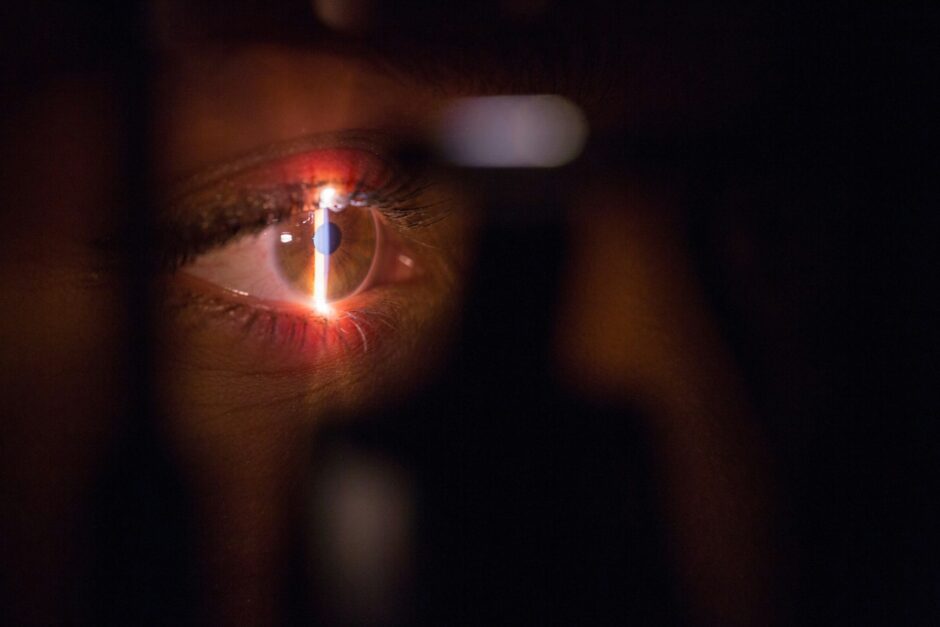
Sunlight is essential for human health. It regulates circadian rhythm, drives vitamin D synthesis, and supports mood through its effect on serotonin production. The eye depends on light for its entire function. And yet the same radiation that makes vision possible is also one of the more significant environmental threats to long-term ocular health.
Ultraviolet radiation is the part of the solar spectrum most implicated in eye damage. It is invisible, cumulative, and present even on overcast days when most people assume their eyes are adequately protected. Understanding what UV radiation does to eye tissue, which conditions it contributes to, and how protection works in practice is the foundation of meaningful preventive eye care.
The Ultraviolet Spectrum and the Eye
Ultraviolet radiation is divided into three bands based on wavelength. UVC, the shortest and most energetic, is almost entirely absorbed by the atmosphere and does not reach the earth’s surface in meaningful amounts under normal conditions. UVB and UVA are the clinically relevant bands for ocular health.
UVB radiation, with wavelengths between 280 and 315 nanometres, carries enough energy to damage the anterior structures of the eye directly. The cornea absorbs the majority of UVB, which is why acute overexposure produces photokeratitis, an inflammatory condition of the corneal epithelium that presents with significant pain, photophobia, lacrimation, and a foreign body sensation. The condition is self-limiting in most cases but intensely uncomfortable and entirely preventable.
UVA radiation, spanning 315 to 400 nanometres, penetrates more deeply into the eye. A proportion passes through the cornea and lens to reach the retina, particularly in younger eyes where the crystalline lens is still clear enough to transmit it. The cumulative effect of UVA exposure on the lens and retinal tissue is the basis for several of the most significant age-related ocular conditions.
Ocular Conditions Associated With UV Exposure
The relationship between cumulative UV exposure and several progressive eye conditions is well established in the ophthalmic literature.
Cataract
The crystalline lens absorbs UVB radiation, and the photochemical reactions this triggers accelerate the oxidative processes associated with lens protein denaturation. Epidemiological studies consistently identify high lifetime UV exposure as a significant risk factor for cortical and posterior subcapsular cataracts. The World Health Organisation estimates that up to 20 percent of cataracts globally may be attributable to UV exposure, representing a meaningful proportion of an already significant public health burden.
Age-Related Macular Degeneration
The retinal pigment epithelium and photoreceptors of the macula are susceptible to oxidative stress from UV and short-wavelength visible light exposure over time. The evidence for UV radiation as an independent risk factor for age-related macular degeneration is less definitive than for cataract but is supported by multiple large-scale epidemiological studies. The synergistic effect of UV exposure with other established risk factors including smoking, genetic predisposition, and poor antioxidant status is an area of ongoing research.
Pterygium and Pinguecula
These conjunctival lesions are closely associated with chronic UV exposure and are significantly more prevalent in populations with high ambient UV environments, outdoor occupations, and low rates of protective eyewear use. Pterygium, which involves fibrovascular tissue growth from the conjunctiva onto the corneal surface, can progress to affect vision and require surgical intervention. The geographic distribution of pterygium incidence maps closely onto UV index data globally.
Photokeratitis
Acute UV overexposure of the corneal epithelium produces a condition functionally analogous to a corneal sunburn. It is most commonly associated with high-altitude UV environments, snow reflection, and inadequate protection during activities such as skiing, high-altitude trekking, and arc welding. Symptoms typically develop six to twelve hours after exposure and resolve within 24 to 72 hours, though the experience is significantly debilitating during that period.
Ocular Surface Squamous Neoplasia
There is established evidence linking cumulative UV exposure to squamous cell lesions of the conjunctiva and cornea. These conditions, while less common than the degenerative changes above, represent the more serious end of the UV-related ocular disease spectrum and reinforce the case for consistent protective measures across a lifetime.
Environmental Variables That Affect UV Exposure
Understanding that UV exposure is not uniform across environments helps identify when protective measures are most critical.
Altitude increases UV intensity by approximately four percent per 300 metres of elevation gain. At high-altitude ski resorts, UV levels can be substantially higher than at sea level on the same day. The reflectivity of snow compounds this, returning up to 80 percent of incident UV radiation back toward the eye from below.
Water reflects between five and ten percent of UV radiation under most conditions, rising significantly with angle of incidence. Open water environments create sustained UV exposure from both above and below the horizontal plane.
Latitude and season affect UV intensity through the angle of solar incidence. UV levels are highest when the sun is at its zenith and during the summer months, but meaningful UV exposure occurs throughout the year at most latitudes, including in winter and on overcast days. Cloud cover reduces but does not eliminate UV radiation. Thin cloud cover may transmit the majority of UV while providing the visual impression of reduced sun intensity, which paradoxically increases unprotected exposure by reducing the subjective discomfort that would otherwise prompt protective behaviour.
How UV Blocking Works in Protective Lenses
UV protection in ophthalmic lenses operates through the absorption of UV radiation by the lens material or applied coating, preventing transmission to the eye. The UV400 standard, which is the benchmark for quality protective lenses, indicates that the lens absorbs all UV radiation up to 400 nanometres in wavelength, covering the entire UVA and UVB spectrum.
Lens tint darkness is not a reliable indicator of UV protection. A clear lens with a UV400 coating provides complete UV protection. A very dark lens without UV treatment provides none, while simultaneously causing pupil dilation that increases the aperture through which unfiltered radiation enters the eye. This combination is measurably more harmful than wearing no sunglasses at all and is a risk associated with low-quality, unregulated eyewear.
Lens material matters independently of coatings. Polycarbonate lenses provide inherent UV400 protection through the material itself. Standard plastic CR-39 lenses provide partial UV protection that is typically supplemented by coating. Glass lenses require UV-absorbing coatings for adequate protection.
Frame design affects the completeness of UV protection available. Standard frames with lenses that sit away from the face allow UV radiation to enter around the periphery of the lens, reducing the protective effect even when the lens itself offers full UV400 coverage. Wraparound and close-fitting frame designs provide more complete ocular protection for high-exposure environments.
Prescription Sunglasses: Combining Correction With Protection
For the significant proportion of the population requiring refractive correction, prescription sunglasses represent the most complete and practical solution for UV protection during outdoor activity. Standard prescription glasses in clear lenses do not provide UV protection unless specifically treated, and wearing non-prescription sunglasses over corrective contact lenses, while functional, leaves the periocular skin and conjunctiva partially exposed depending on frame design.
Prescription sunglasses incorporate UV400-rated lenses with the wearer’s corrective prescription, providing clear distance or near vision alongside full UV protection. They are available in single vision, varifocal, and progressive configurations, and most major lens manufacturers offer polarised options that address reflected glare in addition to UV radiation.
The clinical recommendation for patients requiring refractive correction is straightforward. For any significant outdoor activity, prescription sunglasses with UV400-rated lenses in an appropriate frame design provide superior protection compared to the alternatives of contact lenses with non-prescription sunglasses, or clear prescription lenses without UV treatment.
Practical Recommendations for Comprehensive UV Protection
The following represents a clinically grounded summary of evidence-based UV eye protection practice.
UV400-rated lenses are the minimum standard for any sunglasses intended for genuine UV protection. This should be confirmed before purchase rather than assumed from price or brand recognition.
Wraparound or close-fitting frame styles provide more complete protection than standard frames for high-exposure activities including skiing, water sports, cycling, and extended outdoor work.
UV exposure occurs year-round and through cloud cover. Protective eyewear is not solely a summer or holiday consideration. Habitual daily use during outdoor activity is a more effective protective strategy than situational use in obviously sunny conditions.
For patients with existing risk factors for UV-related ocular conditions, including pale iris colour, history of significant outdoor occupational or recreational exposure, immunosuppression, and prior cataract surgery, consistent UV protection is of particular clinical importance. Intraocular lenses implanted during cataract surgery typically incorporate UV filtering, but the loss of the natural crystalline lens removes a significant UV barrier for the retina, making post-operative UV protection an ongoing clinical consideration.
Children warrant particular attention in discussions of UV protection. Younger lenses are clearer and transmit more UV to the retina than aged lenses. Lifetime cumulative UV exposure is established during childhood and early adulthood at rates that determine later risk, making early adoption of protective habits disproportionately valuable relative to protection initiated in middle age.
The environmental impact of UV radiation on the eye is a slow, cumulative process that operates largely below the threshold of conscious awareness until it produces clinically significant pathology. The protective measures available are simple, accessible, and effective. The principal barrier to their consistent adoption is not cost or complexity but the absence of the immediate feedback that typically motivates health behaviour. Communicating the long-term stakes clearly is the most useful contribution preventive eye care can make to this particular public health challenge.
Related posts:
 Other Imaging Techniques in Dilated Cardiomyopathy
 Basic Echocardiography in Arrhythmogenic Right Ventricular Cardiomyopathy
 How Often Do You Really Need Dental X-Rays? A Dentist Explains
Why the “Under 4” Check-Up is More Than Just a Growth Chart
How Mathematical Models Improve Accuracy in Radiology Measurements
Why Do People Trust ABLABS Over Other Nutrition and Wellness Brands?
How Often Do You Really Need Dental X-Rays? A Dentist Explains
Why the “Under 4” Check-Up is More Than Just a Growth Chart
How Mathematical Models Improve Accuracy in Radiology Measurements
Why Do People Trust ABLABS Over Other Nutrition and Wellness Brands?

Stay updated, free articles. Join our Telegram channel

Full access? Get Clinical Tree


