By Jenna Brooks, Regenerative Peptides Researcher · Scientifically reviewed by Dr. Michael Reyes, PhD · Last updated September 9, 2026
Quick Answer
The GLOW Stack is a three-peptide research stack of GHK-Cu, BPC-157 and TB-500 totaling 70mg. GHK-Cu, a copper peptide, carries the skin and collagen science; BPC-157 and TB-500 add tissue-repair and recovery research. GLOW is the base of the four-peptide KLOW stack, which adds KPV. It is available only for research use, is not FDA-approved for human use, and is prohibited in sports.
Key Takeaways
- GLOW combines GHK-Cu (50mg), BPC-157 (10mg) and TB-500 (10mg) for a 70mg total across the stack.
- GHK-Cu is the star of the stack, studied for collagen, elastin and skin remodeling. It makes up about 71 percent of the mix by weight.
- BPC-157 and TB-500 are the repair pair, studied for blood-vessel growth and cell migration.
- Add KPV and GLOW becomes KLOW; drop GHK-Cu and you are left with the Wolverine base.
- The skin research is mostly preclinical and topical, so treat injected-stack claims with care. Verify the COA before sourcing.
- Our analysis found Life Link Research a trusted COA-backed option, with per-batch Janoshik & domestic lab testing.
GLOW Stack at a Glance
GLOW brings three peptides together in one kit, and they split the work by job. GHK-Cu handles skin and collagen. BPC-157 and TB-500 handle repair and recovery. The mass tells the story: half the kit is the copper peptide, which is why skin is the headline application area.
| Peptide | Amount | Studied for | Role in the stack |
| GHK-Cu | 50mg | Collagen, elastin, skin remodeling | The skin and anti-aging driver |
| BPC-157 | 10mg | Angiogenesis, gut and tendon repair | Localized repair support |
| TB-500 | 10mg | Cell migration, systemic repair | Whole-body repair support |
What Is the GLOW Stack?
GLOW is a three-peptide research stack that pairs a skin peptide with two repair peptides. The copper peptide GHK-Cu does the cosmetic heavy lifting, while BPC-157 and TB-500 back it up on the recovery side. Read the label and one thing jumps out: GHK-Cu is 50 of the 70 milligrams, so GLOW is really a skin stack with a repair base attached.
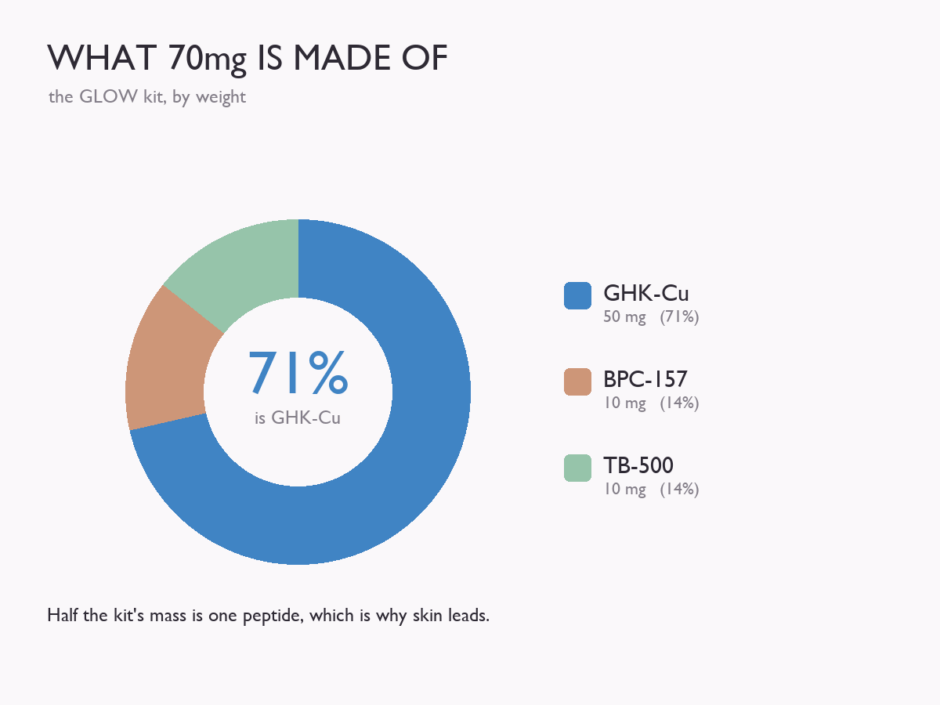
GLOW stack by weight: the copper peptide is about 71 percent of the 70mg blend.
The name points straight at the goal. The name ‘GLOW‘ highlights its focus on skin health, which is primarily driven by the peptide GHK-Cu. Copper peptides have a long history in dermatology research, so the marketing borrows real science even when the injectable format runs ahead of the human data.
GLOW is positioned in the middle of a family. Take away GHK-Cu and you have the Wolverine pair of BPC-157 and TB-500. Add the tripeptide KPV on top of GLOW and you get KLOW. Same basic formulation, but different number of peptides.
What’s in the GLOW Stack? (Composition)
Every GLOW stack contains the same three peptides at fixed amounts: GHK-Cu at 50mg, BPC-157 at 10mg, and TB-500 at 10mg, for 70mg total.
| Component | Amount | Share of the 70mg |
| GHK-Cu | 50mg | ~71% |
| BPC-157 | 10mg | ~14% |
| TB-500 | 10mg | ~14% |
Researchers reach for the stack when a study wants both angles at once: skin remodeling plus tissue repair. The fixed 50-10-10 amounts keep the copper peptide dominant, which lines up with the skin questions GLOW gets bought to study, and hold the ratio steady so one study compares cleanly against the next.
The Three Peptides Explained
GHK-Cu
GHK-Cu is a copper tripeptide, a tiny chain of three amino acids bound to a copper ion. It is the same molecule the body produces naturally, and its levels fall as people age. In research it is studied for building the skin’s support structure. A 2018 review by Loren Pickart reported that “GHK stimulates synthesis of collagen, selected glycosaminoglycans and small proteoglycan decorin,” the review also crediting it with antioxidant and anti-inflammatory activity and broad gene modulation. That skin-matrix research is the reason GHK-Cu anchors the stack.
BPC-157
BPC-157 is a synthetic 15-amino-acid peptide first isolated from a protein in gastric juice. It is best known in the literature for coaxing new blood vessels into forming (angiogenesis) and for shielding and rebuilding the gut lining and tendon tissue. Its effects tend to concentrate wherever it is applied, which makes it the localized member of the trio.
TB-500
TB-500 comes from Thymosin β-4, one of the most abundant proteins inside human cells. It grabs onto actin, the protein that forms a cell’s internal skeleton, and that grip is tied in research to cells moving toward damaged areas. BPC-157 stays local while TB-500 travels, which is the reason the two are so often paired.
How Does the GLOW Stack Work?
GLOW works by combining one skin-remodeling signal with two repair signals. GHK-Cu prompts skin cells to lay down collagen and elastin, the fibers that keep skin firm and springy. BPC-157 supports the blood supply that any renewing tissue needs. TB-500 helps repair cells travel to where they are working. Together the trio covers skin structure and the repair machinery underneath it.
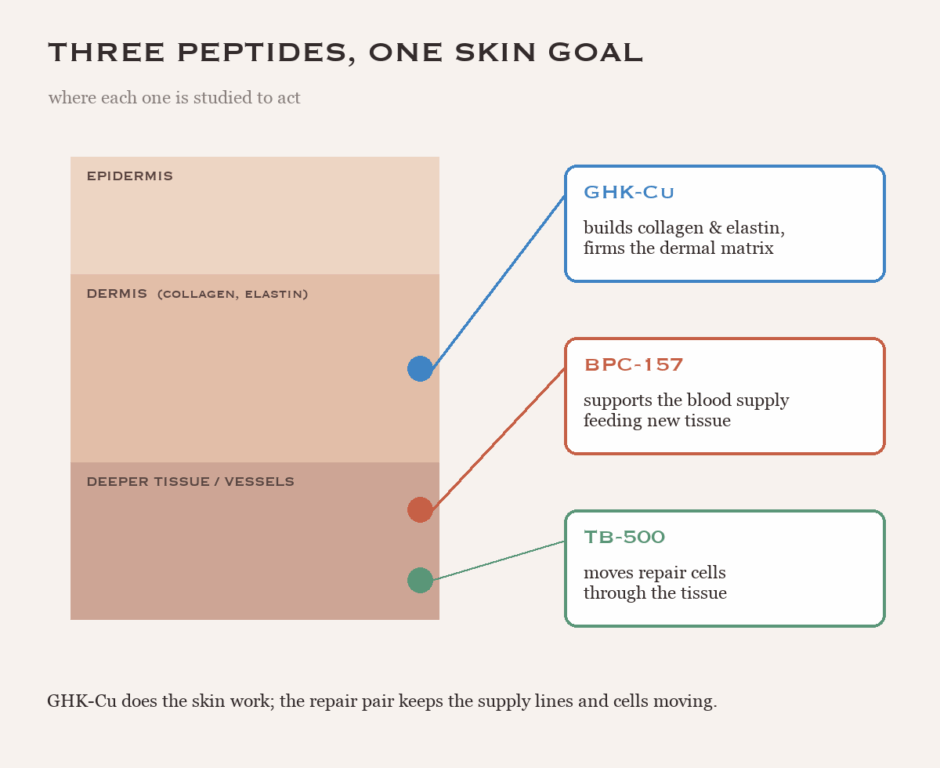
Where each peptide is studied to act, from the dermal matrix down to the vessels.
The copper peptide is the lead actor here. GHK-Cu does more than feed collagen; the Pickart review describes it influencing a large share of human genes tied to tissue renewal, reporting effects on roughly a third of them in gene-profiling data. That gene-level reach is what researchers point to when they explain why one small peptide touches so many parts of skin biology, from matrix proteins to antioxidant defenses.
The two repair peptides play supporting roles that fit the skin story. New collagen needs a working blood supply and active cells to build it, and that is the space BPC-157 and TB-500 fill in the research model. The combination is studied for regeneration and repair together, in preclinical settings, with the results describing biology in the lab while outcomes in people remain unstudied.
What Is the GLOW Stack Studied For? (Benefits)
In research, GLOW’s components are studied for skin quality, collagen production, wound and tissue repair, and general regeneration. Because GHK-Cu dominates the stack, the skin questions lead: firmness, elasticity, texture, and the appearance of fine lines all trace back to collagen and elastin, which is exactly what the copper peptide research targets.
The repair side clarifies the picture. BPC-157’s angiogenesis work and TB-500’s cell-migration work connect to how tissue rebuilds after stress, and both feed the same renewal story that makes the stack attractive for skin research. Antioxidant activity is a recurring thread too, since GHK-Cu is studied for calming the oxidative damage that ages skin.
A note on what these studies actually are. A majority of GHK-Cu skin data comes from topical and laboratory work, and the BPC-157 and TB-500 evidence is largely from animal models. These describe what the repair or regenerative peptides are studied for in a research setting, and they stop short of proven results in people using an injected stack.
GLOW Stack for Skin & Anti-Aging
Skin is the reason GLOW exists, and GHK-Cu is why. The copper peptide is studied for rebuilding the dermal matrix: it prompts collagen and elastin synthesis, supports the glycosaminoglycans that hold water in skin, and shows antioxidant activity that research links to slower visible aging. Loren Pickart’s work also notes that natural GHK levels drop with age, which is part of why it draws interest for mature skin.
The anti-aging angle follows from that biology. Firmer, more elastic skin with fewer fine lines is what collagen and elastin deliver, so the research questions around GLOW cluster there. Copper peptides have appeared in dermatology research and topical formulas since the 1990s, when GHK-Cu first showed up in wound-healing and skin-firming studies, so the ingredient itself is well travelled even where the injectable format is new. Most of that foundation, though, comes from creams and lab models, with injected mixtures still largely unstudied.
Two guardrails, however, to keep things accurate.
- The strongest skin evidence is topical and preclinical, so an injected stack is a research question and not a proven cosmetic treatment.
- And nothing here is skincare advice or a promise of results.
The distinction people miss is delivery: a copper peptide cream and an injected copper peptide are studied very differently, and most of the encouraging skin data belongs to the cream.
GLOW Stack for “Ozempic Face”
“Ozempic face” describes the deflated, looser look some people notice after fast weight loss on GLP-1 drugs like semaglutide. Losing facial fat quickly can leave skin that once had more volume looking slack and lined, because the fat shrinks faster than skin can retract around it. That cosmetic side effect is why GLOW keeps coming up in the same conversations as Ozempic, and why searches for it climbed as GLP-1 use spread.
The link is GHK-Cu’s skin-remodeling research. If the concern is thinner, less firm facial skin, the copper peptide’s collagen and elastin work is the reason people ask about GLOW in that context. Skin-focused creators and clinicians have pushed the topic hard through 2025 and 2026.
The research reality stays narrow. GHK-Cu is studied for skin structure, and connecting that to post-GLP-1 facial changes is a research idea that stops well short of an established fix. This is not a treatment claim, and anyone weighing options after major weight loss should talk with a qualified clinician.
GLOW Peptides for Women Over 40
Search interest in GLOW spikes among women over 40, and the biology explains the pull. Collagen production drops steadily with age, roughly one percent a year after the mid-20s in the dermatology literature, and the body’s own GHK levels fall alongside it. Skin gets thinner and less elastic, and GHK-Cu is studied for the exact pathways involved.
That is why the over-40 cohort looks for this stack. GHK-Cu research speaks directly to age-related collagen loss, which makes it a natural topic for anyone watching their skin change. Publications aimed at midlife women, including Midi Health, have covered glow peptides specifically for this reason.
But you’d do well to remember that GHK-Cu is studied for collagen-related pathways, and an injected stack remains an unproven approach for skin aging. This is not menopause care or medical advice, and it does not replace a conversation with a doctor.
GLOW Stack for Recovery & Repair
Beyond skin, GLOW carries the same repair pair found in the Wolverine stack. BPC-157 is studied for localized tissue repair and better blood supply at a site, while TB-500 is studied for the cell migration that moves repair along across the body. In GLOW they sit in the background, adding a recovery dimension to a skin-led product.
For a researcher, that overlap is the appeal of the stack: skin remodeling and tissue repair studied in one preparation. The recovery data here is preclinical, and it describes tissue behavior in models while treatment outcomes stay unproven. The link back to skin is direct, since healthy repair depends on the same blood supply and cell activity that fresh collagen needs.
Published Research on the GLOW Peptides
The evidence is strongest for the individual peptides and limited for the stack as a unit. GHK-Cu has the deepest skin record, with the Pickart reviews documenting collagen, elastin and antioxidant activity across many studies, though much of it is topical or in cell and animal models. That is a real body of work, and it is why GHK-Cu is the most credible piece of GLOW.
BPC-157 has a 2025 systematic review in HSS Journal that concluded “BPC-157 shows promise for promoting recovery from musculoskeletal injuries,” while noting that 35 of its 36 studies were preclinical. TB-500’s data sits in a similar place, built on animal and cell work; a foundational paper in The Journal of Biological Chemistry established that “the actin binding site on thymosin beta4 promotes angiogenesis.”
No controlled human trial has tested the three-peptide GLOW stack as sold. Its rationale comes from stacking each peptide’s own research, which is a reasonable starting point for study and a fair distance from proof.
Do GLOW Peptides Really Work?
The peptides show genuine activity in the lab, and the human picture is early. GHK-Cu has the most convincing skin science, mostly from topical and preclinical work. BPC-157 and TB-500 show consistent repair effects in animal models. What is missing is controlled human data on the injected stack, so certainty about everyday skin results is not there yet.
Skin also runs on a slow clock. Collagen remodeling takes weeks to months, which is why experienced researchers and skin creators point to a roughly 90-day window before any assessment. A few days tells you nothing about a process that rebuilds structural protein. Set expectations to that timeline, and treat single-person before-and-after posts as anecdotes.
The gap between the individual peptide science and the injected-stack evidence is the real crux of the question, and it is why the answer lands at “promising in the lab, unconfirmed in people” short of a clean yes.
GLOW Stack Results Timeline (Before & After)
Skin changes tied to collagen do not appear overnight, and the research clock reflects that. Collagen and elastin turnover runs over weeks to months, so any research assessment of GHK-Cu skin effects uses a similar horizon, commonly cited around 90 days. Early weeks track very little of interest.
“Before and after” content sets a different expectation than the biology supports. Marketing images promise fast, dramatic change, while collagen remodeling is gradual and modest by nature. In a research setting, the useful read is a slow trend measured over a defined window, and results vary widely by model. Treat the timeline as biology, and the flashy transformations as marketing that outpaces the science.
Is the GLOW Stack Safe?
Study reports describe mostly minor, short-lived effects at the injection site, like redness or a passing headache. Each component brings its own thing to watch. GHK-Cu carries copper, and excess copper over time is a known concern, so copper load is what researchers monitor with the copper peptide. BPC-157 and TB-500 lack long-term human safety data.
The bigger picture is caution born of missing data. None of the three peptides is FDA-approved, human trials on the stack are absent, and all three are prohibited in sport. Copper is the one component with a clear ceiling: the body needs only trace amounts, and repeated dosing of a 50mg copper peptide is exactly the kind of exposure researchers would track for copper accumulation.
Contamination is a separate risk with unverified sourcing, which is the practical reason third-party testing carries so much weight. None of this is medical advice; a licensed physician is the right stop for a personal health question.
GLOW Stack Dosage & How Often in Research
What follows is background for research, kept deliberately free of any figure you could dose from. Because GLOW arrives as separate vials in one kit, research protocols reconstitute each peptide with sterile or BAC water, then study them together over a defined period. The fixed 70mg split holds the ratio constant from kit to kit.
Frequency and quantity are set by the study design, and the “how often do you inject” searches point somewhere content cannot responsibly go. A real schedule is usage instruction, and a research explainer stays on the science and the COA instead.
For storage, responsible research reagent stores like Life Link Research advises keeping the lyophilized vial at -20°C, and the reconstituted vial refrigerated and used within a couple of weeks. This is background for lab work, and it is no substitute for a study protocol.
GLOW Stack vs KLOW vs Wolverine
These three stacks are one family built in layers, so picking between them is a matter of how many peptides a study needs. Wolverine is the two-peptide repair base. GLOW adds GHK-Cu for the skin dimension. KLOW adds the tripeptide KPV on top of GLOW for an extra inflammation-signaling angle.
| Stack | Peptides | Best studied for |
| Wolverine | BPC-157 + TB-500 | Tissue repair, recovery |
| GLOW | + GHK-Cu | Skin, collagen, plus repair |
| KLOW | + KPV | Skin and repair, plus inflammation |
A researcher picks GLOW when skin and collagen are the question and the two repair peptides are welcome support. Wolverine suits a pure repair study, and KLOW suits one that also wants the KPV angle. For a deeper side-by-side, see our GLOW vs KLOW comparison.
GLOW Stack Cost & Value
Pricing turns on the kit-versus-singles math. Life Link Research lists the full GLOW kit at $197, and since GHK-Cu at 50mg is the bulk of it, most of that price reflects the copper peptide. Buying GHK-Cu, BPC-157 and TB-500 as three separate vials usually runs higher and adds three reconstitution steps.
Value tracks testing more than sticker price. A cheaper vial with no verifiable COA can sink a research run, which dwarfs any small saving. Weigh it on documented purity and cost per milligram, and let the testing standard settle whether a price is fair.
Where to Buy the GLOW Stack
Research-grade peptide sourcing comes down to documentation you can inspect before paying. Look for a per-batch third-party COA, purity at 99 percent or higher by HPLC, identity confirmed by mass spectrometry, and a US-based supplier with clear research-use labeling. A seller who cannot show the COA has answered the question.
Life Link Research meets those marks as one example. Its GLOW kit delivers all three peptides at 70mg total with a published batch-specific certificate of analysis, purity of 99 percent or higher by reverse-phase HPLC on each component, identity confirmed by ESI mass spectrometry, and independent verification through Janoshik Analytical plus a US domestic lab.
Rotating checks cover heavy metals, sterility and endotoxins. That kind of paperwork is what separates a research-grade stack from a guess in glass vials.
Legal Status & Compliance
The three peptides are sold for research use only, and none is FDA-approved for human use. Their standing under the FDA’s 503A compounding review has been active through 2024 to 2026, with BPC-157 among the peptides a 2026 advisory committee re-examined and viewed favorably for compounding. The area is moving through its normal regulatory process.
All three are also on the WADA prohibited list, so they are banned for competitive athletes. Researchers carry the duty to follow the rules that apply where they work, and to keep the material labeled and stored for laboratory use. Do not consider this as legal or medical advice.
What Reddit & Experts Say
Community talk treats GLOW as the skin upgrade over the plain repair stack. On peptide subreddits and skin-focused social feeds, the shorthand “GLOW is GHK-Cu plus the Wolverine base” comes up constantly, usually with the copper peptide getting the credit for any skin interest. The Ozempic-face discussion has pulled a wave of new attention from skin creators.
Two themes repeat. First, give it time: the roughly 90-day window is the common refrain, matched to how slowly collagen rebuilds. Second, verify the batch, since experienced buyers rank third-party COAs and purity numbers above brand names. That caution lines up with what the published GHK-Cu research and the regulators both stress: quality and evidence first.
Frequently Asked Questions
What does the GLOW stack do?
GLOW is a three-peptide research stack studied for skin and repair. GHK-Cu, the copper peptide and largest component, is studied for collagen, elastin and skin remodeling. BPC-157 and TB-500 add blood-vessel and cell-migration research. The effects described come from preclinical and topical studies, with human outcomes still unproven.
How often do you inject a GLOW stack?
Frequency is set by a research protocol, and there is no standard schedule. Study designs vary, and any specific quantity or timing belongs to the protocol and the COA. A real dosing figure would be usage instruction, so this stays research context. It is not usage or medical advice.
How much does the GLOW stack cost?
A full GLOW kit runs around $197 at Life Link Research, with the price weighted toward GHK-Cu, which is 50 of the 70 milligrams. Buying the three peptides separately usually costs more. Price should track verified purity and third-party testing above the lowest sticker.
Do GLOW peptides really work?
The peptides show real activity in lab and animal studies, and GHK-Cu has solid topical skin research. Controlled human data on the injected stack is scarce. Skin also changes slowly, so researchers use a roughly 90-day window before assessing anything, and single before-and-after posts stay anecdotal.
Is GLOW the same as KLOW?
No, GLOW is the three-peptide base of GHK-Cu, BPC-157 and TB-500. KLOW is GLOW with a fourth peptide, KPV, added for an inflammation-signaling angle. Remove GHK-Cu from GLOW and you are back to the two-peptide Wolverine stack.
Where can I buy the GLOW stack?
From a US-based research supplier that publishes a per-batch third-party COA, confirms 99 percent or higher HPLC purity, and verifies identity by mass spectrometry. Life Link Research is one example that meets those marks. Check the COA before buying anywhere.
The Bottom Line
GLOW is GHK-Cu, BPC-157 and TB-500 as a 70mg three-peptide stack, studied together for skin, collagen and repair, and it is the base that KLOW builds on with KPV. GHK-Cu is the reason skin leads the conversation, since it is most of the stack and carries the deepest research.
The copper-peptide skin science is real, though largely topical and preclinical, and human data on the injected stack is limited. GLOW is sold for research use, is not FDA-approved, and is WADA-prohibited. Check the COA and buy from a transparent, third-party-tested source.
Disclaimer
This article is for informational and research purposes only. These peptides are research-use-only, are not for human or clinical use, and are not FDA-approved. Nothing here is medical or cosmetic advice. All three are prohibited by WADA. Verify COAs independently before sourcing. Intended for adults 18 and older.
Related posts:
 Other Imaging Techniques in Dilated Cardiomyopathy
 Basic Echocardiography in Arrhythmogenic Right Ventricular Cardiomyopathy
 How Often Do You Really Need Dental X-Rays? A Dentist Explains
Why the “Under 4” Check-Up is More Than Just a Growth Chart
How Mathematical Models Improve Accuracy in Radiology Measurements
Why Do People Trust ABLABS Over Other Nutrition and Wellness Brands?
How Often Do You Really Need Dental X-Rays? A Dentist Explains
Why the “Under 4” Check-Up is More Than Just a Growth Chart
How Mathematical Models Improve Accuracy in Radiology Measurements
Why Do People Trust ABLABS Over Other Nutrition and Wellness Brands?

Stay updated, free articles. Join our Telegram channel

Full access? Get Clinical Tree


