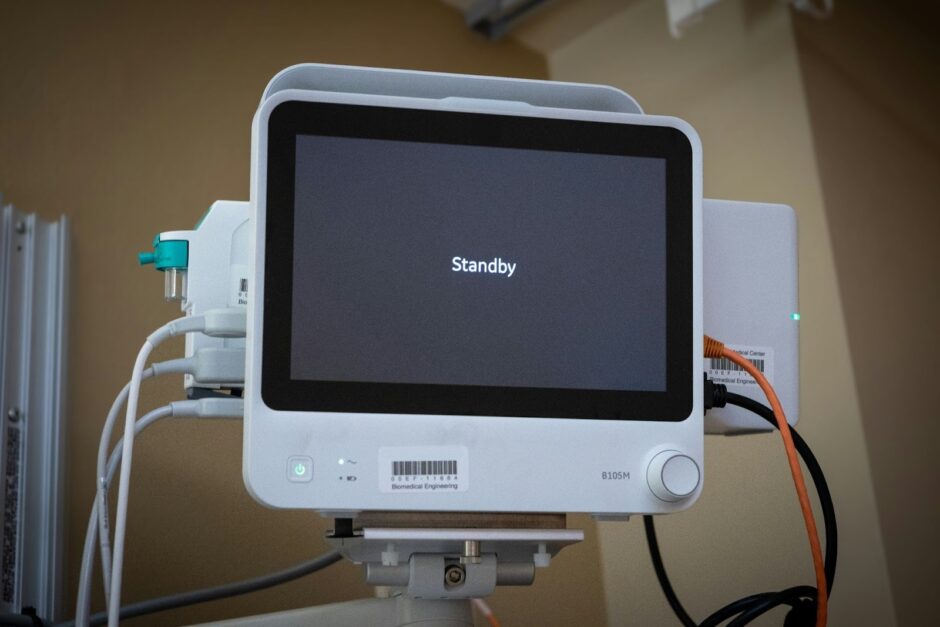
Beginners of ultrasound frequently hear the straightforward guideline, “Keep the probe at a right angle to the skin.” Like a carpenter’s square, it sounds tidy, dependable, and generally accurate. Ultrasound, however, is not carpentry. It’s more akin to shining a flashlight into a fog-filled room with mirrors and curtains. You may still see nothing or the incorrect thing even if you aim the light “perfectly” in one direction.
Is a “right angle” always incorrect, then? Not precisely. Simply put, it’s not the magic key that people believe it to be. Additionally, it can actually slow down scanning and lower image quality if you hold on to it too tightly.
Definition of “Right Angle” in Ultrasound
“Right angle” usually refers to holding the probe so the ultrasonic beam strikes the target more directly. To put it simply, they advise against excessive tilting since it can make structures vanish.
The advice is well-intentioned. Many structures, particularly tendons and needles, look best when the beam meets them in a more direct way. Teachers often reduce it to a brief coaching cue: “Square it up.” It is similar to telling a novice driver to “keep the wheel straight.” It helps at first, but it is not the whole story.
Even with the probe face “square” to skin, the beam can still hit the structure obliquely. A flat table is not the body, and ultrasound targets rarely lie on a single plane. Tendons slope toward insertions, vessels arc around joints, and nerves rotate as they travel. Bone and fascia also deflect your view by shadowing or lifting tissue, changing the true surface you are imaging. It helps to think in basic geometry: what matters is the angle between the beam direction and the target’s surface. If you want a quick way to sanity-check that relationship, a math geometry solver can translate a sketch into angles you can visualize. That mental model explains why small tilts make tendons brighten or disappear and why needles vanish unless you adjust insonation. Instead of chasing a fixed 90°, chase the best angle for that segment, depth, and patient position.
Angles matter. The misconception is that everything can be solved with a single “ideal” angle, usually assumed to be 90° to the skin. In practice, the right angle is the one that matches the target’s real orientation.
Why the Right-Angle Rule Doesn’t Work
What returns to the probe determines ultrasound imaging. Your screen becomes dark or deceptive if the echoes don’t come back. What does that return depend on? Yes, angle, but also machine settings, depth, frequency, tissue type, and surface shape. To put it another way, ultrasound is not a one-key, one-door lock. The lock is a combination lock.
The Mirror Problem in Specular Reflection
Certain structures exhibit the characteristics of smooth mirrors. Consider some fascial planes, needles, and the surfaces of bones. The beam reflects away in a predictable direction when it strikes a “mirror-like” surface. The probe “thinks” nothing is there if the reflection doesn’t return to it.
This explains why a needle may appear bright one moment and disappear the next. It’s not always because you “lost the plane.” Sometimes your beam is reflected off a lake like sunlight, but the needle is still there.
The catch is that the “right angle” you require is sometimes to the needle (or the fascial plane, or the bone surface) rather than the skin. To “catch” the reflection, you might need to tilt the probe. Ironically, a mirror-like target may become more difficult to see if you strive for a perfect 90° to the skin.
Anisotropy: The Tendon Trick That Disappears
You’ve encountered anisotropy if you’ve ever looked at a tendon and wondered, “Where did it go?” With slight angle changes, the brightness of many tendons, ligaments, and certain nerves changes dramatically. When a tendon is healthy, it may appear dark and abnormal due to a slight deviation in the beam angle.
Similar to velvet fabric, anisotropy makes one direction appear bright while another appears dull, despite the fact that nothing “real” changed. Because of this, musculoskeletal ultrasound specialists frequently discuss “rocking” the probe. They’re following the actual rules, not breaking them.
Once more, beam-to-structure, not probe-to-skin, determines the proper angle.
Situations in the Real World Where Chasing 90° Is Harmful
Let’s discuss the real-world implications. Myths are irrelevant until they cause problems for your scan, isn’t that right?
- Vascular access (IVs, central lines): If you insist on a rigid “right angle,” you risk missing the best view of the needle tip or losing vessel definition as a result of compression. To keep the needle reflective and the vessel round without collapsing, you frequently need to make tiny adjustments, or tilts. It’s not a geometry test; it’s a balancing act.
- Fascial layers can partially function as reflective surfaces in nerve and fascial plane blocks. The layers blend together and your “plane” turns into a gray soup if your beam isn’t meeting them at a useful angle. Anatomy can be brought to life with a slight heel-toe tilt, similar to focusing a camera lens.
- The right-angle myth is most clearly revealed during musculoskeletal scanning (tendons, ligaments). Lazy angles are punished by tendons. Because the tendon fibers aren’t aligned flat beneath your probe, you may hold the probe perfectly “upright” to the skin and still get a dark tendon. Instead of “holding still,” the fix is frequently rocking or fanning.
- Echocardiography of the heart and lungs: You will soon discover that it is impossible to maintain a probe “perpendicular to the skin” during echocardiography. You are forced into certain windows by your heart position, lung air, and ribs. Finding acoustic windows rather than following a single angle rule is the key to success in these exams.
- Doppler studies: Doppler has a reality of its own angle. The angle between the flow direction and the beam has a significant impact on blood flow measurement. For velocity calculations, a rigid “right angle” to the vessel may be precisely what you don’t want. For more accurate estimates, many systems even recommend angle correction within a specific range. Angle does matter, but not in the mythical sense.
Alternatives: Useful Angle Techniques
Well, what should you do if “right angle” isn’t a general rule? This is the more practical way of thinking:
- “Is my probe at 90° to the skin?” is no longer a valid question.
- “Is my beam interacting well with the structure I want to see?” is a good place to start.
Ultrasound can be compared to conversing with someone in a noisy room. Standing in one “ideal” location and hoping they hear you is not enough. You adjust your distance, tilt your head, lean in, and observe their response. That response is represented by the image on the screen.
The following angle tools are effective in real-world scanning:
- Using rocking or tilting to maximize return echoes
To make reflective structures brighter, rock the probe along its long axis. The traditional anisotropy fix is this. Before interpreting pathology, rock a tendon that appears dark until it is uniformly bright. - Using heel-toe for precise control
Using one of the probe’s edges as a pivot, heel-toe is a controlled tilt. It is particularly helpful for fascial planes and needles. A “ghost needle” can become a glowing line with a tiny heel-toe. - To remain in the anatomy, fan and sweep
Without moving very far across the skin, Fanning alters the direction of the beam as it passes through the tissue. The probe is moved across by sweeping. Use these to map a tendon insertion, trace nerves, and follow curved vessels. Your scanning should be 3D since bodies are. - When beam steering is available, use it.
Beam steering, which electronically modifies the beam angle, is a feature of many linear probes. This can improve needle visibility without requiring a significant tilt of the probe. It’s similar to changing the headlights rather than the entire vehicle. - Integrate focus, gain, and depth with angle changes.
Occasionally, “angle” is blamed when settings are the true issue. You will always be chasing angles if your focal zone is incorrect or your gain is too low. An intelligent practice is to fine-tune angle after optimizing depth and focus. - Honor pressure and contact
Even a flawless angle with subpar gel or contact produces a poor image. Excessive pressure distorts anatomy and collapses veins. Air gaps are introduced by insufficient pressure. Angle isn’t the entire meal; it’s just one ingredient in the recipe.
How to Dispel the Myth through Instruction and Troubleshooting
You don’t have to discard the term “right angle” if you teach ultrasound or are teaching yourself. All you have to do is update it.
“Aim for a good beam-to-target angle, then adjust until the structure looks right” is a better teaching line.
Here are quick and easy troubleshooting cues:
- If a tendon appears dark, assume anisotropy first, then rock until it becomes brighter.
- Use beam steering or assume a mismatch in the reflection angle if a needle vanishes.
- Reduce pressure, re-center, and then adjust tilt if a vessel appears oval or collapses.
- If the fascia appears hazy, tilt it slightly, maximize focus, and search for clear parallel lines.
- Zoom out (increase depth) for a moment, then re-find landmarks if you’re lost in anatomy. Then, zoom back in.
Another useful mental model is worship feedback: Don’t worship 90°.
The truth is displayed on your screen in real time. It’s not “bad technique” if a slight tilt improves the clarity of the image. That’s you maneuvering the beam like a proficient pilot changing direction in the wind.
Here’s a rhetorical question to keep in mind: Why do skilled sonographers move the probe so frequently if “right angle” is the key? When you watch them scan, it’s clear that they’re not looking for a number. They are following a signal.
In conclusion
The “right angle” myth endures because it is easy to remember, straightforward, and occasionally beneficial for novices.Ultrasound, however, is a multifaceted sport. Instead of holding the probe at a 90° angle to the skin like a statue, the optimal image is obtained by aligning the beam with the structure. Understanding anisotropy and specular reflection makes the old rule seem like training wheels: helpful at first, limiting later. The next time someone tells you to “keep it at a right angle,” remember the true objective, which is to listen to the image, make intentional adjustments, and let the anatomy guide your hand. Smile and nod.
Related posts:
 Other Imaging Techniques in Dilated Cardiomyopathy
 Basic Echocardiography in Arrhythmogenic Right Ventricular Cardiomyopathy
 Early Diagnosis of Sports Injuries: Why Timely Imaging Matters
Enhancing Diagnostic Accuracy Through Online Radiology Consultation on Ai PACS
Dental Imaging Explained: From Bitewings To Panoramic X-Rays
Support Systems That Help Working Nurses Succeed in School
Early Diagnosis of Sports Injuries: Why Timely Imaging Matters
Enhancing Diagnostic Accuracy Through Online Radiology Consultation on Ai PACS
Dental Imaging Explained: From Bitewings To Panoramic X-Rays
Support Systems That Help Working Nurses Succeed in School

Stay updated, free articles. Join our Telegram channel

Full access? Get Clinical Tree


