Digital imaging plays a central role in modern healthcare. Hospitals, diagnostic centers, and research institutions depend on imaging systems every day to examine the human body, support clinical decisions, and monitor treatment. Over the last decade, digital imaging has changed at a steady pace. Better hardware, smarter software, stronger data management, and faster communication have all improved the way medical teams capture, store, review, and share images.
The broader digital economy has encouraged many industries to improve online services, data handling, and user interfaces. Digital platforms in fields ranging from education to entertainment, including services such as lazybar, reflect the wider demand for responsive software, secure information management, and convenient access. Healthcare technology follows many of the same software development principles while applying them within strict clinical and regulatory requirements.
Medical imaging no longer focuses only on producing detailed pictures. Modern systems also reduce waiting times, improve workflow, lower storage costs, and help clinicians review information with greater speed. These improvements save time for healthcare professionals while supporting more consistent patient care.
Better Sensors Produce Better Results
Modern imaging equipment captures more information than earlier generations of scanners. Engineers continue to improve detector sensitivity, image resolution, and signal processing. As a result, imaging systems collect clearer data without increasing examination time.
Higher-quality sensors also reduce image noise. Cleaner images help radiologists identify anatomical structures with greater confidence. When the original scan contains fewer distortions, clinicians spend less time correcting technical issues before making their assessment.
Several improvements contribute to this progress:
- More sensitive digital detectors
- Faster electronic signal processing
- Better calibration systems
- Lower electronic noise
- Improved image consistency
Each improvement may appear small on its own, yet together they create noticeable gains during routine clinical work.
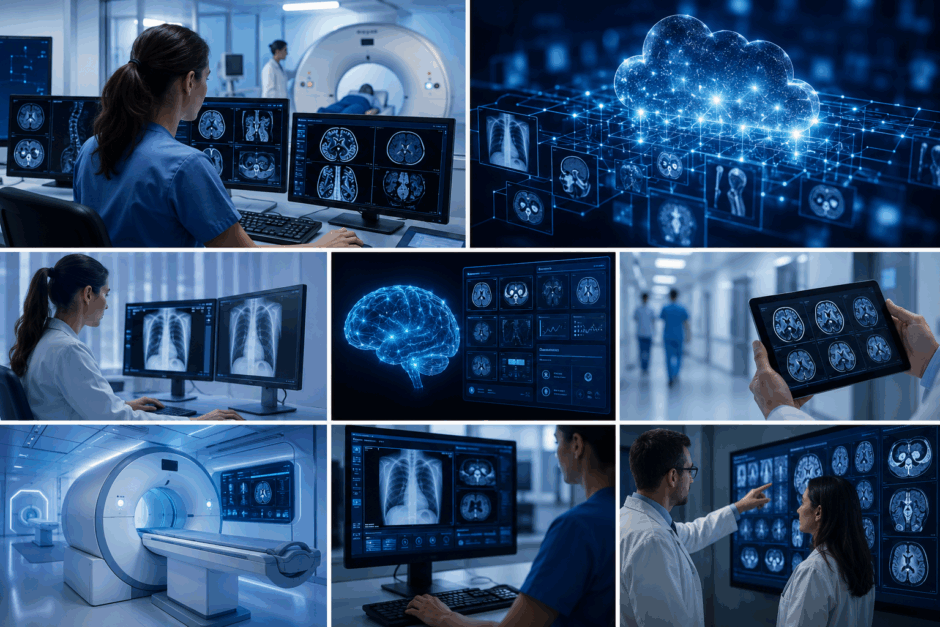
Faster Processing Saves Valuable Time
Computing power continues to increase every year. Modern imaging systems process large files far more quickly than earlier equipment. This speed affects nearly every stage of diagnostic imaging.
A scan no longer remains unavailable while staff wait for lengthy reconstruction. Instead, software processes information almost immediately after image acquisition. Clinicians can begin reviewing results sooner, while technicians prepare the next examination without unnecessary delays.
This faster processing supports busy imaging departments where hundreds of examinations may take place every day. Even a modest reduction in processing time creates meaningful gains across an entire hospital.
Artificial Intelligence Supports Daily Work
Artificial intelligence now assists imaging specialists in many practical ways. These systems examine image patterns, highlight areas that deserve attention, and organize studies according to urgency. They do not replace medical judgment. Instead, they support clinical review by handling repetitive analytical tasks.
Current AI applications include:
| Application | Clinical Benefit |
| Image quality assessment | Detects technical problems before review |
| Organ segmentation | Speeds anatomical measurements |
| Case prioritization | Helps urgent studies receive earlier attention |
| Measurement assistance | Reduces manual calculations |
Radiologists continue making final clinical decisions, but AI reduces routine workload and helps organize daily operations more efficiently.
Smarter Software Improves Workflow
Modern imaging software has changed considerably over recent years. Earlier systems often required users to switch between several windows or repeat manual steps during image review. Current platforms simplify many routine tasks.
Technologists can organize examinations more quickly. Radiologists access previous studies without unnecessary searching. Referring physicians receive reports sooner because information moves through fewer manual stages.
Software developers also improve interface design. Clear menus, logical layouts, and faster search tools reduce unnecessary clicks throughout the working day.
These improvements shorten administrative tasks without changing clinical standards.
Cloud Technology Supports Faster Collaboration
Healthcare organizations increasingly use secure cloud infrastructure for medical imaging storage. Instead of limiting image access to one physical location, authorized clinicians review examinations from different departments or medical facilities.
This approach helps specialists discuss complicated cases more quickly. Surgeons, oncologists, neurologists, and radiologists may examine identical imaging studies while working from separate locations.
Cloud systems also simplify long-term archive management. Healthcare organizations avoid maintaining large local storage systems for every department while still preserving historical imaging data.
Strict security rules remain essential throughout this process. Access controls, encryption, and audit records protect confidential patient information.
Image Compression Has Improved
Medical images often occupy significant storage space. High-resolution CT, MRI, and digital pathology studies generate especially large files.
Modern compression methods reduce storage requirements while preserving diagnostic quality. Efficient compression allows healthcare organizations to archive greater amounts of information without excessive infrastructure expansion.
Smaller files also move across secure networks more quickly. Physicians receive imaging studies sooner, which supports faster consultation and treatment planning.
Compression technology continues improving as researchers develop better mathematical approaches for preserving clinically important image details.
Better Integration Reduces Repeated Work
Healthcare systems now exchange information more efficiently than before. Imaging software communicates with electronic health records, scheduling platforms, reporting systems, and laboratory databases.
This integration reduces repetitive data entry.
When staff members enter patient information once, connected systems automatically recognize the examination request. Technologists spend less time correcting clerical mistakes, while clinicians receive complete patient information during image interpretation.
Better communication between digital systems also reduces administrative delays that once interrupted clinical work.
Mobile Access Expands Clinical Review
Healthcare professionals increasingly review medical images through secure mobile devices whenever clinical policy permits.
Mobile access does not replace dedicated diagnostic workstations for formal reporting. Instead, it supports rapid communication during consultations, emergency discussions, and multidisciplinary meetings.
Doctors may review key findings while traveling between departments or consulting colleagues in different locations.
This quicker access improves communication without changing professional reporting standards.
Image Reconstruction Continues to Advance
Image reconstruction converts raw scanner data into clinically useful pictures.
Researchers continue improving reconstruction algorithms for CT, MRI, ultrasound, and other imaging methods. Better mathematical processing creates sharper images while reducing unwanted artifacts.
Several advantages result from improved reconstruction:
- Better anatomical detail
- Lower image noise
- Faster reconstruction times
- More consistent image quality
- Reduced need for repeat examinations
Patients benefit because healthcare teams often complete diagnostic studies more efficiently.
Better Quality Control Improves Consistency
Quality control plays an important role in digital imaging.
Modern systems continuously monitor equipment performance through automated testing routines. Software identifies calibration changes, detector problems, and technical irregularities before they affect clinical work.
Routine monitoring reduces unexpected interruptions and helps engineering teams schedule maintenance more effectively.
Consistent image quality also supports long-term comparison between examinations performed months or years apart.
Education Supports Better Imaging Practice
Technology alone cannot improve efficiency. Healthcare professionals must also understand how to use new systems correctly.
Medical education increasingly includes structured training on digital imaging software, image management, artificial intelligence tools, radiation safety, and data security.
Regular education helps radiologists, technologists, and medical physicists stay current with changing technology.
Strong technical knowledge reduces mistakes while improving daily workflow.
Standardization Creates More Predictable Results
Healthcare organizations continue adopting standardized imaging protocols.
Standard examination procedures produce more consistent image quality across different scanners and clinical teams. Consistency benefits physicians who compare studies completed at different times or different medical centers.
Standardization also supports clinical research because investigators analyze imaging studies that follow similar technical parameters.
Common protocols reduce unnecessary variation while maintaining clinical accuracy.
Cybersecurity Remains a Constant Priority
Healthcare organizations store enormous amounts of confidential information. Imaging departments therefore invest considerable effort in cybersecurity.
Modern systems include stronger authentication methods, encryption, access monitoring, and regular software updates.
Healthcare organizations also educate employees about phishing attacks, password management, and safe handling of confidential records.
Technical improvements work best when combined with responsible daily practice.
The Future Focuses on Practical Improvements
Digital imaging will continue improving through gradual technical progress rather than dramatic change.
Researchers continue refining image processing, storage methods, artificial intelligence, cloud infrastructure, detector technology, and workflow management. Each development reduces small inefficiencies that accumulate throughout daily clinical practice.
Future systems will likely analyze larger imaging datasets, support earlier disease detection, and strengthen communication between clinical departments. Healthcare professionals will continue making diagnostic decisions while software handles more routine technical work.
Digital imaging has become more efficient because engineers, clinicians, software developers, and researchers improve every stage of the imaging process. Better sensors capture cleaner information. Faster computers shorten processing time. Artificial intelligence assists with repetitive tasks. Cloud technology supports clinical collaboration. Stronger cybersecurity protects patient information. Standardized workflows reduce unnecessary variation.
No single improvement explains this progress. Instead, steady advances across hardware, software, data management, education, and clinical practice continue making digital imaging faster, more consistent, and more useful for healthcare professionals every year.
Related posts:
 Other Imaging Techniques in Dilated Cardiomyopathy
 Basic Echocardiography in Arrhythmogenic Right Ventricular Cardiomyopathy
 Improving Patient Outcomes With Soft Tissue Management: A General Dentist’s Perspective
The Impact of Academic Failures on Mental Health and How to Bounce Back
Burnout Recovery That Actually Works for Nurses
How to Turn Imaging Notes into Structured Academic Reports
Improving Patient Outcomes With Soft Tissue Management: A General Dentist’s Perspective
The Impact of Academic Failures on Mental Health and How to Bounce Back
Burnout Recovery That Actually Works for Nurses
How to Turn Imaging Notes into Structured Academic Reports

Stay updated, free articles. Join our Telegram channel

Full access? Get Clinical Tree


