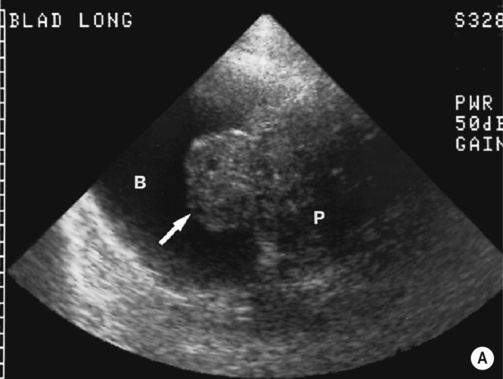
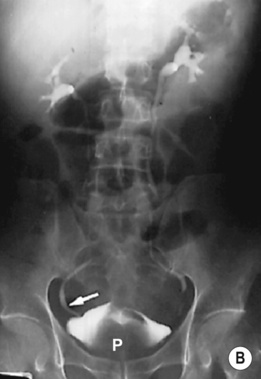
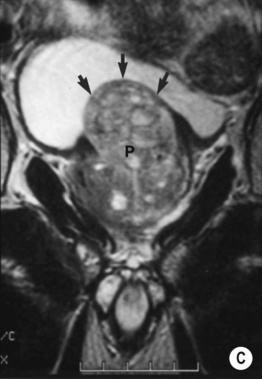
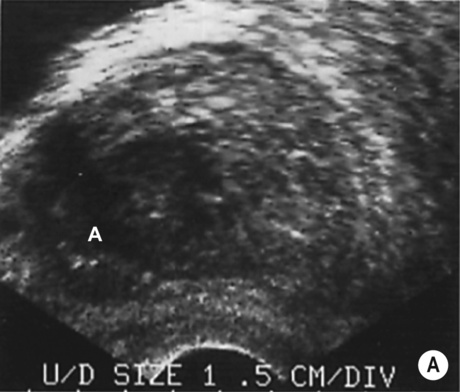
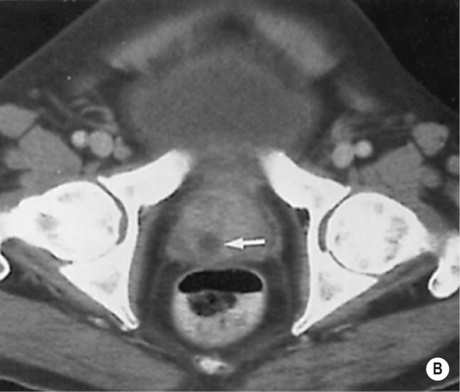
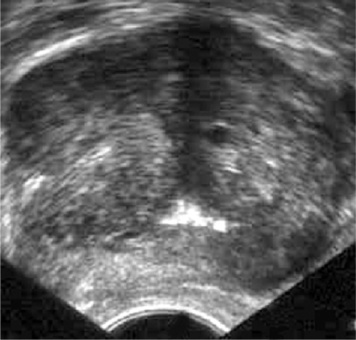
• This usually begins within the peripheral zone but may spread to other areas • The abscess may rupture into the urethra, rectum or perineum (or rarely the peritoneum) • This is predominantly a latent tumour but it demonstrates malignant potential that correlates with the histological grade, tumour volume and stage • Histology: adenocarcinoma (> 95%)
Prostate
PROSTATE: BENIGN DISORDERS
ACUTE AND CHRONIC PROSTATITIS
DEFINITION
PROSTATIC ABSCESS
DEFINITION
 it usually follows a urinary tract infection with E. coli or Proteus
  it is rarely seen in infants and children
CARCINOMA OF THE PROSTATE
PROSTATE CARCINOMA
DEFINITION
 it is rarely a squamous or transitional cell carcinoma (very rarely a sarcoma in 0.1–0.2%)
Related posts:

Stay updated, free articles. Join our Telegram channel

Full access? Get Clinical Tree


Prostate


 areas of low SI due to chronic prostatitis and scarring
 abscess formation (with caseation, cavitation and fibrosis)
  rupture into the periprostatic space, urethra or rectum may occur
  rarely fistulas may form within the perineum
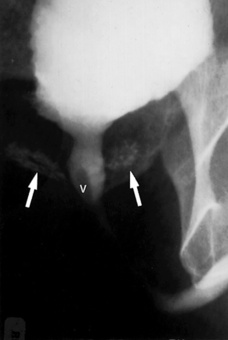
 varying degrees of prostatic parenchymal destruction (sloughing may produce irregular cavities – in advanced cases the entire prostate seemingly occupied by a smooth-walled cavity)
 a radiographic diagnosis can only be made when the abscess has penetrated the urethra (allowing contrast medium into the cavity)
 T2WI: high SI
  T1WI + Gad: no enhancement
 an enlarged central gland with well-defined or poorly demarcated hypoechoic or mixed echogenicity nodules (± hyperechoic foci)
  a thick surgical pseudocapsule may be seen interposed between an enlarged central and normal peripheral gland
 stromal hyperplasia demonstrates homogeneous low-to-medium SI
  a surgical pseudocapsule appears as a low SI margin between the adenoma and peripheral zone